It is finally starting to feel and look like fall.
With that, it also means it is time to take care of the leaves that fall into yards and streets.
This year, the Harrison Township Environmental Commission launched its “Leave the Leaves” campaign. The campaign is intended to raise awareness about sustainable leaf clean-up and encourage residents to take take a more thoughtful approach to how they clean and discard the leaves on their properties.
In its campaign materials, the environmental commission shared that fallen leaves are beneficial to wildlife and soil enrichment. Plus, it makes it easier for residents and saves them time, as there can be less raking, bagging and transporting leaves to the curb.
“The main message is that fallen leaves provide shelter and food for a variety of beneficial insects, reptiles and amphibians, so we’re asking residents to keep some leaves in garden beds and under trees through the winter,” said Deb Murphy, a member of the environmental commission.
Fallen leaves, or leaf litter, can act as free mulch and fertilizer for gardens in resident’s yards or in municipal spaces. According to research conducted by the environmental commission, “as leaves break down, they feed your soil with nutrients,” “leaf layer(s) hold moisture and reduce runoff” and “help control erosion during storms” and suppress weeds.
Additionally, several insects, reptiles and amphibians, like fireflies, Luna and Polyphemus moths, bumble bees, wood frogs and box turtles all use fallen leaves as their habitats. Raking and disposing of leaves can leave these species without their home, or they might be hidden within the leaves and injured during those acts.
Young fireflies spend most of their lives in fallen, decomposing leaves; while both kinds of moths are catapillars, they spin cocoons in the fallen leaves and spend their winters there; queen bumble bees burrow under leaves to survive the winter, and they begin building their new colony of bees there in the spring; and wood frogs and box turtles spend their winter underneath leaf litter.
“The campaign is around awareness and behavior, so explaining to residents that leaf litter shelters a lot of beneficial insects and invertebrates. A lot of those animals are declining, too,” Murphy said.
The environmental commission shared a stat that 11% of U.S. and Canadian firefly specifics, for example, are threatened with extinction. Rutgers University found that leaf removal is on of the main reasons the number of fireflies in New Jersey have fallen.
Additionally, research from the U.S. Environmental Protection Agency found that 12% of all U.S. municipal waste is yard trimmings. To help lower that rate, the environmental commission suggests residents “leave your leaves and keep them working in your yard, not in a landfill.”
When it comes time to declutter the leaves from your property, consider saving even a small pile of leaves in your yard. The environmental commission recommends raking the leaves away from lawns and walkways and creating a three- to six-inch layer of leaves under trees or in garden beds.
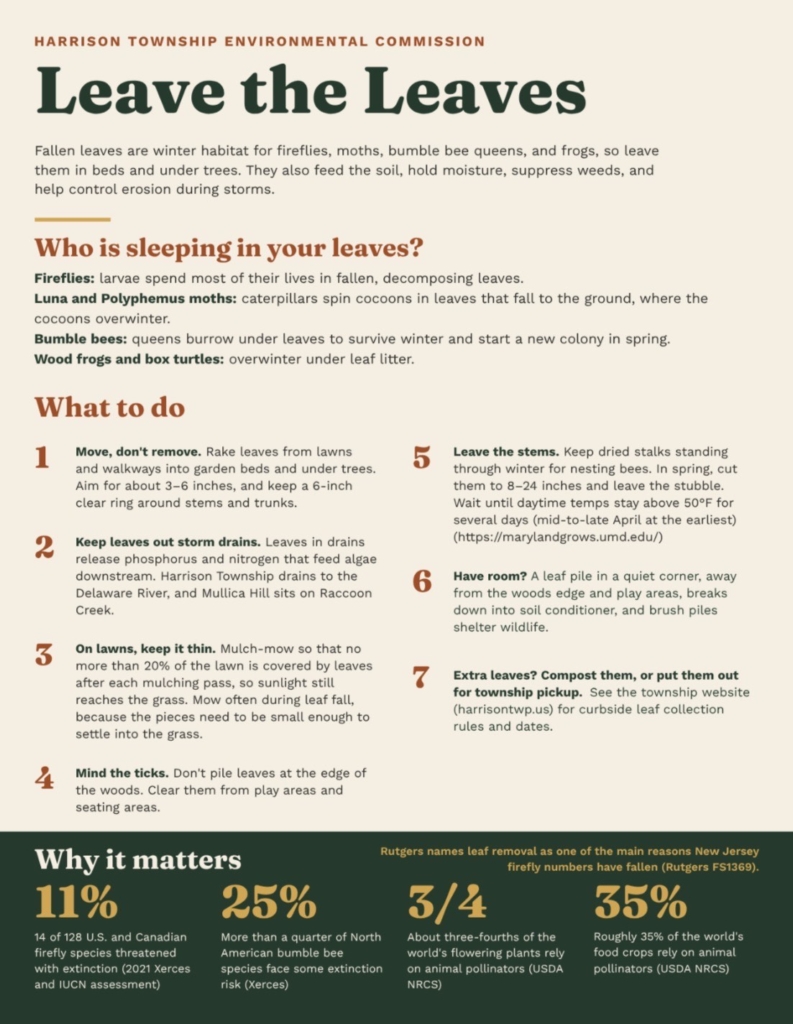
Additional recommendations include: turning the leaves into mulch by running the lawn mower over the leaves to shred them into the lawn, composting them by starting a leaf pile or bin to create a “rich” compost by springtime, or leave one corner of full, untouched leaves until spring warms up as a way to keep shelter for species
While Murphy from the environmental commission said that “any leaf that goes to curbside pickup, in a bag or not, is no longer a habitat,” if you do not want leaves on your property, you can pile them on your curb for Harrison Township’s fall leaf collection, which begins this month and will run through December.
There are six zones in the township, provided in a map on the Harrison Township Trash & Recycling webpage, and each zone will have different pickup times. The township requires leaves to not be placed in trash bags, but rather left in long, neat piles (or wind-rows) away from storm drain inlets and not blocked by cars. Leaves will be picked up via a leaf vacuum; if the leaves are in trashbags, the vacuum and possibly the workers can be harmed.
For more information or to get in contact with the environmental commission, go to www.harrisontwp.us/department/environmental-commission. For more information on fall leaf collection, go to www.harrisontwp.us/department/trash-recycling.

