Though many of us think of orchids as tropical beauties displayed indoors, yet orchids are everywhere on Earth and on every continent except Antarctica. There are about 28,000 known species and likely many more that have yet to be discovered, which means the orchid family (Orchidaceae) competes with the daisy family for the most diverse group of plants.
New Jersey is home to almost 60 kinds of the plant: Yes, the Garden State is also the Orchid State.
If you know where and when to look, you can witness a striking variety of native orchids here. Tucked into shaded woodlands and acidic wetlands – as well as sandy stretches of the Pine Barrens – the intricate flowers are deeply tied to the ecosystems in which they live. And they’re an absolute joy to witness.
What makes an orchid an orchid? Botanists generally agree it comes down to one wild little feature: the column. Unlike most flowers, where the male (stamen) and female (pistil) parts are separate, orchids fuse the column into a single structure that often protrudes dramatically from the center. It’s just one of many reasons these flowers seem a little other-worldly.
One of New Jersey’s rarest orchid gems is the small whorled pogonia. It grows only 10 inches tall with a little whorl of leaves, and it’s a big deal. Federally listed as threatened and state listed as endangered, this elusive species is confirmed in only three places in northern New Jersey.
The best way to protect whorled pogonias is to preserve and carefully steward the forest ecosystems on which the flowers depend. If we take care of the land, we take care of the plant.
Unlike many of their tropical cousins, New Jersey’s wild orchids are terrestrial, meaning they grow in the ground. They rely on a network of underground fungi, forming a relationship essential to their survival. Orchid seeds are tiny and contain almost no nutrients, so the plants depend on fungi to nourish them until they’re big enough to photosynthesize on their own.
The fungi/orchid root relationship is delicate, and if you disturb the soil, you risk cutting the whole performance short. Reproduction cannot occur without that relationship.
One of the showiest orchids in the Pine Barrens is the white-fringed orchid, a tall stunner with elegant, feathery blooms. Biologists rank it as “apparently secure” on the global scale, but it faces serious local threats such as direct habitat loss, habitat degradation and deer browsing.
Major reductions in open, sunny wetlands have made this species much scarcer than it used to be. Fire suppression and hydrological changes may allow other species, especially woody plants, to outcompete it.
An unassuming, once-rare orchid has become more common in southern New Jersey – the Southern twayblade – most likely due to climate change. At only a few inches high, it’s easy to mistake the tiny brown plant for an inconspicuous weed, especially due to its dull colors of dark reddish to greenish purple.
But if you look in a shady wet area, you may find this fascinating orchid hidden among the Sphagnum moss. Pollinated primarily by fungal gnats, the Southern twayblade blooms in May and June.
Then there’s the crowd favorite: the pink lady’s slipper. Big, bold, and a little bit whimsical, it pops up statewide each spring and early summer. It’s the most common orchid in New Jersey, but like many native species, it’s threatened by habitat destruction and poaching.
Want to go orchid seeking? The New Jersey Pinelands Commission offers a blooming schedule for orchids in the Pine Barrens at https://www.nj.gov/pinelands/infor/fact/orchids.pdf. Just remember: look, admire, maybe snap a photo, but don’t pick or dig. These wild beauties need to stay where they are.
Wild orchids are a reminder of how much natural wonder is hiding just off the trail in our small and fascinating state.
To learn more about how you can help preserve New Jersey’s natural resources, visit the New Jersey Conservation Foundation at www.njconservation.org or reach out to us at info@njconservation.org.
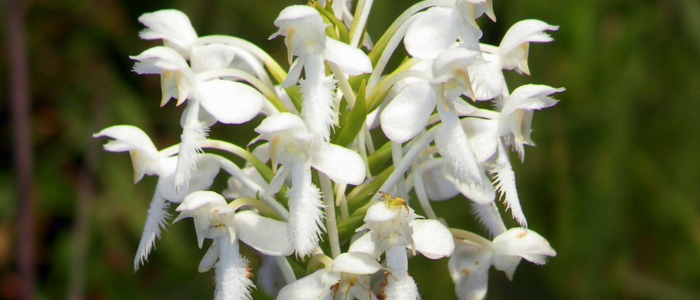
One of the showiest orchids in the Pine Barrens – with elegant, feathery blooms – is the white-fringed orchid.

