Right on time for Halloween, author Tony DiGerolamo shared the tall tales of the New Jersey Devil at Zed’s Beer on Oct. 20, giving a little bit of local folklore, strange stories and New Jersey history. The event was a part of the Evesham Historical Society’s 2026–2027 Lecture Series.
DiGerolamo is a screenwriter, novelist, comic book writer, game designer and comedian. He is best known for his work on “The Simpsons” and the “Bart Simpson” comic book series. Performing in the Philly comedy scene for over ten years, DiGerolamo performed and directed such improv groups as Next Line Improv, The Cabal, The Ninjas and Bulletproof Giraffe. Aside from other career highlights, he is the mastermind behind “The Pineys,” a book series about a Pine Barrens family that has been hunting the kin of the Jersey Devil for over 250 years. Currently, there’s 21 books in the series. Book 22 will be coming out later this month and will be set in Chatsworth, New Jersey. Each book is like an episode of a television show, DiGerolamo shared. The basic premise of the books is that Mother Leeds (frequently associated with Deborah (Smith) Leeds) was a witch who opened the portals of Hell in the 1730s and flooded the Pine Barrens with devils. In the neighboring village of Abe’s Hat, New Jersey, four cousins from the Galloway family form a secret hunting society to hunt down the devils and send them back to Hell. Their ancestors continue to hunt to this day.
“With that premise, I re-tell a lot of the old legends and some of the history of South Jersey,” DiGerolamo said. “A lot of my relatives inspired some of the characters and some of the characters are inspired by what happens in the books. I did improv for 15 years and the way that you do improv on stage is you are constantly moving forward in a scene, and you kind of cater the movement forward to what the scene will be. You don’t come up with the scene and then try to move forward. You move forward and then the scene erupts around that.”
DiGerolamo will introduce characters in his books and not much will be known about them other than their names but later, more information is revealed. Writing that way is more interesting to DiGerolamo because it fits in better and the story might need something at that point, and then it’s revealed.
Like a lot of South Jersey residents, DiGerolamo grew up hearing stories about the Jersey Devil. He and his grammar school classmates were even taught about the creature and watched a film that was a short dramatization of its birth. In middle school he was tasked with a book report and wanted to find the shortest book he could. He did his report on the classic 1976 folklore book “The Jersey Devil,” written by authors James F. McCloy and Ray Miller, Jr. and that’s when his interest in the cryptid (an animal or creature whose existence is claimed or reported by witnesses or folklore, but which has never been scientifically proven or verified) piqued.
DiGerolamo has heard many different variations on the history of the Jersey Devil, but he believes that the devil is different for two reasons: it’s New Jersey’s official state demon and it’s connected to real history. For instance, DiGerolamo shared, when Ben Franklin was a young printer in Philadelphia in the 1730s, he was already putting out his yearly pamphlet “Poor Richard’s Almanack.” At the same time, the Leeds family had written their own almanac that was originally published by Daniel Leeds, the patriarch of the Leeds family. Daniel would have been the grandfather of the Jersey Devil, according to McCloy and Miller. Franklin wasn’t a fan of their work because he didn’t like the content which included astrology, something Franklin had compared to witchcraft at the time. The dislike Franklin had for the Leeds caused a back-and-forth smear campaign between Franklin and the family, with both publishing disparaging things about the other in their works, DiGerolamo explained.
For about 170 years, the Jersey Devil was referred to as the Leeds Devil until 1909 when the name Leeds Devil was transformed – by carnival promoters – into the Jersey Devil. Their shenanigans at the Ninth and Arch Street Dime Museum would cement the reputation and the appearance of the creature in the popular imagination for the modern age. For many families who lived in the Pines and in South Jersey around the time that the devil would have been born to Deborah and dad Japheth, their names still exist today, DiGerolamo said. Those include Leeds, Elwell, Collins and more. DiGerolamo has met many descendants of these families, and he loves to hear their stories and folklore tales. His talk at Zed’s also touched on the smear campaign between Franklin and the Leeds family, as well as when the Leeds Devil had its name officially changed to the creature we know today, and after every talk he looks forward to hearing people’s recollections of what they know about the Jersey Devil.
“For a lot of people, it’s nostalgia because they’ve heard the story when they were young, so a lot of it brings memories back up,” DiGerolamo said. “A lot of my extended family lives nears the Pines, so when I was a kid, I used to go down there a lot. My dad would take us, and we would go down there and meet my relatives and a lot of them were hunters at the time, so that was part of the inspiration for the books.”
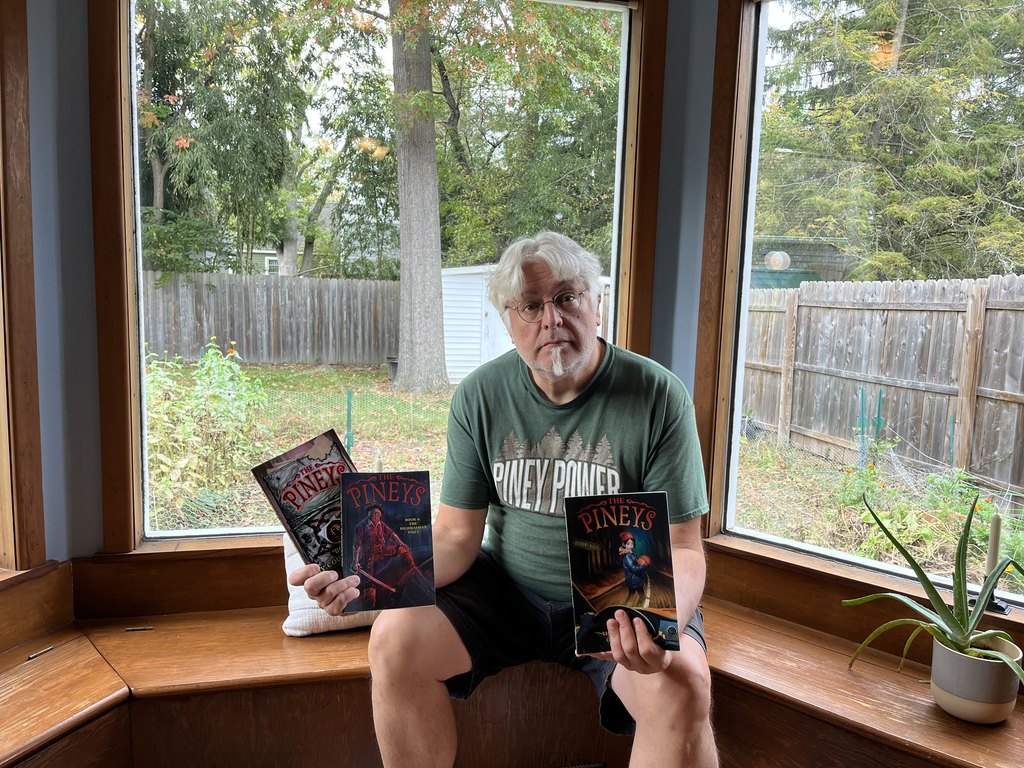
Laurel Springs resident Tony DiGerolamo is the author of the 22-book series “The Pineys,” which is about a Pine Barrens family that has been hunting the kin of the Jersey Devil for over 250 years.

