There are plenty of reminders of “Miss Ruth” Lowe inside Lowe Dance Studio.
Some are obvious: the building itself, the programs she created and the generations of dancers who still walk through its doors. Others are smaller.
Push in your chair. Don’t run up the stairs. And definitely don’t bring gum into the building.
Even now, months after Lowe died at 87 on April 9, her family and former students can still hear her voice.
“We all remember to push our chair,” said Jenna Adams, Lowe’s great-niece, who grew up dancing at the studio and later became a teacher there. “She’s always watching us.”
For the family behind the longtime Voorhees institution, Lowe’s death earlier this year marked the loss of a mother, grandmother, great-aunt, teacher and mentor. But it also underscored the scope of something she began nearly seven decades ago with five students and a dream.
Today, Lowe Dance Studio remains at 1207 Haddonfield-Berlin Road, where multiple generations of the Lowe family — along with teachers who have spent much of their lives there — continue what Miss Ruth started 69 years ago.
And that is exactly what she wanted.
Daughter and studio director Suzanne Steinbach remembers her mother repeatedly saying she never wanted the dance studio to end.
Five students and a dream
Lowe was 9 when she took her first dance lesson and decided she wanted to become a dance teacher. She trained under Dorothea Riegert at the Crystal School of Dance before opening her own school in 1958 in her parents’ basement with five students.
Within a year and a half, enrollment had nearly doubled, and her first recital featured nine dancers.
As the school grew, Lowe moved from basement to basement and eventually into other temporary spaces. In 1966, the family purchased the property at 1207 Haddonfield-Berlin Road for $12,000, according to Lowe’s obituary. What began as a small, one-bedroom house was repeatedly expanded as the school grew.
“She just kept adding on,” Steinbach recalled. “Oh, we need a bigger waiting room. Oh, we need another studio.”
Eventually, there was nowhere else to go.
“This is where it is,” she joked. “We can’t add on anymore.”
The programs expanded, too. A student-teaching program gave young dancers a path toward becoming instructors themselves, while a competition team formed in the late 1970s. In 1986, Lowe created the Voorhees Ballet Theatre, whose Voorhees Danse Ensemble offered more intensive training for serious ballet students.
Today, the studio offers ballet, tap, jazz, acrobatics, modern and hip-hop, along with competition, student-teaching and pre-professional opportunities.
But the studio’s history may be most clearly visible in the people inside it.
Growing up at the studio
For Steinbach’s children — Allie, Leisl, Jacqueline and Karl — Lowe Dance Studio wasn’t simply where their mother worked or where they took dance lessons.
It was where they grew up.
“We literally grew up here,” Leisl said.
Their memories extend far beyond ballet barres and recital rehearsals. They remember eating dinner at the studio, playing with chalk and bubbles in the parking lot, catching frogs in the grass and sneaking snacks from vending-machine backstock.
Karl remembers something else: While his friends went home from school and headed outside to play, the Steinbach children usually went to the studio.
“It was definitely a different upbringing,” he said. “I would get home, and I would go right to the studio.”
But that meant growing up surrounded by far more people than his immediate family.
“It was kind of like a second family,” Karl said. “You see these people every day, and you’re growing up with them, and you literally grew up with the same people.”
Karl started dancing at about 3 and continued until he was a teenager. Dance wasn’t his only activity. He also pursued sports and later entered the military, and his family believes dance helped develop the coordination, flexibility and core strength that carried into those pursuits.
Karl even found some similarities between the discipline demanded by dance and what he later encountered in the military.
“There’s definitely some aspects of dance that were harder,” he joked of comparing his mother’s ballet class with military training.
His sisters followed dance into adulthood.
Allie began taking classes at about 18 months old and is now in her 21st season of teaching. Leisl started dancing at 3 and began teaching as a teenager. Jacqueline started around age 2, later trained pre-professionally in ballet and returned home in 2014 before reluctantly — at first — stepping into teaching and choreography.
“I did not want to be a teacher,” Jacqueline recalled.
Her perspective eventually changed. Today, she teaches multiple disciplines, works extensively with Voorhees Ballet Theatre and serves as costume mistress for its productions.
The next generation is already growing up around the studio, too. Jacqueline brings her young son to work much the same way generations before him spent their childhoods there. Karl’s son can also be found under the watchful eye of his grandmother, aunts, and extended family.
“It’s interesting seeing now from a parent perspective,” she said.
Family beyond a last name
Not everyone who grew up at Lowe Dance Studio has Lowe or Steinbach in their name.
Leigh Menold is proof.
Menold arrived at the studio at 7 after a neighbor recommended it to her mother. She started with one ballet class a week and continued until she was 14.
Then came the 1976 Summer Olympics.
Like plenty of kids watching gymnastics at the time, Menold and her friends started trying it themselves in the backyard. She wanted to take acrobatics at Lowe badly enough that she began paying the bill for the class herself.
By then, she and Steinbach had also become close friends.
Menold became a student teacher, progressed to assistant teacher around age 18 and became a teacher shortly thereafter.
She has been teaching at Lowe ever since.
Over the decades, the relationships have come full circle: Menold taught Steinbach’s children in acrobatics, raised her own children in the program and has taught many of the instructors who now stand beside her.
That kind of longevity is not unusual at Lowe. Adams similarly started there as a child, received her first classes to teach from her great-aunt and later returned to teaching. Her daughter, Braylin, now dances there as well.
Some families coming through the doors today represent third and even fourth generations of Lowe dancers.
For Karl, those relationships are what make the word “family” extend well beyond relatives.
“There’s some people here that have been here since I was a little kid,” he said. “They are still very much a part of how this is.”
Technique — and the work behind it
Longevity alone isn’t what Menold believes has kept students coming back.
“Focus on technique,” she said when asked what distinguishes Lowe.
For acrobatics, Menold follows the Acrobatic Arts program, a structured syllabus that takes students through 12 levels of progression. The larger philosophy, she explained, is applicable across the studio.
“We try to really structure the classes where everyone’s getting what they need,” Menold said.
That can mean separating students by ability and teaching them at their current level rather than pushing everyone through the same material.
A student can also decide how deeply to become involved at Lowe.
One child might take a single ballet class. Another might join the competition team, perform in ballet productions, student-teach and train across multiple disciplines. Neither, the family stressed, is considered more important.
“You can be as involved as you want to,” Jacqueline said.
“The kids are all treated the exact same,” Leisl added.
The teachers say maintaining that philosophy has become more challenging as the culture surrounding dance — and childhood itself — has changed.
Social media gives dancers instant access to videos of extraordinary performances, but those polished clips rarely show the years of work behind them.
“You see that dancer do that triple pirouette and they land it beautifully, but we don’t see the hard work that goes behind it,” Leisl said.
Menold has noticed another shift, particularly since the COVID-19 pandemic: sustaining commitment.
“I’m always trying to encourage passion,” she said. “Anyone can do anything. You can all rise to a higher level if you want it.”
Natural ability, she has learned over decades of teaching, only goes so far.
Some of the students who make her proudest are not necessarily those for whom acrobatics comes easily. They are the ones who struggle, return and keep working because they want to improve.
“They’re the ones that I teach well,” Menold said. “The ones that work and have a passion and really want it.”
A teacher can provide instruction, corrections and encouragement, she added, but ultimately the student has to supply something, too.
“I can’t make them want it,” Menold said.
She is encouraged by what she sees in some of the studio’s youngest dancers, describing an up-and-coming group that seems to have rediscovered some of the drive she remembers from earlier generations.
Seeing Miss Ruth’s reach
The breadth of the family Miss Ruth created became particularly clear after her death.
At Lowe’s funeral, Karl watched generations of former dancers and their families arrive to pay their respects.
“It was pretty moving,” he said. “To see how many people she kind of brought in.”
For some students, the studio offered more than dance lessons. Children who might have been struggling elsewhere could come through the doors and find another place where they belonged.
Jacqueline noticed the same thing after her grandmother died.
“Everybody in the community either knows somebody that danced here or they danced,” she said.
Miss Ruth’s own connection to dance had remained remarkably strong even as dementia progressed.
Steinbach officially took over the studio in 2014, the same year her mother moved into memory care following the death of her husband, Charles.
But dance remained.
Even in memory care, Lowe continued teaching. Her family found lesson plans written on napkins and scraps of paper. Students from the studio performed at the facility, and Lowe would sometimes join them, particularly when it came to tap.
Dementia took away much, her family wrote in her obituary, but somehow the rhythm remained: She still remembered her time steps.
The next generation
Today, responsibility for what Miss Ruth created is increasingly being shared.
Allie helps with office operations and teaches. Leisl has taken on a larger role with the competition team. Jacqueline is heavily involved with Voorhees Ballet Theatre, choreography and costuming. Karl has gradually found his own way back into the family operation. Cousins remain involved, too, including some who help from out of state.
And Menold is still teaching acrobatics decades after first walking through the doors as a 7-year-old beginner.
For Steinbach, seeing the next generation become more involved also means she can begin thinking about a slightly different role.
“I’m just really looking forward to being with my grandkids,” she said.
But she isn’t going far.
“I’m gonna be here.”
That may be the most fitting continuation of her mother’s legacy.
What began with a 9-year-old girl discovering dance, and an 18-year-old teacher with five students in a basement, has become a Voorhees institution that has survived changing dance styles, changing generations and now the loss of the woman who started it all.
Nearly seven decades later, the names and faces inside Lowe Dance Studio have changed.
The idea behind it hasn’t.
Students arrive to learn how to dance. Somewhere along the way, many of them become part of the family.
And they (hopefully) still remember to push in their chairs.
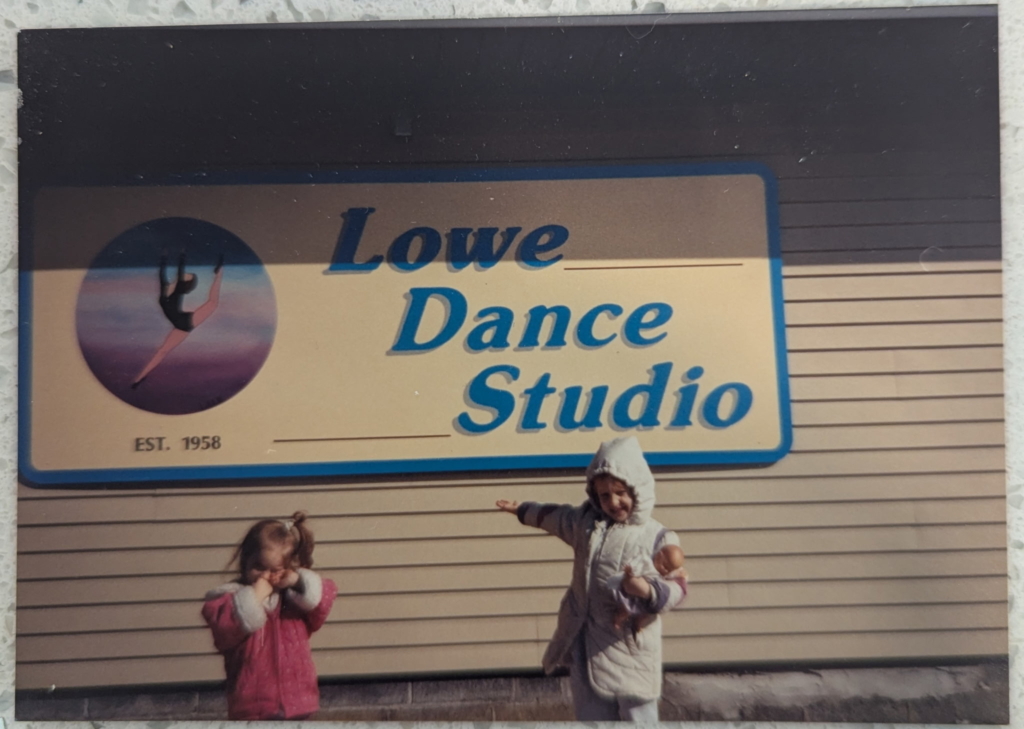
Pictured are Leisl (left) and Allie Steinbach in front of the Lowe Dance Studio sign, circa 1990s

