Our columnist had her own inventive ideas about the eyed click beetle. Manipulation by author
The click beetle illustrates how nature drives invention—from a child’s toy to engineering feats.
Exiting the side door of my home in July, I looked down at the pavers beneath my feet only to see two large eyes staring back at me. These eyes took up nearly a third of my visitor’s perceived head. But like so many others, I was initially deceived, for these were eye spots and not eyes. My greeter was an eyed click beetle or eyed elater—Alaus oculatus.
The bug’s true eyes are on its head near the base of its antennae, while its eye spots are on the thorax beneath. The spots are oval, of an ebony color, and encircled by a buffy whitish ring. Beneath the thorax are the wing covers or elytra (singular wing cover elytron), and hidden below the elytra are the actual wings. The covers are speckled and protect the translucent wings beneath.
The entire bug looks like it was designed in a motorhead’s powder coat shop. In fact, one day when I get a motorcycle I’ll have a black gas tank decorated like this beetle, and the handlebars will be the antennae. Hopefully it will not flip over like the beetle does (more on that later).
The eye spots are what naturalists call mimicry, the imitation of something that it is not. In this case, the large eye spots suggest a larger or scarier animal, to dissuade would-be attackers. Scales on its exoskeleton enhance the designs.
Honestly, the beetle elicits all kinds of nonsensical thoughts because of its most notable behavior—flipping. And it’s not just any flip but a massively impressive one for a creature just 1.0 to 1.75 inches long. When the beetle is put on its back, it rights itself with a click mechanism that catapults it up to six inches in the air. This triggers in you, the invader, a startle response like a two-year-old with a jack-in-the-box.
What enables it to launch itself nearly 20 times its body length into the air? The insect has a hinge-like tool in its thorax, just behind its head. A mechanical science and engineering team at the University of Illinois studied the maneuver using high-speed x-rays. Of the ultrafast energy release, Professor Marianne Alleyne wrote, “The hinge mechanism has a peg on one side that stays latched onto a lip on the other side of the hinge. When the latch is released, there is an audible clicking sound and a quick unbending motion that causes the beetle’s jump.” They determined that the power released was 300 times that of the Earth’s gravitational acceleration.
This explains what happens outside the bug, but the team further studied what takes place inside the bug’s anatomy to release such power. Fast deformation of soft tissue causes the peg to oscillate before coming to a stop. The engineers concluded that the forces are analogous to “snap buckling,” a basic principle in mechanical engineering—when elastic energy is released very quickly.
There are many different kinds of click beetles. According to one citation in Wikipedia there are 9,300 worldwide and 965 in North America. I know of two. On night walks in Costa Rica and Belize, we saw the headlight beetle—Pyrophorus noctilucus—whose eye spots glow. In fact, its bioluminescence is said to be 45 millilamberts, bright enough to read by, and said to be the brightest bioluminescence of any insect. They use this glow much like lightning bugs in signaling to prospective mates. Standing streamside, their signals were truly magical as I looked up and down the corridor. They do not flash like our lightning bugs but rather increase and decrease the intensity of their illumination as if controlled by a slowly operated dimmer switch.
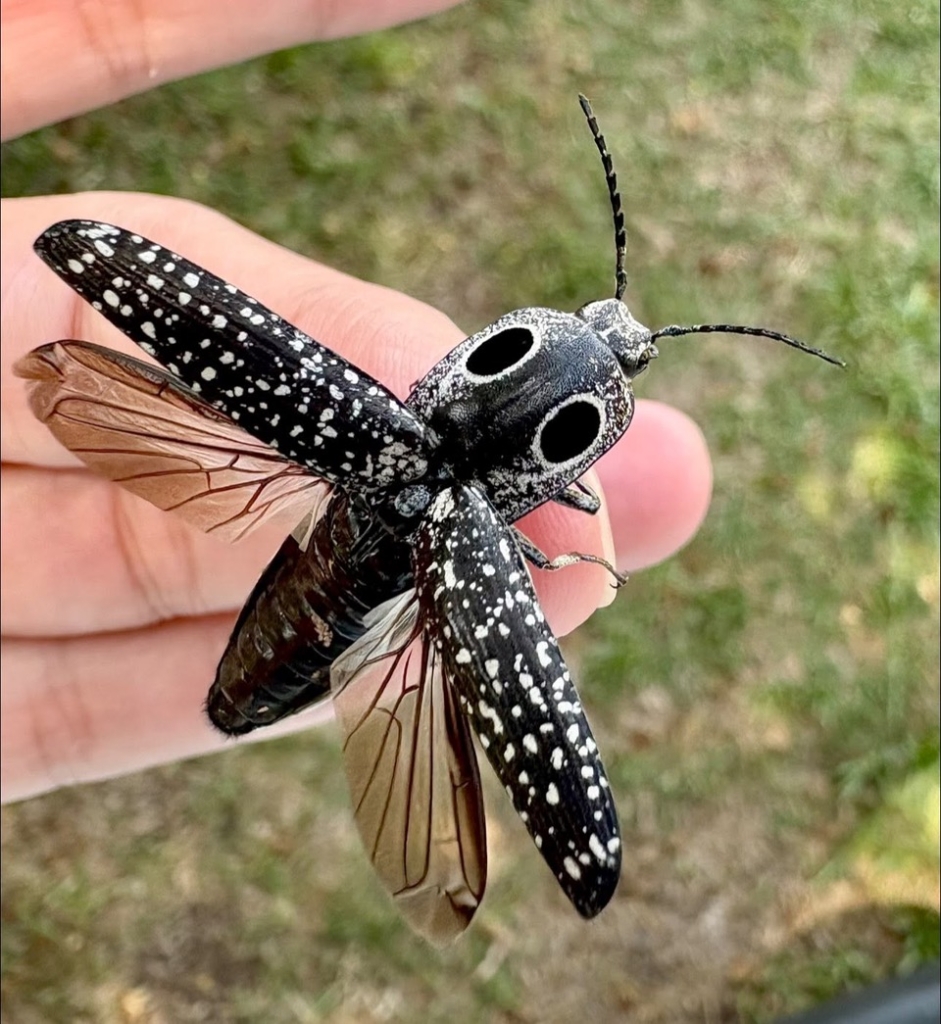
With the wing covers spread you can get a glimpse of the wings sheltered beneath. Photo: Kevin Wiener
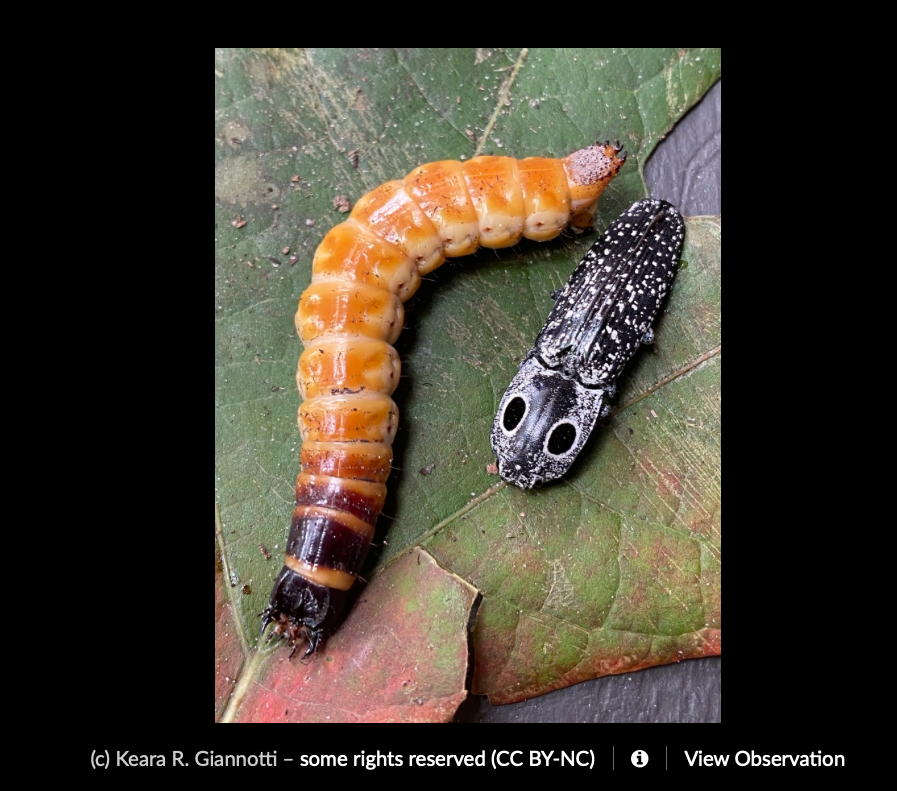
Photo at right by Keara allows you to see both the larvae and the beetle of the eyed elater. Photo: Keara R. Giannotti, iNaturalist
As much as children, and big kids like me, enjoy eyed click beetles, their larval stage is not very popular with farmers. Adult beetles lay eggs in soil that produce a slow-growing larva known as wire worms. As adults they are active from spring to September. Alaus octlatus will only live as an adult for weeks to several months. At night the adults are attracted to light. Larvae, however, spend two to five years as worms before pupating into adults. The larvae are also found in crops where they eat the roots of vegetables and some flowers. They will even eat seed, ruining it for germination.
Conversely in forests they are beneficial. The larvae are found in hardwood trees such as oak, apple, and cherry, and in rotting logs. The larvae grow in decaying logs and prey upon longhorn beetle grubs and other noxious wood-boring larvae.
Whether you focus on their foibles or virtues, their prowess for flipping is hands-down way cool.
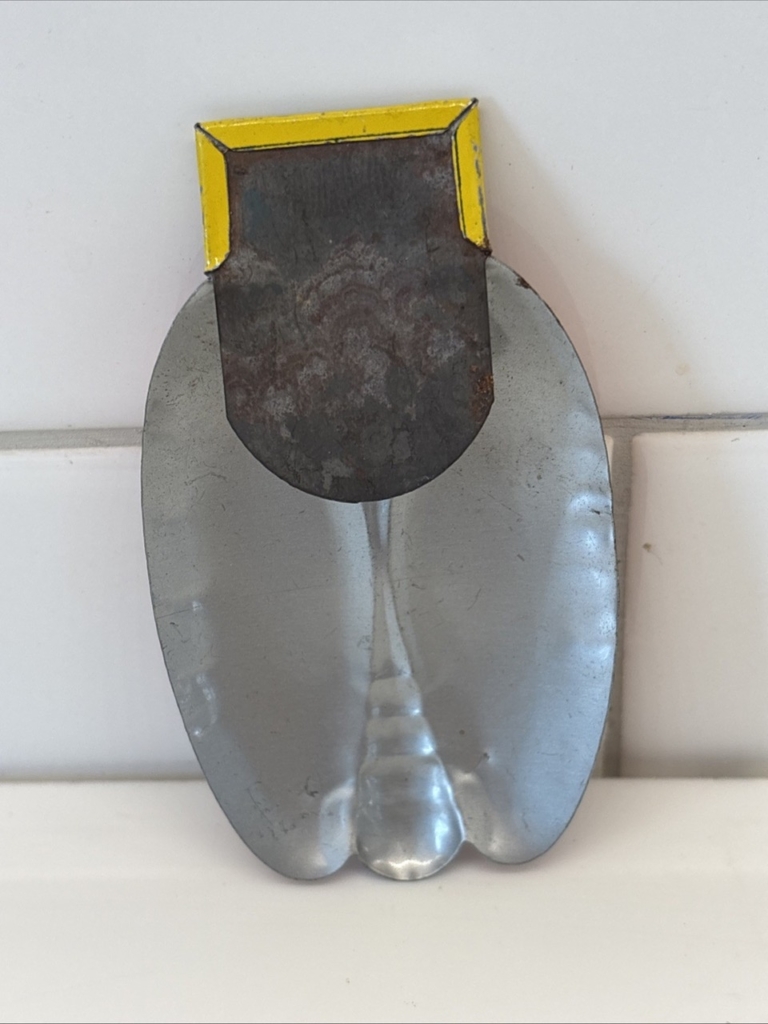
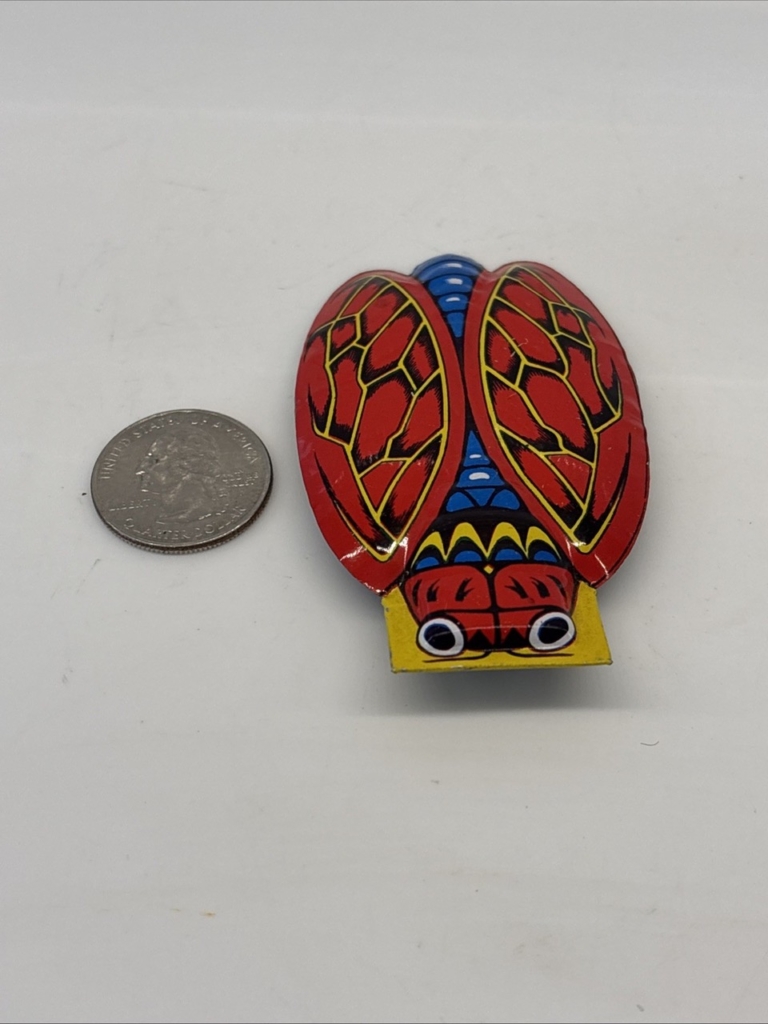
In the mid 1900s, clicker sound makers were a popular kids’ toy inspired by the click bug. Ebay sales photos
Click bugs were the inspiration behind the “clicker” that was a childhood toy. Often painted with a very colorful beetle on its surface, the toy involves a piece of metal that is pressed and then released to produce an audible click.
Today clickers are sold primarily to train dogs; you are likely familiar with these devices. I suppose today’s toys are much more exciting than those that held my attention growing up, and likely, clickers have fallen out of vogue. Nonetheless, the real-deal click bug that inspired them remains a humdinger.
Sources
Latch, load and release: Elastic motion makes click beetles click, study finds, University of Illinois Graduate College, published 2/1/2021.
Alaus oculatus, Eyed Click Beetle. Animal Diversity Website.
Harvey, E. N. and K. P. Stevens. 1928. The brightness of the light of the West Indian elaterid beetle.
Eyed Click Beetle, Missouri Department of Conservation.
Eastern Eyed Click Beetle, Minnesota Seasons, Exploring Nature in Minnesota.

