Staff members Becky Lein, Allie Hider, and Elias Flores break for a few moments to be photographed harvesting corn at Sheppards Farms in Cedarville. PHOTOS BY THE AUTHOR
Farmers, organizations, and volunteers help to reduce food insecurity at a local farm—and statewide.
This week, I want to share a different kind of outdoors experience, one in which you can participate to make a big impact on someone else’s quality of life. My husband and I were recently asked by my husband’s former employer, Stanker and Galetto, Inc.(S&G), a Vineland building contractor, if we might like to join their office staff picking vegetables at Sheppard’s Farm in Cedarville, NJ. S&G is a family-owned business where my husband Peter was partners with his brother-in-law Mark D’Onofrio until his retirement. Now D’Onofrio’s family owns and runs the enterprise.
Our nephew Ethan Byler is executive vice president of S&G and he serves on the advisory board of the Community Food Bank of New Jersey. He made the arrangements for S&G’s staff of 15 people to leave the office and devote an entire morning to picking corn to feed people in need. His fellow board member, attorney Steve Fabetti, was also trying out his picking skills with three staff members from his office. Architect and friend Larry Merighi was recruited as well.
Stanker and Galetto supplied one of two large work crews that turned out to help. We were informed that another group was out the week before us, including staff from Inspira Health.
On our visit, Cumberland Christian School’s faculty and staff had a walloping 25 to 30 participants giving the rows of corn a yank as well. Head of school Stacy Geiger explained that the school’s director of development made her aware of the America-Grow-A-Row opportunity through connections with the Vineland Chamber of Commerce. The School’s mission is reaching “the mind, heart, and hands through Christian service.” Geiger viewed the project as a way for the school’s enthusiastic staff to bond before school begins, and more importantly to model community engagement for its students.
Southern New Jersey has a great network of organizations that strive to fight food insecurity. And the key organizers of our Sheppard’s Farm/ Eastern Fresh Growers experience were America’s Grow-a-Row and Farmers Against Hunger. These two organizations provided an orientation to the volunteers, explaining the origins of their groups and how they feed a hungry community.
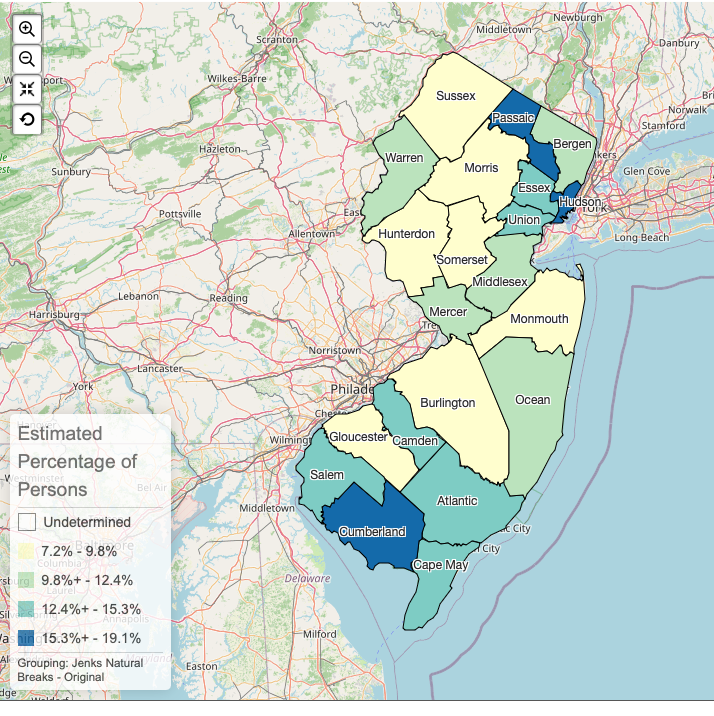
The State of New Jersey’s 2024 map, representing the percent of people by county that have inadequate food resources. Department of Health, NJ.gov
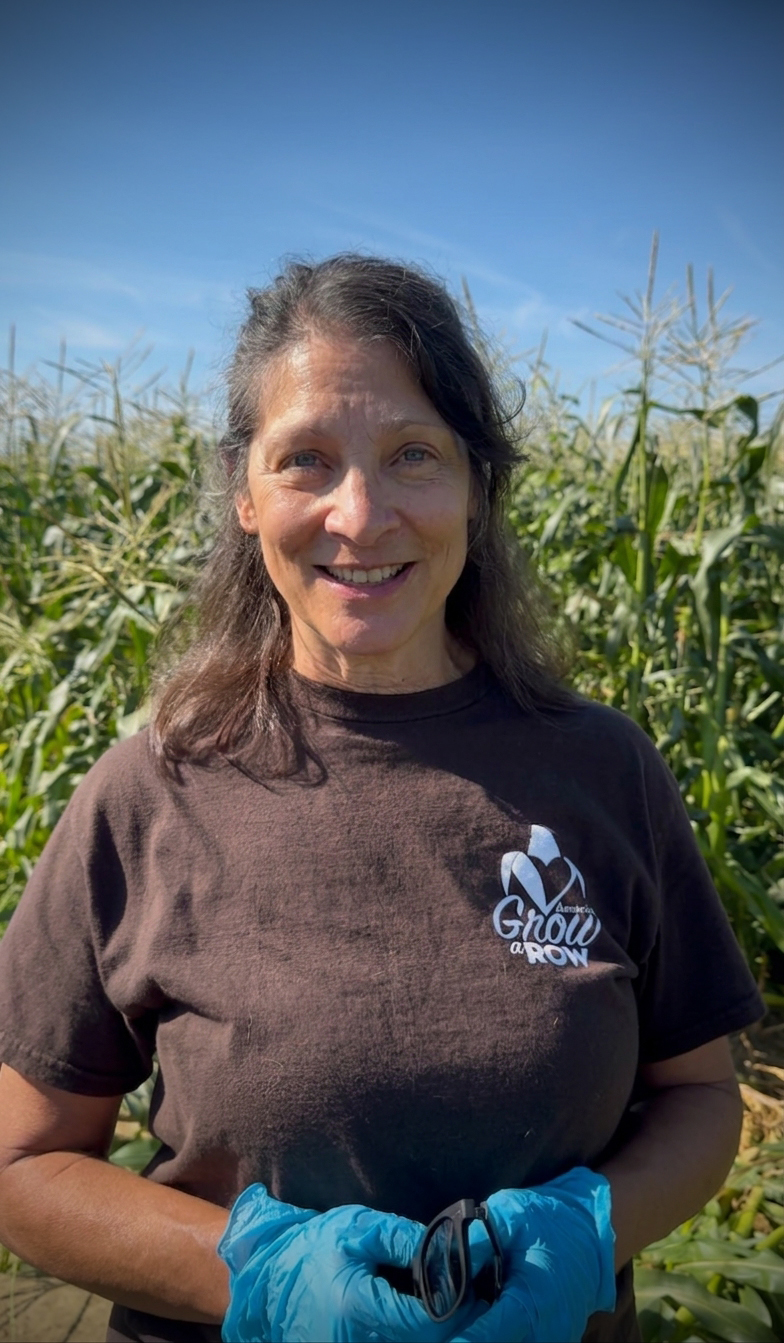
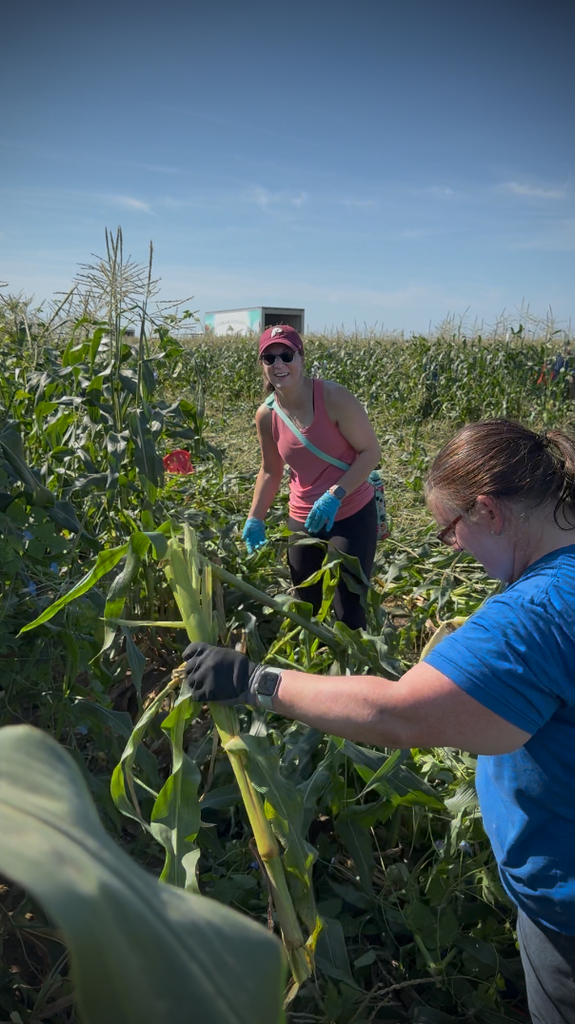
Connie Miller of America’s Grow-a-Row; in 2025, the organization donated 4.2 million pounds of food. • RIGHT: Cumberland County Christian School’s music teacher Nikki Halter joined her Head of School, Stacy Geiger, filling burlap bags with corn to load onto America’s Grow-a-Row truck.
Connie Miller was the coordinator from America’s Grow-a-Row. She told the story of Chip Paillex, who in 2002, with his four-year-old daughter, had a garden so bountiful that they had more than they could possibly use themselves. Paillex happened upon a notice in the newspaper stating that a food pantry was looking for donations, and they decided to participate. When he was leaving the drop-off point a woman chased after him and said, “Please come back! I have a health issue and need to eat healthy foods.” He was moved by her appeal and his generosity snowballed.
Paillex returned with more produce. When he learned that more than one million people suffer from food insecurity, and one quarter of them being children, he was motivated. That year he donated 120 pounds of vegetables. He continued his efforts and in 2008 formed an official non-profit organization—America’s Grow-a-Row. By 2025 they distributed an astonishing 4.2 million pounds of food.
Today, America’s Grow-a-Row has its own 423 acres of farmland, as well as partnering with farmers for their surplus. They work with food banks to distribute the produce—groups such as Community Food Bank of New Jersey, City Harvest in New York, and Philabundance in Philadelphia.
Judith Rosenberg was on site representing Farmers Against Hunger, a program spearheaded by the New Jersey Agricultural Society. For Judith, one of four full-time employees, this is her second season. She stressed the program’s reliance on gleaning, which has Old Testament roots; in Biblical times the four corners or edges of a farmer’s field were left for people in need to pick with dignity. Today many factors influence when farmers’ crops become available for gleaning. A few common reasons are where the costs of harvest exceed the economic return, when there are storage or labor shortages, if crops exceed market demand, or where there are too many crops that ripen simultaneously.
I spoke to Ethan Byler about why S&G had made such a commitment to help that morning. He said he saw other companies arranging corporate outings to give back and to assist people who don’t have enough to eat, and he knew that his staff would like to get involved. Byler was concerned that a lot of folks can’t meet their most basic needs and that gleaning food can make a big difference. He noted that southern New Jersey has a great food pantry network wherein a little effort by many can make a big difference.
I teased him about being in his element as a dairy farmer’s son who grew up with cornfields for their own livestock. He replied with a huge grin, “It just doesn’t feel right not to be picking corn in August.”
By the end of the morning, the novice group of harvesters had picked about 6,000 pounds of corn, or 24,000 servings! Most of the food on this occasion would be going to the Trenton area. The staff of America’s Grow-a-Row and Farmers Against Hunger explained that most of the families have no access to fresh vegetables, and if it weren’t for the efforts of food pantry networks, those in need would have none. They also explained that sadly many city areas are food deserts (see sidebar).
Farmers Against Hunger and America’s Grow-a-Row are first and foremost made possible by the generosity of farmers’ willingness to give to communities in need. Major components must be in place for success in helping solve food insecurity—gathering, transportation, distribution by food pantries, and lots of volunteerism. Should any aspect break down, food resources simply go to waste and people continue to lack fresh food and vital nutrients.
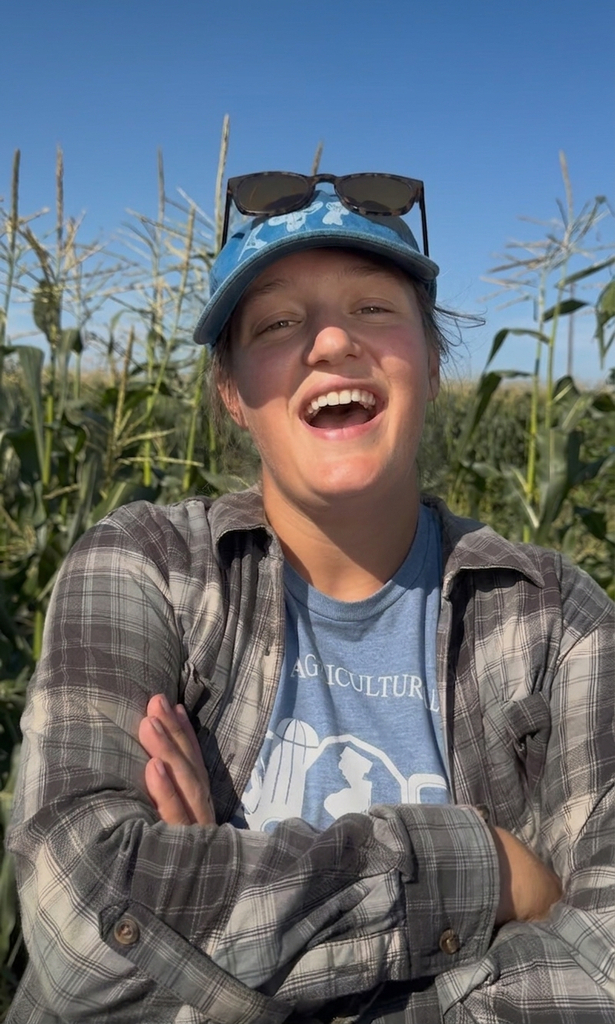
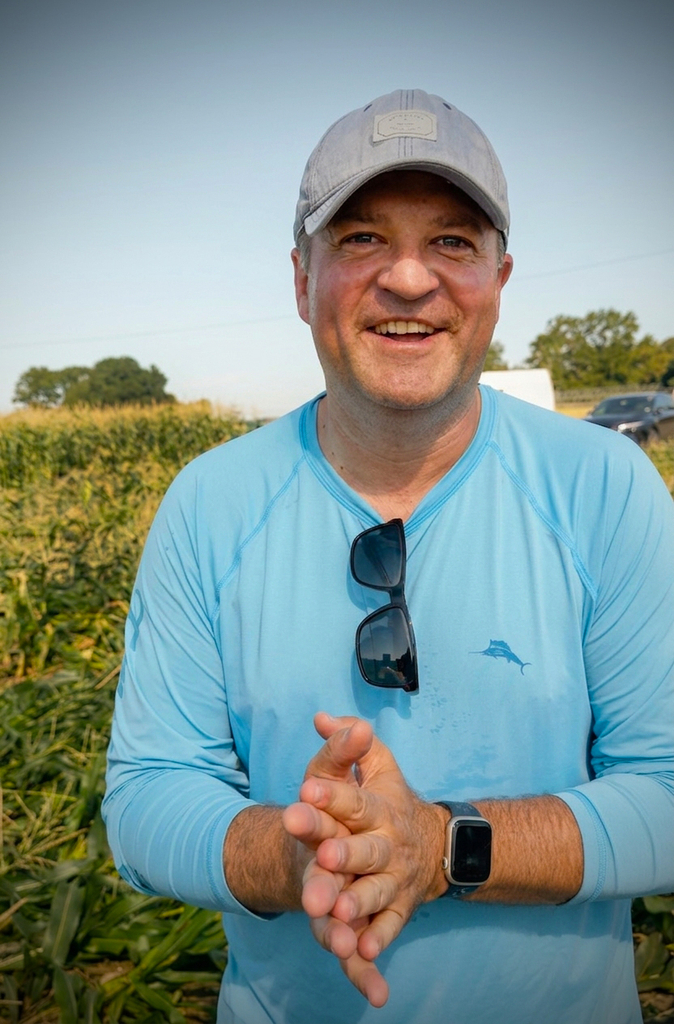
Judith Rosenberg, from Farmers Against Hunger, an organization that gleans produce from farm fields. RIGHT: Ethan Byler, executive vice president of S&G and Advisory Board member, Community Food Bank of New Jersey.
What is a Food Desert?
The U.S. Department of Agriculture defines a food desert as an area more than a mile away from a grocery store or supermarket in urban and suburban areas, and more than 10 miles away in rural areas. In general, this situation is coupled with a low-income and low-access locale. The combination of distance and lack of financial resources creates a void in access to food, or a food desert.
Food deserts are generally related to supply and demand in a neighborhood. Systemic factors come into play as well, such as income inequality, lack of transportation, safety issues, and theft.
Groups like those discussed in this week’s column are often the only source of fresh, healthy food for people in New Jersey’s impoverished areas.
New Jersey’s Economic Development Authority addresses food security with several programs established through the Food Desert Relief Act. You can see the map of communities and learn of programs addressing needs at: https://www.njeda.gov/food-security-program
How Can You Help?
• Farmers Against Hunger – Online sign up NJAGSOCIETY.org. > programs > FARMERS AGAINST HUNGER. Here you can check out the calendar or offer an organized group of 10 to 20 individuals for a gleaning event.
• America’s Grow-a-Row’s website americasgrowarow.org has both donation and volunteer options on its home page. A $30 donation feeds a person for 30 days.
• Community Food Bank of New Jersey’s website cfbnj.org has options from donating or volunteering to addressing people’s food needs. If you know someone who has food insecurity but no computer access or skills you can help with the tools offered here. There is a map of food pantries within a radius of any town you select in New Jersey.
• You can get involved through a donation of time, money, or resources.

