An easy and economical way to save costs on heating and air conditioning is to change filters often. Clogged air filters cause HVAC systems to work harder and use more energy. CU File Photo
The LEED Certification Program addresses sustainability and the design of healthy buildings that prioritize wellness.
By Larry Merighi (AIA, LEED AP), CU Maurice River
When asked to write about sustainable building practices and more specifically the LEED green building program, I was excited to share some information. It goes without saying that incorporating green building practices into the design and construction of a building, be it a school, an industrial building, or a private residence, makes sense. It’s not only good for the environment but also for the pocketbook. And we all are probably aware of the low-hanging fruit of green design—LED lighting, energy efficient glass, low water consumption fixtures, high efficiency mechanical systems, etc. All are win-win strategies, but LEED is more comprehensive and a lot more complex to navigate.
A little history. Leadership in Energy and Environmental Design (LEED) is a green building certification program developed by the U.S. Green Building Council. It includes a set of rating systems for the design, construction, operation, and maintenance of green buildings, which aims to help building owners and operators be environmentally responsible and use resources efficiently.
LEED is a design tool that focuses on energy modeling rather than actual energy consumption. It has been criticized for its point system that can lead to inappropriate design choices, but for the most part it has provided a framework for green building, expanding the use of green practices and products in structures, and helping professionals, including architects and engineers, to consider buildings in terms of the well-being of their occupants.
LEED hit the ground running more than 25 years ago. Given our firm’s interest in sustainable design and the growing trend of having buildings meet LEED standards (even without going through the formal process for LEED certification), several of our firm partners became LEED-certified professionals. Over the years we have incorporated many LEED standards into our design practice and have designed three schools to meet LEED certification requirements for the New Jersey School Development Authority, including the Wallace Middle and Petway Elementary schools in Vineland and the Gloucester City Elementary School.


Changing out conventional light bulbs with LED bulbs reduces both electrical costs and the need for light bulb replacements. Atlantic Electric will often do a Whole Home Energy Assessment and provide not only free LED lights but lots of other energy tips. To find out more call 1-866-353-0007. Photo: SchaferElectric.com RIGHT: Bicycle racks outside of public buildings encourage green transportation and provide cyclists with a safer storage option. Photo: J. Morton Galetto
To attain LEED certification, a building needs to achieve a minimum of 26 points in various categories, including water efficiency, energy conservation, materials and resources, and indoor environmental quality, to name a few. But it also recognizes the importance of a building’s access to existing utility infrastructures and public transportation, the adaptive reuse of existing buildings and materials as they relate to carbon footprint reduction, enhanced daylighting, and acoustics. Some points are easy to achieve, such as installing a bike rack and using low water consumption plumbing fixtures. Others require more research and documentation, such as where building materials are manufactured and the percentage of construction waste that is recyclable.
For me, the benefit of the LEED Certification program is that it takes a holistic approach to sustainability and emphasizes not only energy savings, which is very important, but also recognizes the importance of designing healthy buildings that prioritize occupant wellness by focusing on cleaner air, natural light, safe materials, and acoustic comfort.
So, if you are buying a new home or own a home and want to make improvements, what are some of the strategies that will make your home “greener” and align with LEED standards?
Start by recognizing the following attributes of a green home.
• Health: Green homes are designed to maximize indoor fresh air and minimize exposure to airborne toxins and pollutants.
• Savings: Green homes use less energy and water.
• Value: With proper planning, green homes can be built for the same cost as non-green homes.
There are also financial advantages.
• Lower operating costs: Green homes typically use 20 percent to 30 percent less energy than standard code-built homes, significantly lowering gas, electric, and water bills.
• Increased resale value: Green homes often sell faster and for higher prices.
• Tax and insurance incentives: Many states, municipalities, and insurance providers offer financial rebates, permit discounts, and reduced homeowner insurance premiums for green-certified properties.
So, what are some of the strategies one can do to make an impact?
• Seal air leaks, especially around doors, windows, pipes, and ducts.
• Confirm there are no gaps in your attic insulation and consider adding more insulation if it is less than nine inches thick.
• Upgrade to LED bulbs if you haven’t done so already.
• Replace your HVAC unit’s air filters at least twice a year and have it serviced once a year.
• Clean vents and registers.
• Lower the temperature on your water heater to 120 degrees F.
• Fix dripping hot water faucets.
• Install double or triple pane windows with low E glass.
You can find more information on the LEED program at www.usgbc.org/leed.
Larry Merighi, AIA, LEED AP, is an architect and professional planner with MMPF Architects, LLC., in Vineland, NJ. His work focus is on the master planning and design of educational facilities.
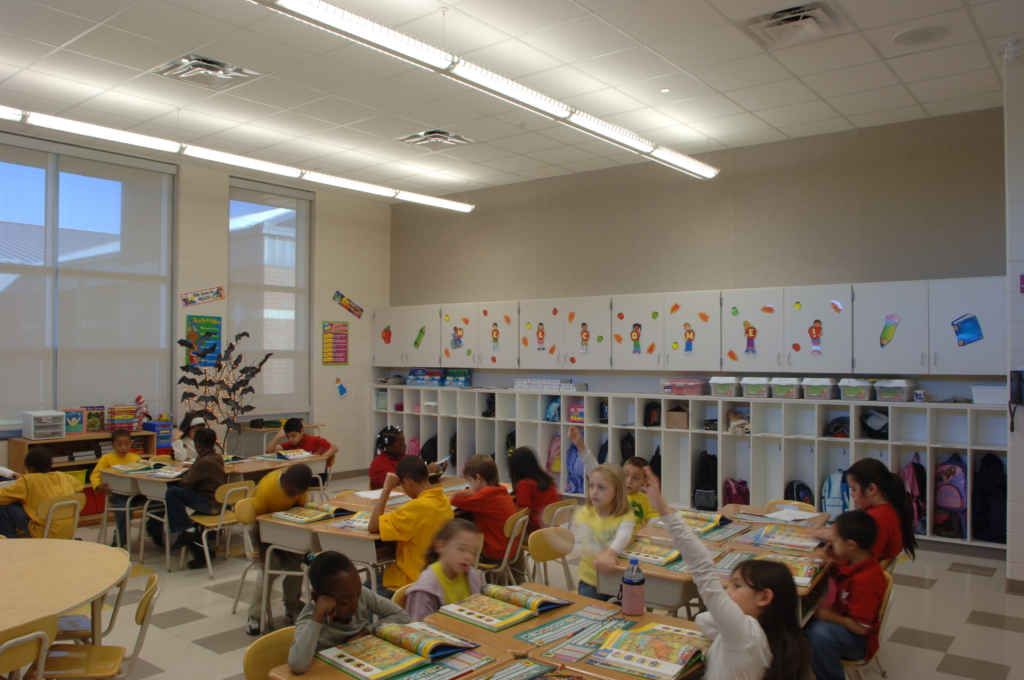
Green building strategies in the classroom include ceiling tiles that absorb 70 percent of all sound. The walls have sound-absorbing panels above casework to minimize sound traveling between rooms. Lighting is equipped with daylight and motion sensors, so that lights work only when necessary. The high percentage of window glass in the classrooms provides a connection between indoor spaces and the outdoor environment through the introduction of daylight and views into the occupied areas of the building. All windows have shading devices to minimize glare.These LEED strategies have been linked to improved occupant wellness.
Photo: Manders Merighi Portadin Farrell Architects, LLC

