A male blue bird visits the author’s yard in winter. Photo: Trudy Pomerantz
Monitoring trails, mapping nest boxes, and banding bluebird chicks—are all part of the job for our guest author and volunteers. By Trudy Pomerantz, CU Maurice River / NJ Bluebird Society Coordinator
I’ve been asked several times recently what I have been doing this spring and summer. My friends had noticed that I have not been uploading many photos to Facebook lately and that I have been missing meetings and lunches. This year, spring and half of summer have passed in somewhat of a happy blur as I have been busy monitoring bluebird trails, mapping nest boxes, and banding bluebird chicks—all part of the job as the Cumberland County coordinator for the NJ Bluebird Society. The goal of our organization is to increase the population of eastern bluebirds throughout the state. We are contributing to the story of the recovery of the bluebird population. But where does the story start?
The 20th century saw a catastrophic decline in the number of bluebirds, primarily due to the introduction of invasive species and the loss of habitat. Eastern bluebirds are obligate cavity nesters. This means they need to find an enclosed space in which to lay their eggs and raise their young but are unable to excavate the hole themselves. They often rely on holes built by woodpeckers in snags and still-standing dead and dying trees. The early to mid 20th century saw a large reduction in these snags as the land was cleared for other uses. At the same time, aggressive non-native birds—the house sparrow and European starling—had been introduced and competed for these same nesting sites.
What could be done? It was found that Eastern bluebirds were more than happy to use nest boxes to lay their eggs and raise their young. A program that began in the 1970s saw the establishment of bluebird trails throughout North America and the resulting recovery of the bluebird population. Here in Cumberland County, we have trails and individual boxes located in suitable habitat across several state-owned wildlife management areas; on utility company grounds; at local schools, farms, and nurseries; and in people’s yards. Many of these were set up by Allen Jackson, my mentor and a giant in our area for conservation, particularly of bluebirds and purple martins.
Before going further, it would be helpful to identify which bluebirds we are talking about. The male Eastern bluebird has a stunning blue back and head with a reddish-brown chest and neck and a white belly. The female is not so brilliantly colored and is more brownish-grey but still beautiful.
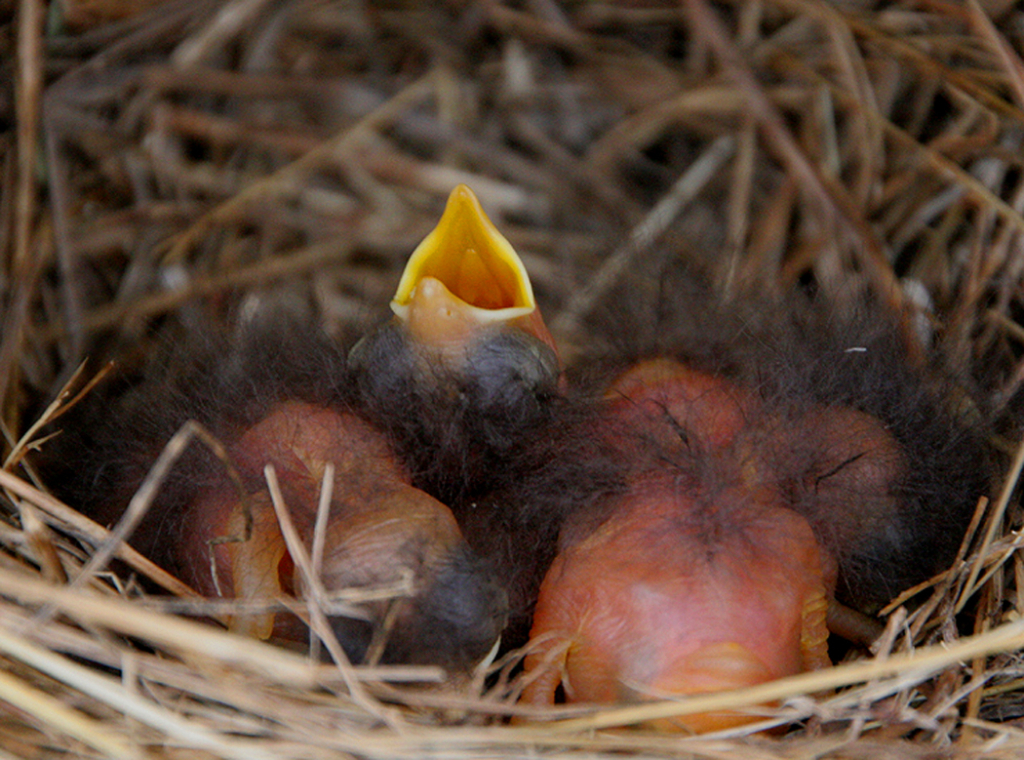
These chicks are only a few days old. They have down but no feathers as yet. What they lack in feathers they make up for in appetite. Photo: David Lowenstern
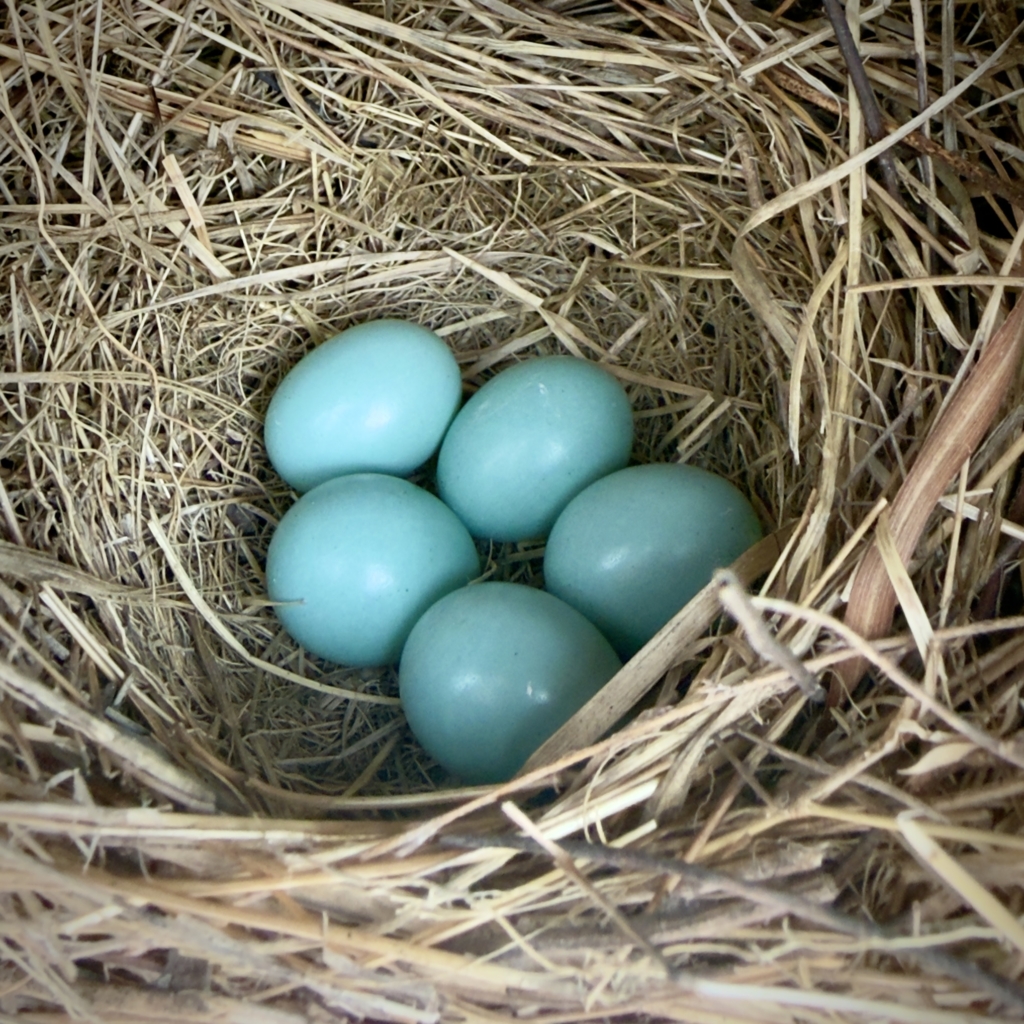
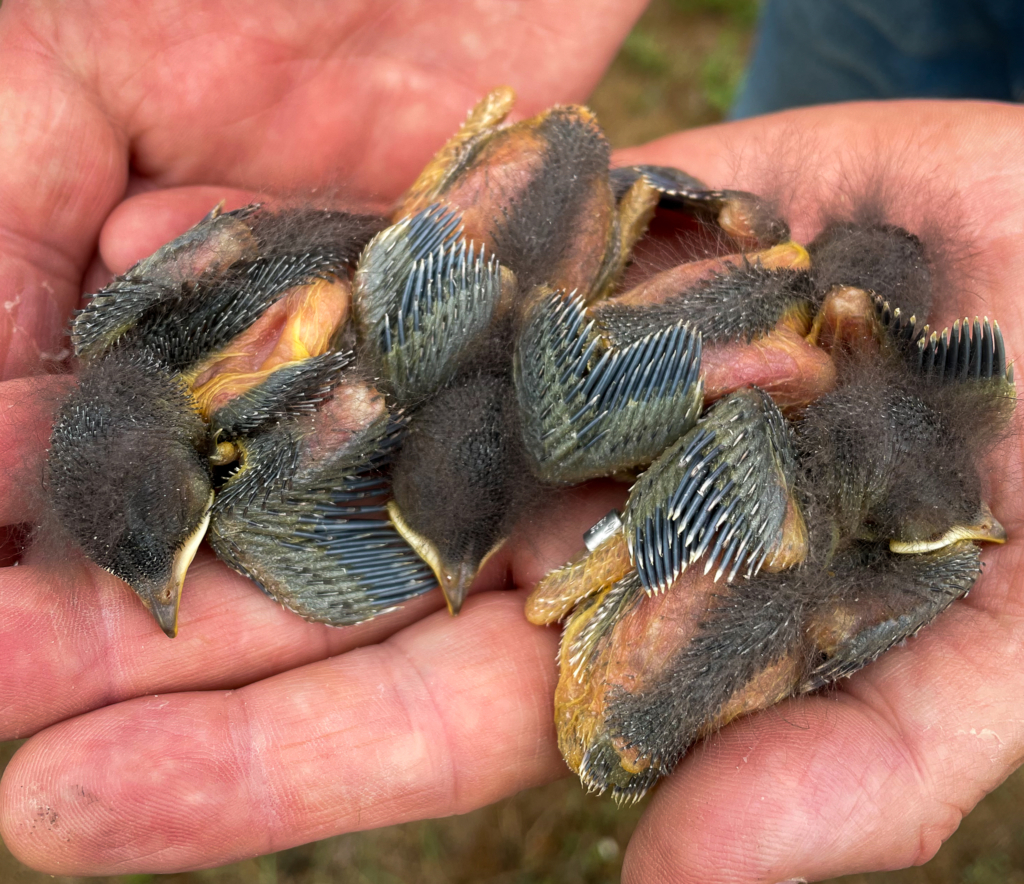
Four to five lovely eggs are typical of a bluebird clutch. RIGHT: Eight newly banded bluebird chicks, note the silver ring around the one’s leg in the foreground. PhotoS: Trudy Pomerantz.
I mentioned that we located the nest boxes in suitable habitat; what does that mean? Bluebirds are primarily insectivores. The best location for bluebirds to find insects is in grasslands. We also like to have some trees nearby for two reasons. First of all, bluebirds like to perch up high and scan the ground for insects. Secondly, when fledglings first try to fly they are not always very good at it. If there is not a tree limb close by they may end up on the ground, leaving them exposed to predators.
What does the year for a trail monitor look like? In March, we head out to check the condition of the boxes. Bluebirds and other cavity nesters often use the boxes in the winter to shelter from the weather. So we clean them out and get them ready for a new season. Weather and woodpeckers can also damage the boxes; sometimes this means having to replace them and other times we can simply mend them with sealant. Sanding down and waxing the predator guard is often done at this time. In early April, I start making weekly checks, and this continues until the end of August.
By mid-April we often see the completion of some nests, with eggs appearing by late April/early May. Since it is the male that scouts out potential nesting sites, it is always exciting to see one perched atop a box when out checking the trail. However, once he has attracted a female, it is she who actually does the nest building. The bluebird nest is a neat structure since she weaves together grass and pine needles.
The female bluebird lays one egg each day up to a total of between two and seven, though four or five eggs appear to be most common. She starts incubating once she has laid the final egg. The chicks hatch after 14 days and then grow apace. Even after several years of monitoring bluebirds, it still amazes me to see them grow from a tiny, featherless fuzzy thing to juveniles leaving the nest about 20 days later. Here in New Jersey, we find that many couples will produce two or three broods each year.
The banding program in the state has been running under the auspices of the NJ Bluebird Society (NJBBS) for about 10 years now. Currently, Bernnie Visalli, our president and the county coordinator for Salem and Gloucester counties, has the master permit, which allows us to offer this program. In the past five years we have seen about 1,000 birds fledged per year in Cumberland County alone, with about 6,000 fledged throughout the state.
Why do we band? Banding has helped us learn about bluebird migration and life expectancy. Eastern bluebirds banded here in South Jersey have been located as far north as Canada, though more frequently they are found near where they were banded. It is believed that their average life span is two to three years, but many may not even survive their first winter.
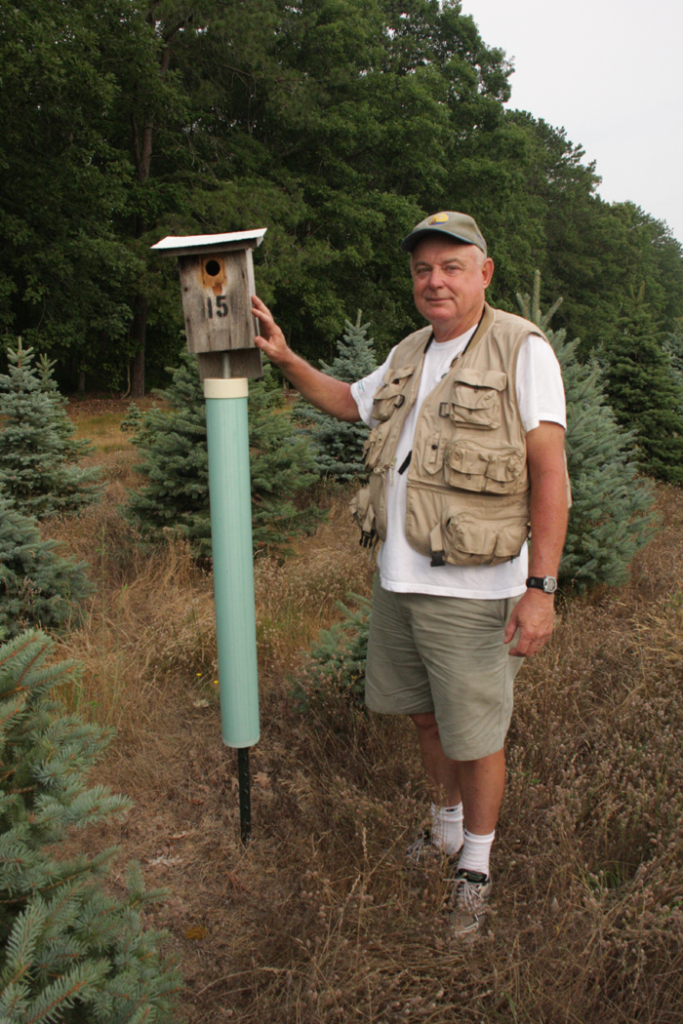
The author’s mentor Allen Jackson stands alongside a bluebird nesting box at a local Christmas Tree farm that offers great habitat for bluebirds. Photo: CU Maurice River File photo
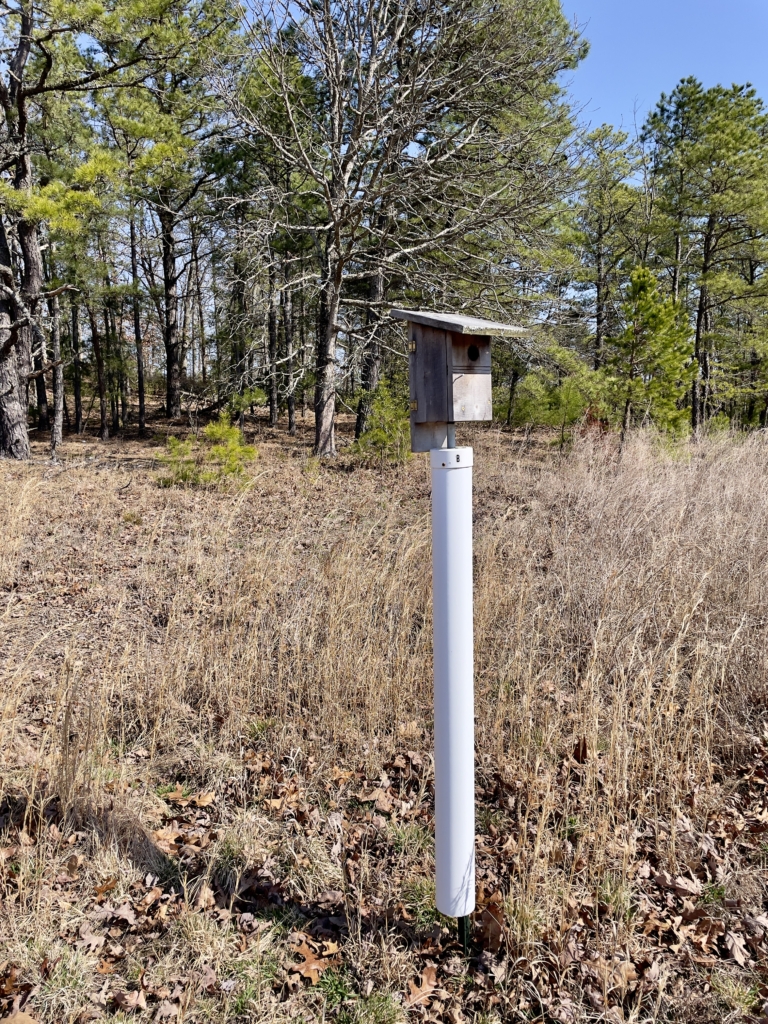
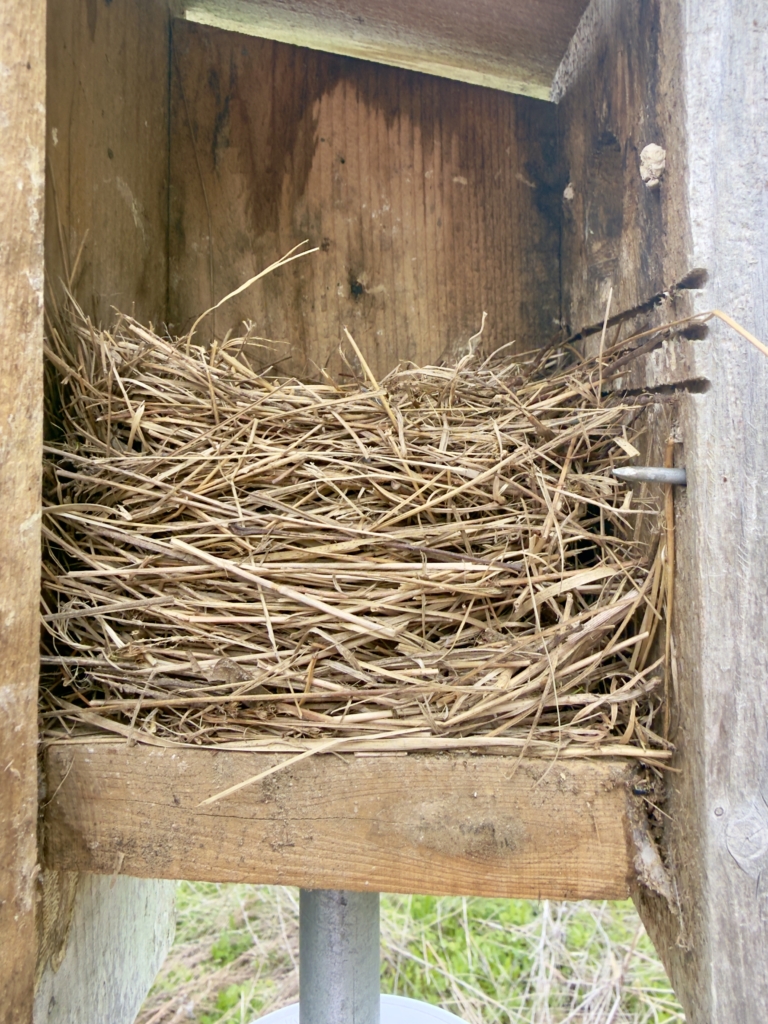
The habitat around this nest box is appropriate with grasses for foraging and trees for newly fledged birds to perch in while gaining their flying skills. The white PVC pipe is a predator guard that makes it difficult for snakes to rob nesting chicks. Photos: Trudy Pomerantz
We band when the chick is between eight and 12 days old. If the chick is younger than eight days, there is a risk of injuring it because its legs are not strong enough to support the aluminum tag. After 12 days, there is a risk of premature fledging; that is, the disturbance may result in the chicks attempting to leave the nest before they can fly, exposing them to the danger of predation.
How can you help? Locally, think about joining the NJBBS and/or Citizens United to Protect the Maurice River. Both these organizations have provided funding, expertise, and encouragement for our nestbox program. Nationally, the North American Bluebird Society provides education and spearheads conservation efforts for our beloved bluebird throughout all North America.
Realize that insects are foundational in our ecosystem. I used to think that having insect holes in my plants was a problem and looked ugly. Now I realize they are the sign of a healthy ecosystem and are a way to welcome birds to my yard.
Lastly, particularly in the winter, provide a source of fresh water. I have added a heated bird bath to my yard for the past few winters and, as a result, have seen many more visitors, including bluebirds, which would not otherwise frequent my property.
About the Author: Trudy Pomerantz
Trudy was born and bred in Queensland, Australia. A week after submitting her Ph.D. thesis in Chemistry, she married an American and moved to Germany for 2 years. She has lived in the US since 1993. She homeschooled her 4 children through the end of high school taking them through college level course work in both the sciences and arts. Trudy moved to the Millville area 6 years ago and learned about bluebirds shortly after. She started monitoring a trail at Holly Farm 4 years ago and became the NJBBS County Coordinator two years ago.
Sources
https://www.allaboutbirds.org/guide/Eastern_Bluebird/lifehistory

