Mist rises off Cumberland Pond in mid-October while fall foliage reflects on the surface of the still waters.
Photos: J. Morton Galetto
Who knew that the bladderwort was so busy underwater?
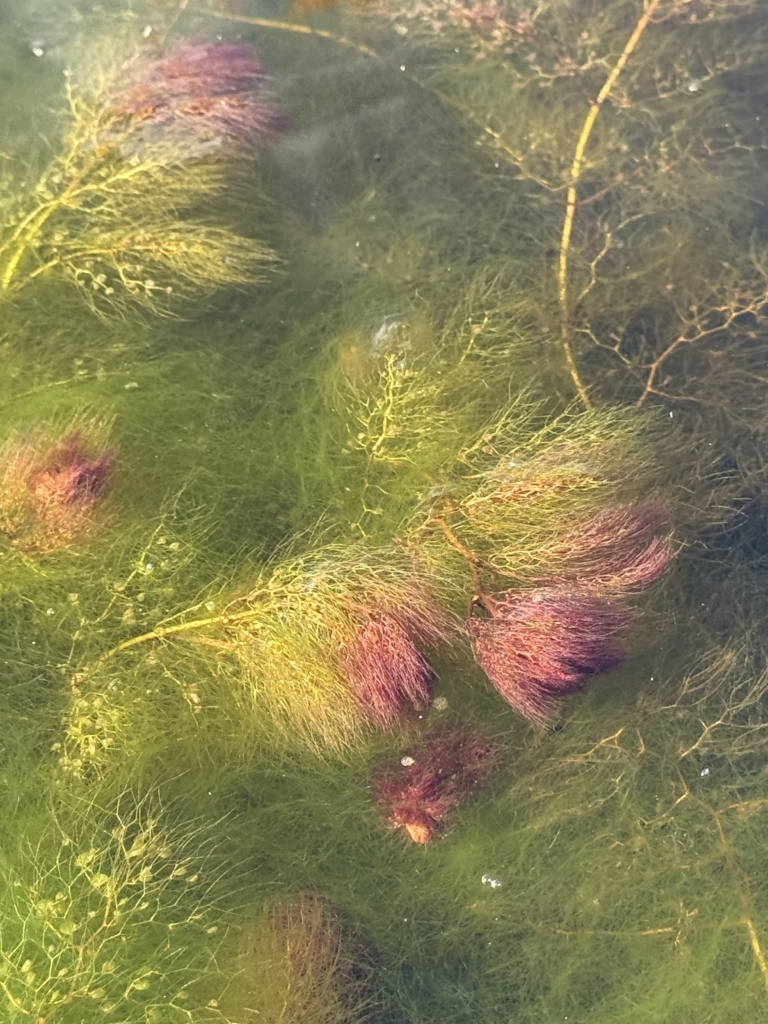
In mid-October a group of CU paddlers basked in the reflection of fall foliage on the still surface of Cumberland Pond, on Route 49 in Maurice River Township. Upon our arrival there was a chill in the air and we enjoyed the columns of mist that rose off the surface of the warmer water. We paddled across what looked like a floating mass of fine hairy roots, which were actually the stems of bladderwort. At least a dozen of the 230-some species of this plant worldwide are extant to the pine barrens. Bladderworts exist on every continent but Antarctica.
The 33-acre dammed Manumuskin River that creates Cumberland Pond was once the power source for Eli Budd’s furnace. Here, pig iron was made, taken by wagon to Schooner Landing, loaded onto vessels, and carried downstream on the Menantico River to the Maurice. Then it was shipped upstream to Millville Manufacturing to make iron products. Budd’s also fashioned products like firebacks, stovetops, and tombstones. The fact that iron was harvested from this area is an indicator that the water is acidic, and that is key to today’s species’ natural history.
Our topic is bladderwort, and I believe the species on Cumberland Pond to be swollen bladderwort, Utricularia inflata. It is native in our area but in places where it is non-native it is considered an aggressive invasive, and indeed here it was quite prevalent—even though it belongs.
I found a few of their blossoms left for us to enjoy above the surface; I assume that a few weeks earlier many more would have existed. They consist of a whorl of five flat petals or tepals that float upon the surface of the water. Centrally located is a stiff stem of about seven inches that supports a cluster of yellow flowers, reminiscent of a snapdragon’s structure. Each erect stalk can hold four to 17 flowers.
The mouth-like blossom has a two-part stigma. A foraging bee must pass through the stigma, which closes and traps pollen. Since the bee must climb deep into the blossom it will brush off pollen on both its entrance and exit. This ensures that the stigma will receive pollen from an outside source. If the stigma on the plant is closed it indicates that it has already been pollinated. You can learn more about the process from the Botanical Society of America’s article on bladderwort.
What happens beneath the water’s surface is just as exciting, or maybe even more so than what we see on the little platform above. This plant is carnivorous. On the stems are little bladders that catch microscopic creatures in their pinhead-sized bladder-shaped traps.
To catch prey, this carnivorous plant pumps water out of tiny hollow bladder sacs, creating a negative pressure that, when triggered by its tiny bristle-like structures, sucks in prey and closes a flap shut. These microscopic bristle-like projections stimulate the flattened bladders to inflate, sucking in water and the passing prey. Envision a bulb from a gravy plunger squeezed shut and then released—woosh! Some sources describe this as one of the swiftest suctions in nature.
Sometimes when you lift the plant from the surface you can hear the crackling sound of the bladders being triggered shut by the motion of removing them from the water.
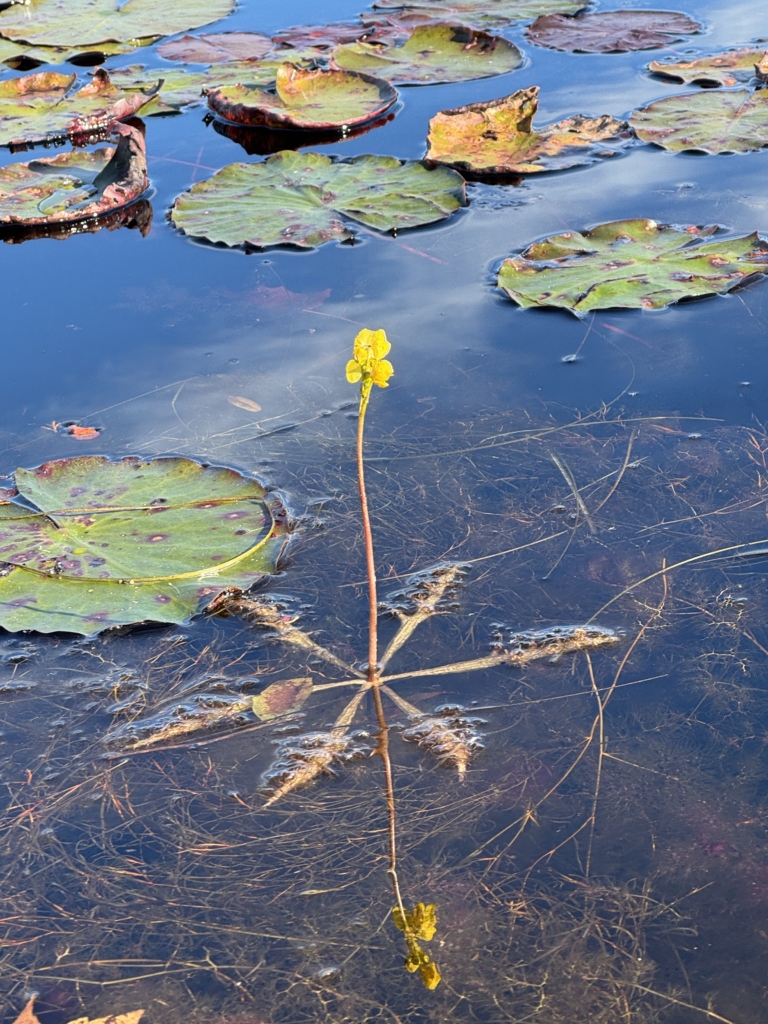
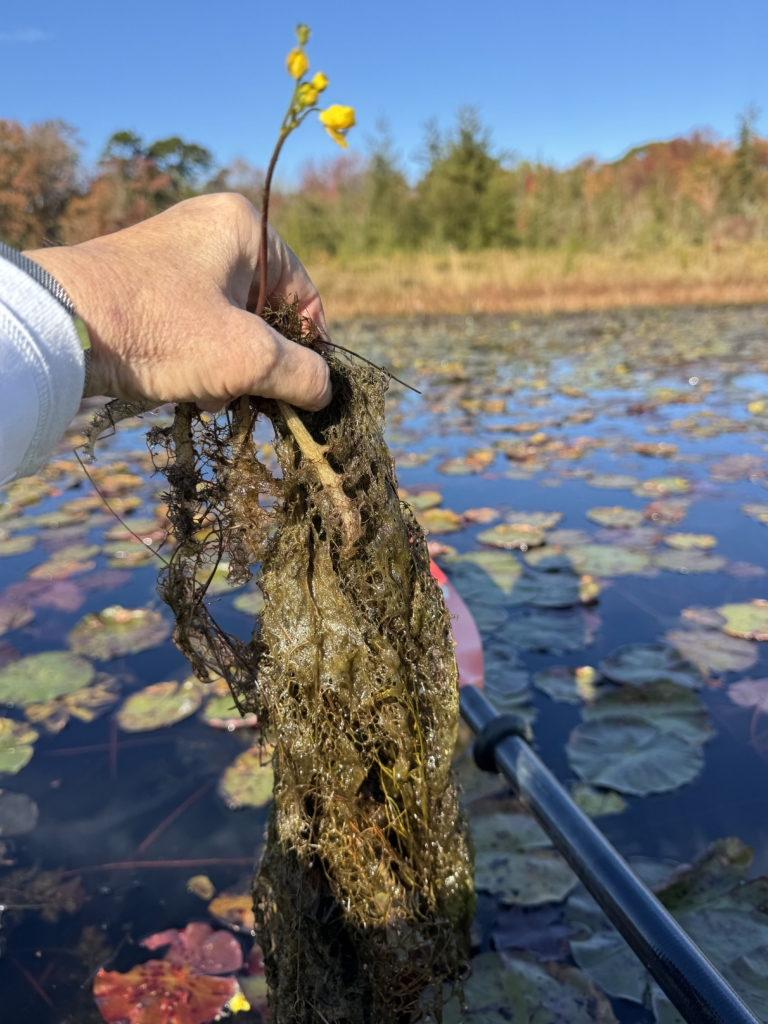
The five petals of swollen bladderwort support a stiff stem on which flowers beckon pollinators to sustain their existence. • The plant that you see above the water is deceiving. The mass of hairy leaves beneath the water is much more abundant.
Although some bladderworts are terrestrial, swollen bladderworts are aquatic. In the pond’s acid waters bladderwort is exposed to sunshine, but nutrients must come from capturing prey. The abundant hairy stems offer the plant lots of surface area which enables it to get enough carbon dioxide for photosynthesis, but it is the bladders that provide food. They eat single-celled organisms, arthropods, zooplankton, mosquito larvae, Daphnia (water fleas), and rotifers that break down dead plants and animals to make soil.
A rotifer is sometimes called a wheel animal because of the tiny moving hairs or cilia on their heads that look like a spinning wheel. Each microscopic animal’s means of propulsion causes ripples of water; these create the movement that triggers the bladders on the bladderwort’s leaves to open and suck in prey. Should the prey be a bit too large, like mosquito larva or a tiny tadpole, the bladder can suck in a portion at a time and digest it in stages.
In botany the world of carnivory is a narrow specialty; of an estimated 435,000 plants only about 750-ish have been identified as carnivorous (Pam Otto). Several organisms use bladderwort as a food source and some lay their eggs in its hairy stems, which provide shelter.
Famed naturalist Charles Darwin took a special interest in carnivorous plants. In our pine barrens other well-known examples of these are sundew and pitcher plants, which rely on pitfalls and sticky substances for capturing prey. Early Vineland resident Mary Treat made a name for herself in studying these native carnivorous plants and sharing her findings with Darwin. In fact, she found some of his work with bladderworts to be in error, earning her an apology from him in one of the 16 letters they exchanged. (Scroll down to story below to learn about the 16th letter, recently found at Vineland Historical Society!)
I did not find any sources that show bladderwort to have been used by indigenous people as medicine or food. However, I found that modern day scientists from India are conducting studies of the plant as a possible alternative to insecticides.
Over time, many mosquitoes become immune to various harmful insecticides. Indian biologist Kumar Mohanty and his colleagues have been studying the effectiveness of using bladderwort as a biological control. Grant Bolton, Ph.D., in his article “Bladderwort: How a Carnivorous Plant Could Be Used in Mosquito Control,” captured Mohanty’s description of their study’s outcomes. Mohanty had observed that in lakes with bladderwort they never saw large populations of mosquitoes.
These studies showed that the aquatic plant was a remarkably fast and effective predator of mosquito larva. Within 12 hours, 95 percent of first, second, and third instar larvae were trapped although the fourth instar, a non-feeding stage, only experienced 60 to 80 percent predation. Size of larvae relates to success of consuming it. Mohanty said, “After introducing the plant to the mosquito larvae for one hour, we saw predation up to 50 percent. We don’t even see insecticide applications work that fast or efficiently.”
Among the advantages of using bladderwort is that you don’t need to introduce a non-native species, since so many types of bladderwort exist worldwide. Furthermore, the use of chemicals kills desirable fauna. The scientists found that the applicability of bladderwort in retention basins and on construction sites apparently holds great promise for reducing the incidence of mosquitoes.
Malaria is but one of the diseases carried by mosquitos, causing more than 282 million cases globally each year and 610,000 deaths annually (World Health Organization). Although bladderwort will surely not solve the problem it might offer solutions in places. In fact, it is already addressing the problem naturally.
If we simply take the time to look, nature often holds the solutions to some of the most difficult problems we face.
Sources
Greater Bladderwort – Utricularia vulgarius, Montana Field Guide, MT Fish and Wildlifemt.gov
Bladderwort facts, Soft Schools.com
Bladderwort, Pam Otto, Outreach Ambassador for St. Charles Park District, Illinois.
Common Bladderwort (Utricularia macrorhiza Le Conte), Plant of the Week, USDA, Forest Service.
Utricularia – The Bladderwort, Botanical Society of America, botany.org
“Bladderwort: How a Carnivorous Plant Could Be Used in Mosquito Control,” Grant Bolton, Ph.D. March 27, 2024
Evaluating the carnivorous efficacy of Utricularia aurea (Lamiales: Lentibulariaceae) on the larval stages of Anopheles stephensi, Culex quinquefasciatus, and Aedes aegypti (Diptera: Culicidae), Kumar Mohanty et.al. Journal of Medical Entomology, Vol. 61, No. 3, May 2024, pages 719–725.
Darwin Letter Surfaces at Vineland Historical Society Museum,
Members Invited to Unveiling
Members of the Vineland Historical Society will be among the first to lay eyes on a Charles Darwin original letter—plus its transcription—that has recently been found at the Historical Society Museum. The VHAS Member Appreciation Annual Meeting is scheduled for Friday, November 13, at 4 p.m. and will include a recap of the past year’s activities, upcoming initiatives, and the Matilda Society awards, in addition to the unveiling of the Darwin letter.
The letters exchanged between Mary Treat and Charles Darwin total 16, nine from Treat and seven from Darwin. Until recently, however, Darwin’s final letter to Treat, though referred to in other correspondence, was not archived or transcribed along with the other 15 in the Darwin Correspondence Project—or anywhere else. All that is about to change as the Vineland Historical Society has uncovered Darwin’s last letter to Treat.
“We have informed the Darwin Correspondence Project of the letter and the archivists there were as thrilled as we are to share the found letter,” said Valerie Neuber, president of Vineland Historical Society. “In the coming weeks, they will be transcribing the letter and adding it to that vast collection of Darwin letters. It’s interesting to note that Darwin exchanged more letters with Mary Treat than he did any other woman scientist.”
“The Darwin letter was mentioned in a letter Treat received from another scientist, ant specialist Frederick Smith, to whom Darwin had forwarded Mary’s final letter to the esteemed scientist,” said Deborah Boerner Ein, author of Mary Treat: A Biography (2022).
In the biography, Ein writes, “Mary tried to pique Darwin’s interest in her ant studies by sending him ant specimens and some observations. In a March 1878 letter to British entomologist Frederick Smith, a curator of the collections and the library of the Entomological Society of London, Darwin mentions Treat in recommending her work with ants: ‘My dear Mr. Smith, / I have thought that the enclosed specimens might interest you…Mrs. Treat…has done some good work with plants…. Should the facts be sufficiently new, I do not doubt that she would be much gratified by your mentioning the fact before the Entomological Society. / Yours sincerely | Charles Darwin’
“Smith wrote to Mary immediately after from the ‘Zoological Department,’ on stationery embossed with The British Museum seal, and dated 13th March 1878: ‘Dear Madam/Mr. Darwin has very kindly sent me your communication on the ‘Harvesting Ant,’ as well as the insects themselves. I venture to address you on the subject, in the hope that you may have known me as an Hymenopterist of long standing—and that you will oblige me by giving me some further information respecting those remarkable creatures. Your observations on the structure and differences in the mandibles of the ant, are quite new to me ….’
“Though these two letters—the first from Darwin to Smith and the second from Smith to Treat—are catalogued in the Darwin Correspondence Project, the preceding letter from Darwin to Treat has gone missing until now,” Ein says.
Mary Treat: A Biography, by Deborah Boerner Ein, is available from the publisher lulu.com (QR code takes you to the book link) as well as Amazon and other online booksellers.
The museum has an open house every third Saturday from 1 to 4 p.m. Learn more, including how to become a member, at discovervinelandhistory.org