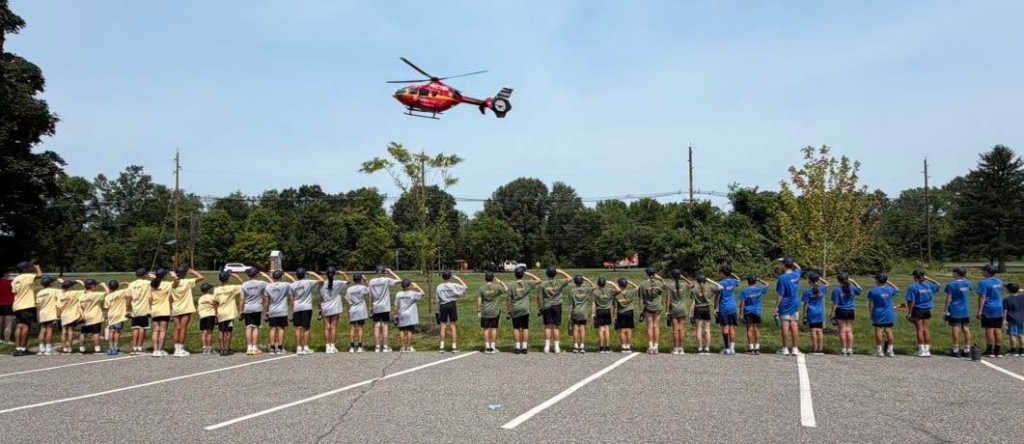
The Medford police department hosted its annual Junior Police Academy last month, graduating 38 recruits from Class No. 9 on the fifth and final day of the program.
The purpose of the academy is to introduce kids to the basics of law enforcement and emergency response, and provide them with valuable life skills that can help them make a positive impact within their own lives and communities. It’s for students residing in Medford and entering sixth, seventh or eighth grade.
The program was led by officers Paul Kostue and Lance Sims, and about 20 others volunteered their time to help with the activities, including command staff and the police chief.
Lt. Patrick Robey has led the academy for the last five years, but he decided to pass it on to Kostue and Sims as he prepares for retirement in the coming years.
“(Kostue and Sims) decided to run a larger class than usual,” Robey said. “When we first started, we were looking at about 14 to 16 recruits. It (eventually) jumped up to 20, then we were pretty consistent with 24. This year we spiked to 38 recruits.”
Robey said that he used to have a “less-is-more” view when it came to the number of academy recruits, as he could give them more individual attention. But since there was great interest in the program and both Kostue and Sims would take the lead, Robey was supportive of their decision to expand the number of participants, who were split into four squads during the program.
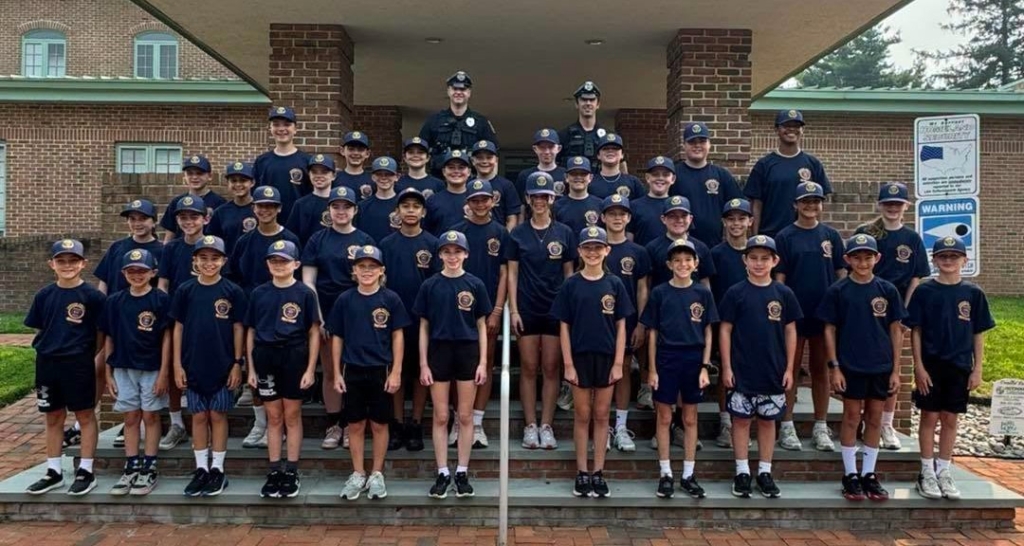
The Junior Police Academy Class No. 9 graduated with leaders Lance Sims (left in back row) and Paul Kostue (right), both Medford officers.
“The more kids we affect, the better off our relationship is with the community,” he noted.
The academy ran from 9 a.m. to 1 p.m. daily, and the recruits were exposed to a different facet of police work each day.
They got an introduction to the department and a tour of the station. They were shown the courtroom and detective bureau, and they were introduced to the chief of police and command staff.
Every day, the recruits participated in physical fitness activities and drill instruction, which included learning how to march in cadence and stand at attention.
Robey said officers try to simulate as closely as they can the training in a real police academy.
The recruits spent their second day with the Medford fire department at Station 251, to work with firefighters and EMS. Recruits were given a tour of the station, trucks and equipment, and taught the basics of CPR, fire escape and other life-saving techniques that can benefit them in emergency response settings and in daily life.
Toward the end of that day, Cooper University Hospital sent over a medical transport helicopter for the recruits to tour.
On their third day, the recruits were back at the police station working with the criminal investigation unit and traffic bureaus, where they learned how officers handle things like crime scenes, arrests and sobriety tests.
The recruits worked with Burlington County Institute of Technology’s criminal justice program on their fourth day to learn hands-on techniques for handcuffing, baton use and physical confrontations. They also had the opportunity to use the school’s firearm training simulator.
“It’s more like laser tag than anything, but they get to learn firearm safety,” Robey pointed out. “We think it’s important that if we affect these 38 recruits, they may tell other kids, and hopefully, if someone does see a firearm that’s haphazardly laid around, they know to make a smart decision.”
The Junior Police Academy wrapped on Friday, ending with a graduation ceremony and demonstration of the skills learned over the week and a family barbecue in Freedom Park. The graduates will be celebrated again on Tuesday, when they will get to walk out with the police department at National Night Out, an annual event that brings together communities and law enforcement around the nation.
While the academy is focused on emergency response, Robey explained that the recruits take away much more than drills and training.
“(It teaches them) confidence and flat-out manners,” he pointed out. “It’s really just some common life skills that I think (kids) are lacking in this day and age, and it’s great to be able to impose that.”