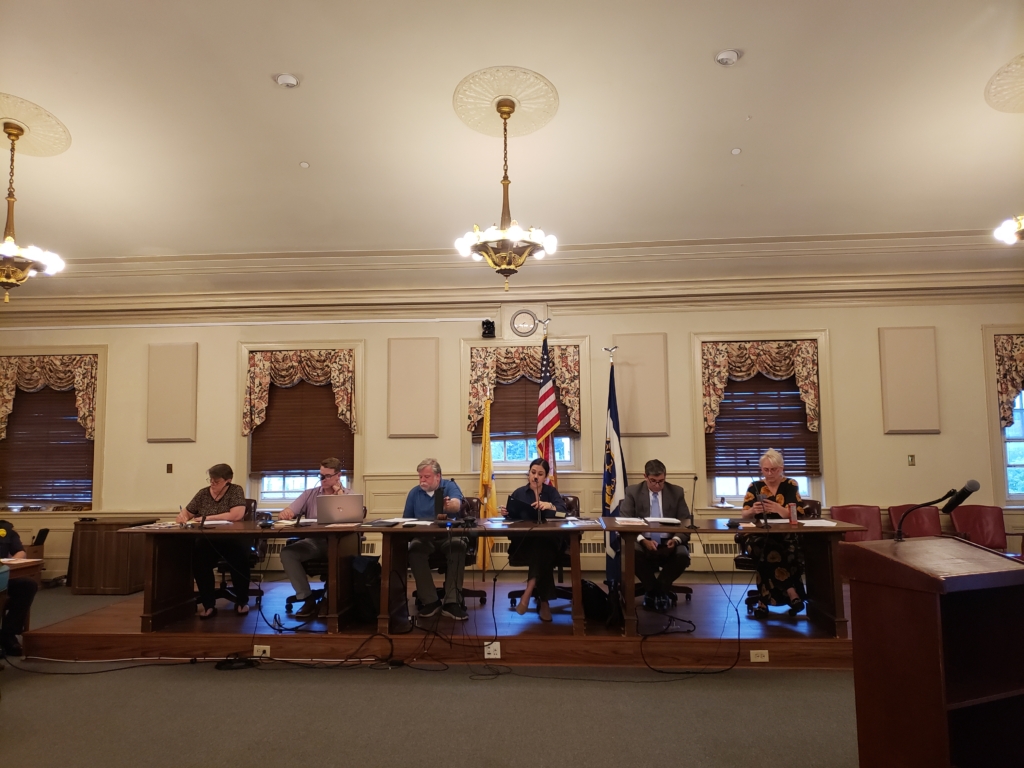
The borough’s board of commissioners introduced a 2026 budget at its May 26 meeting, with an eventual vote expected at the next session on June 23.
The law requires 28 days between introduction of the budget and voting, so the public can read the financial plan and offer comments.
Borough Administrator Sharon McCullough reported that one of the largest increases in the budget is the cost of trash removal, which went from $869,020 in 2025 to $1,042,240 in 2026, a 19.9% increase.
“Those services, the expense of those services, are what’s driving this increase for the predominate reason this year,” she said.
The borough has allocated a total of $24,977,484.03 for the general fund, a 1.1% decrease from last year. Among the fund’s largest outlays are three that each accounted for 21% of the budget: public safety at $5,370,001, other unclassified expenses excluded from the cap at $5,279,760, and the Department of Revenue and Finance at $5,136,208.
The public safety budget this year grew from $5,191,11 in 2025, a 3.4% increase, and the revenue and finance budget increased 20.2%, up from $4,272,315. Unclassified expenses excluding the cap were $7,843,713.20 last year, a 32.6% decrease.
The definition of unclassified expenses are those within and outside the cap. The cap in this case refers to certain expenditures that are limited by how much they can be increased, such as Social Security and pensions, and expenditures that don’t have a the same cap on their increase, such as debt service, capital expenditures and grants.
Under revenues, the budget lists various grants and outside funding, with the borough getting funds this year it did not last year.
For 2025, the borough received $15,342.45 from the Recycling Tonnage Grant, $25,000 from the Camden County Open Space Recreation Grant and $84,000 from the New Jersey Department of Community Affairs Recreation Grant. None of those grants were awarded this year.
The borough will receive $800,000 from the Safe Streets to Transit program this year and $175,720 from New Jersey Department of Transportation Municipal Aid, neither of which it got last year. The biggest increase the borough saw was for grants excluded from the cap, which increased 391.3%, from $206,515 in 2025 to $1,014,585 in 2026. The increase is due to the $800,000 from the Safe Streets to Transit program.
For miscellaneous revenues, Haddonfield brought in $5,081,904.23 last year, compared with $3,810,069.03 this year. The borough raised more in taxes this year, $16,309,155, compared with $15,566,470 last year.
All told, for revenue in general, the borough raised less money this year, $24,977,484.03, compared with last year’s figure of $25,267,820.23. That, in turn, was lower than the $27,219,602 raised in 2024.