By HEIDI YEH
Policy Director, Pinelands Alliance
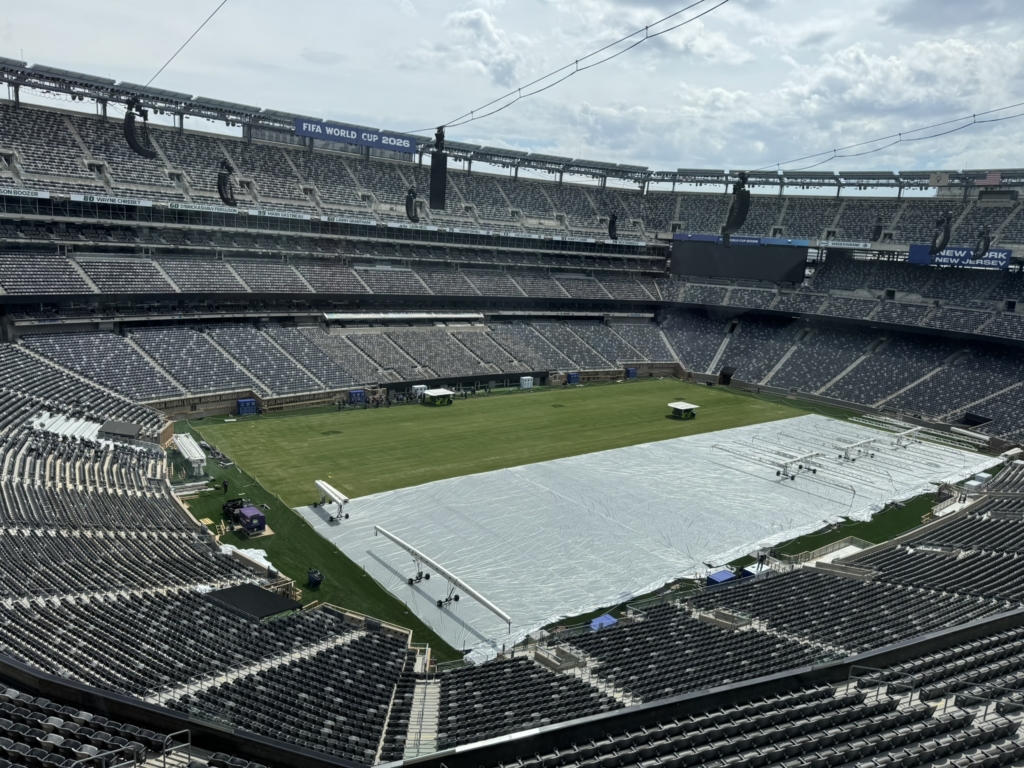
This summer, as millions of fans tune in to the FIFA World Cup, it’s worth paying attention not just to the athletes, but to what’s beneath their feet.
Despite artificial turf’s growing popularity in American towns, FIFA’s biggest stage rejects fully synthetic fields.
Following a landmark challenge from women’s teams who objected to being forced onto artificial turf while men played on natural grass, FIFA shifted its standards. Fully synthetic fields are no longer acceptable for top-level competition. Today, World Cup matches are played on either fully natural grass or hybrid systems, surfaces rooted in real soil, with living grass reinforced by only a small percentage of synthetic structure.
That fact alone should challenge one of America’s most persistent myths: that artificial turf is the premium, elite standard. If plastic fields were truly superior, FIFA – the governing body for the world’s most played and watched sport – would use them.
It doesn’t. Yet across New Jersey and the U.S., municipalities continue pouring taxpayer dollars into synthetic turf under the assumption that it provides more playing time, greater prestige and better value.
The reality is far more complicated. Properly designed natural grass fields with modern drainage can often meet the needs of towns at lower cost and with far fewer environmental impacts. Artificial turf is roughly 40 degrees hotter than nearby grass fields, yet its promise of “more playable hours” typically fails to account for days when it is simply too hot to play.
You would be hard pressed to find a place in South Jersey where natural grass fields that are properly designed and maintained cannot meet the needs of the community. What is harder to justify are the enormous environmental and financial costs of plastic fields.
Artificial turf carries well-documented risks: microplastic pollution, PFAS contamination, urban heat island effects, landfill waste and the fossil fuel demands of manufacturing petroleum-based surfaces. These fields must also be replaced every eight to 10 years, creating recurring costs many towns underestimate. Cherry Hill, for example, recently budgeted $2 million to resurface two artificial turf fields; meanwhile, the district faces a $29 million budget gap and plans to eliminate dozens of positions.
Costs like these are expected to become even more volatile, as the conflict in Iran has caused the price of petroleum products like plastic to skyrocket. Meanwhile, well-managed natural grass – or hybrid fields like those mandated by FIFA – can be cheaper over the long term.
Gov. Mikie Sherrill recently highlighted artificial turf fields as a common “Christmas tree item” in state budgeting, a revealing example of how expensive and heavily subsidized these projects have become. With the state picking up the tab, municipalities have less incentive to seriously consider what strategic investment in natural grass fields, modern infrastructure and skilled field management personnel could accomplish.
At a time when taxpayers across the state are being asked to tighten their belts, continuing to subsidize costly plastic fields is increasingly difficult to defend.
The good news is that communities do not need FIFA-size budgets to build high-quality athletic fields. What they need is smarter investment: modern drainage infrastructure, soil engineering and trained sports field managers who can unlock the full potential of natural grass. Even after accounting for the higher maintenance requirements of grass, a well-managed natural field typically costs far less over its life cycle than an artificial turf field.
There is also a practical path forward for communities that have already invested in artificial turf. Rather than replacing aging, synthetic carpet with another generation of plastic, towns should begin planning now to convert those fields back to natural grass when replacement time arrives.
Many of the benefits commonly attributed to artificial turf – particularly rapid recovery after rain – are actually the result of the underlying drainage system, not the plastic surface itself. In many cases, that infrastructure can be retained and adapted to support a high-performance natural grass field, preserving much of the original investment while eliminating the long-term costs and environmental impacts of synthetic turf.
In this moment, with the world’s eyes fixed on elite sporting events happening in New Jersey, our state has the opportunity to turn the tide on plastic pollution. We must redirect public money away from plastic and toward healthier, fiscally responsible alternatives. The world’s best athletes already know the difference. It’s time we did too.