After months of digging, cataloging and piecing bone and pottery fragments together, an archeological dig taking place at the Kay Evans House on Croft Farm is nearing completion.
And it wasn’t done just by archaeologists.
In February, the township hosted two days where about 200 people – including children – could observe and participate in the active search for fossils at the site.
Matthew Tomaso is senior director of cultural resources at PS&S, the firm hired to do the dig.
“It was probably the most fun I’ve had as an archaeologist in the last 10 years,” he enthused. “It was just really nice … The kids had a wonderful time looking for artifacts in the screens, and my entire staff was super helpful with everybody.”
In an email, Mayor David Fleisher said the dig is an inverse of the Trump administration removing plaques in front of the Independence National Historical Park in Philadelphia about slaves owned by George Washington.
“Just across the bridge in Philadelphia, the federal government is attempting to erase important pieces of our nation’s history,” he noted. “In Cherry Hill, we are quite literally unearthing the history of the Croft Farm property as a stop on the Underground Railroad.
“We are proud to share these findings with the community.”
The reason for the dig in the first place is planned construction work at the Evans House. It was funded by $638,286 from the New Jersey Historic Trust Fund and $150,000 from the Camden County Open Space Fund. And because Croft Farm is listed on the National Register of Historic Places, a dig has to be conducted before work can commence.
The property was acquired by the township in 1985 and listed on the register in 2000. Any work there before that did not require a check for artifacts, so if there was anything in the ground it was most likely lost, according to the mayor’s deputy chief of staff, Megan Brown.
“If they were building a front porch, in rebuilding the front porch in the ’60s and digging new footers, nobody was looking at what’s coming out of the ground and worrying about what’s coming out of the ground,” she explained.
“If we dig new footers today, we are documenting that process.”
A construction contract of $1,447,200 to refurbish Evans House was approved by council on July 27. Brown said that once the project is approved, the township will determine a timeline for repairs.
Chelsea Carrière, an archaeologist with PS&S, said the dig showed what are called faunal remains, meaning various pieces of animal bones that show what kind of animals were eaten by the house’s inhabitants. Of the hundreds of bones found, some were cut in ways that indicate they were prepared by a butcher or an experienced family member, while others were chopped more haphazardly.
“We’re also seeing a lot of very sloppy cut marks,” Carrière pointed out. “Very sloppy preparation of food that could have been related to people who aren’t as familiar. Or who were procuring their foods in other ways. So that we’re kind of relating to the ceramics in those same deposits (and) seeing this wide disparity of socio-economic class.”
Tomaso said the archaeologists were surprised by how many bone remains were found, since New Jersey soil tends to be more acidic, making those kind of remains less common. There have been at least four major excavations at Croft Farm, with other digs turning up artifacts that date back as far as 6,500 years.
The artifacts PS&S found this year only date back as far as 1,500 to 2,000 years.
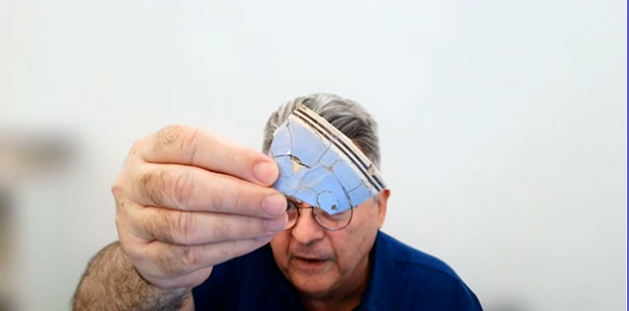
Those artifacts take a lot of work to fit together, with just one small part of pottery using pieces from four different locations at the site. Tomaso said that archaeologists only get complete pieces if they are found mostly unbroken or close together.
In the case of the Kay Evans property, many of the pieces found in what was then the backyard were probably thrown into a garbage pile, something Tomaso indicated could be either because the residents no longer used the pot or were throwing out individual pieces from something that had shattered.
“Now that might not seem like an important question,” Tomaso acknowledged. “But if it’s the latter, why are people that are upper-middle-class Quakers in Cherry Hill using something for 100 years before they throw it out? I think that’s actually an interesting question.”
Among possible answers is that the area was a stop on the Underground Railroad; slaves fleeing from plantations in Maryland could have stayed at the house and used old dishware to eat.
“And they have to use some material to prepare food for them and to give food to them,” Tomaso said. “So the stuff that they kept around for 100 years is likely what’s going to get used there.”
Tomaso estimated the archaeologists got about 20% of the artifacts believed to be at Evans House. Brown indicated that the township could decide to display them in some capacity.
“Right now, it only functions as office space, and prior to that, it was really closed to the public, more or less …” she said. “So part of this whole project is to make the house available to the community. And I do think as part of that, we will use the house as a way to display these artifacts.”
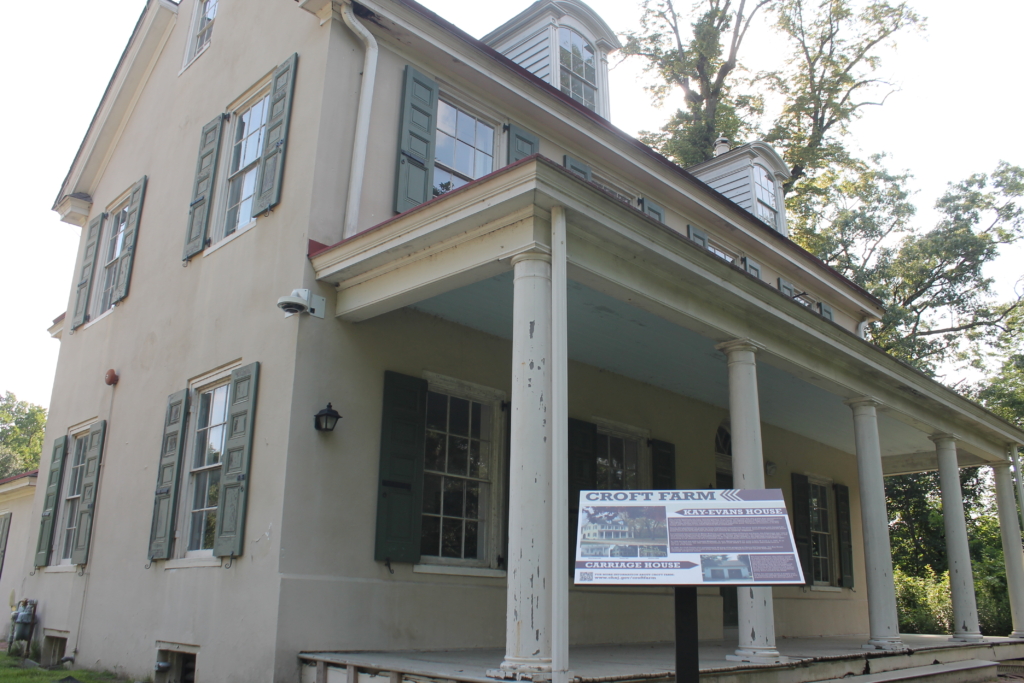
The Kay-Evans House was acquired by the township in 1985 and listed on the National Register of Historic Places in 2000.

