Several students and township community members have voiced their opposition to the idea of eliminating African American studies as a graduation requirement.
The idea first came up at a board meeting earlier this month.
Habibatu Samura, a member of the East High African American Cultural Club, told the school board at its May 26 session that she would like to see the district keep the requirement. She took both AP African American (AA) studies and AP U.S. history and found the former came up short in telling the story of Black Americans.
“A common pattern that I noticed while taking both courses was that in my U.S. history class, although African American history was mentioned, the course did not fully expand the depth of how integrated Black Americans were in U.S. history,” she said.
“In my AA studies class,” Samura added, “I was able to grasp truly how much African Americans contributed to the identity of our country … This course exemplifies that African American history is U.S. history. And to remove it as a requirement would say otherwise.”
Vincent Stern also belongs to the cultural club. He agreed with Samura and also noted that the AA studies course improves the school district for everyone.
“It also allows students to make connections to overwhelming systemic issues for Black people in America, which ultimately serves to undermine certain prejudices, biases and stereotypes against this community,” he explained. “And that allows students to reconsider certain biases that they have learned outside of the classroom.”
Skylar Adams, a member at large of the club and an African American, believes eliminating the AA requirement would send the wrong message given the persistence of discrimination she herself has experienced.
“Making this course an elective instead of a requirement sends the message that learning about Black history is optional and not important enough for every student to understand,” she related. “I understand the district is facing budget challenges. Using budget concerns to specifically target a course centered around African American history sends a damaging message to Black students like myself about what this district truly values.”
Superintendent Kwame Morton – who said the proposal is only in the discussion phase – thanked the students who addressed the board meeting for their comments. The district has also received emails about keeping the requirement.
“It makes me proud to hear our kids come forward and to advocate for what they believe,” he said. “… Thank you for your advocacy though, around the importance of that course and what it’s meant to students across the district.”
At the previous board meeting on May 12, board member Renee Cherfane suggested the AA course could be kept as an elective. The requirement began in 2021 and was championed by students after the murder of George Floyd the year before.
Ineda Elmore-Stratton, a former board member, agreed with students about keeping the course and questioned Cherfane’s reasoning on ending it.
“Where we are already having spaces and places where our students are being erased, torn down, misunderstood, no longer heard and DEI (Diversity, Equity, Inclusion) has become such a dirty word,” she argued, “it really is disheartening to hear that that would even be a thought for anyone on this board of education to think to do at such a time.”
Township councilwoman Carole Roskoph – former supervisor of special projects for the district – also agreed with the students.
“In the current political environment that we are living in,” she offered, “it doesn’t make sense to me that we would want to take away something that would allow our students to learn about each other, learn about themselves and become a part of the community …
“And the one thing that really makes that true, there’s a conversation about taking it away.”
Jennifer LaSure helped develop and teaches the African American studies course at East, said that it was students who originally advocated for the course requirement.
“In many cases, these are topics that receive limited attention in traditional U.S. history courses,” she observed. “Yet they are essential to understanding the broader story of American history. Based on my experience as teacher, curriculum committee member and advisor, I strongly support maintaining African American studies as a graduation requirement for future students.”
Former board president Anne Einhorn said it’s important for the board to consider all mandated courses.
“We need to figure out what courses are running at full power,” she opined, “and (to) keep (that) in mind when you mandate any course, as we know that we have, not just the African American course. There are state mandates that require certain courses.
“I support any kid in any course,” Einhorn added. “But if it’s going to come down to a sense of economies of scale – for some courses, not necessarily the African American one – it’s important the board approach it.”
Board Vice President Adam Greenbaum ended the meeting by thanking those who offered their views.
“Your voices matter,” he emphasized.
So far, there has been no other discussion about removing the AA graduation requirement. The district’s public information officer, Nina Baratti, did not respond to a request for comment.
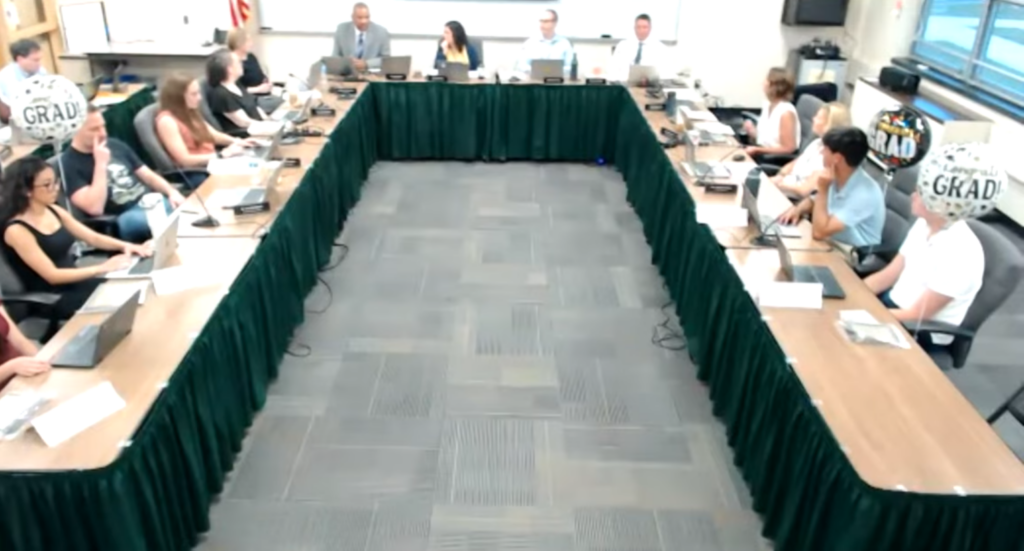
The idea of removing African American studies as a graduation requirement first came up at a board of education meeting early last month.

