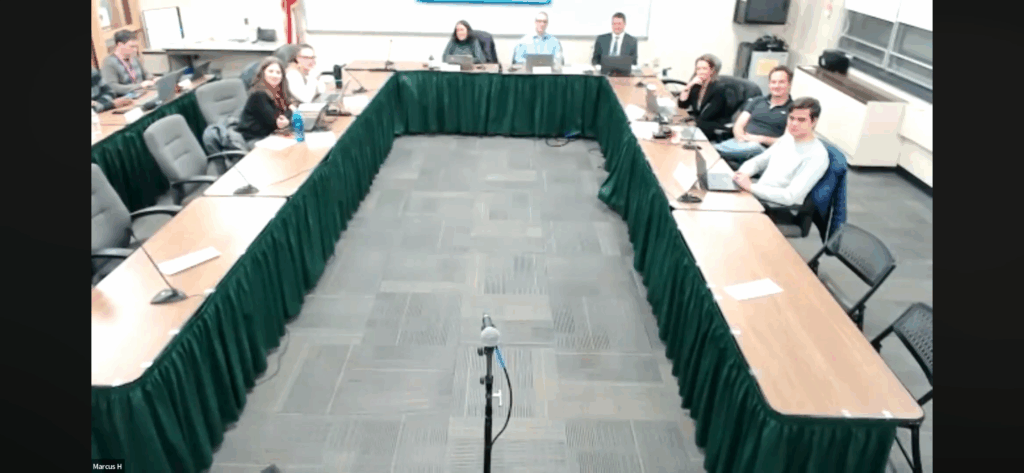
Board of education members listen to details of the budget for the 2026-’27 school year.
The township board of education discussed the ongoing process of preparing a 2026-’27 academic year budget at a Dec. 3 meeting.
Jason Schimpf is the assistant superintendent, business administrator and board secretary responsible for leading the budget preparation process. He presented several slides at the meeting of that process.
“I’ve continued to make my rounds to each of the schools to meet with their school principals and administrative teams,” he noted. “I really enjoyed those discussions, and I thought, now, consistent with our budget preparation calendar, I would continue to provide some updates at our work sessions as we move through the process here.”
As schools within the district have until Jan. 16 to justify their budget requests, Schimpf focused primarily on revenue for the meeting. He began with a rundown of the district’s tax levy analysis, which along with the budget fund balance is one of the only pieces of revenue over which the board has control.
Since there is a 2% cap on the tax levy, that would equate to an additional $4 million in revenue for 2026-’27. The average homeowner in the township would see this impact reflected in a $115 property tax increase.
The coming academic year will be the first time since the $300-million bond referendum in 2022 that residents will see a decrease in the principal and interest payments of the bonds. That would continue for the next three fiscal years, translating to a $61 decrease on the debt service side of the budget for the average homeowner.
“It’ll be a welcome relief having the ability to hopefully or potentially increase the general side of the tax levy to support our operations,” Schimpf pointed out, “while at the same time offsetting that increase with the decrease on the debt service side of things.”
The district also has about $3.3 million in banked cap – or unused taxing authority – that can be utilized for larger tax increases without a public vote. Unused funds will expire during the next academic year if left unallocated. The tax impact of the banked cap is estimated to be around $97, which would translate to a net increase of $151 in taxes on the average assessed home.
Schimpf also touched on state aid, though with a new governor taking office in January, that funding is unknown. Some of Gov. Phil Murphy’s budget legislation changes are not permanent, and governor-elect Mikie Sherrill’s plans for those have not been made public.
One of Murphy’s policies was limiting decreases in state aid to 3% and increases to 6%.
“There’s still the potential there, without those caps, that the district could be looking at another substantial state aid cut,” said Schimpf.
No definitive answer to whether those caps will remain in place will be available to the district until Feb. 26, after Sherrill approves a budget.
Schimpf also discussed the district’s fund balance and the different categories in that amount. The unassigned balance functions as the district’s savings account, estimated to be at about $4 million by the end of this school year. Schimpf estimated that in that same time, the fund balance would have about $5 million in designated revenue and $3.8 million in capital reserve, with no restricted funding in the balance.
The public hearing and final adoption of a budget for 2026-’27 will take place on April 28.

