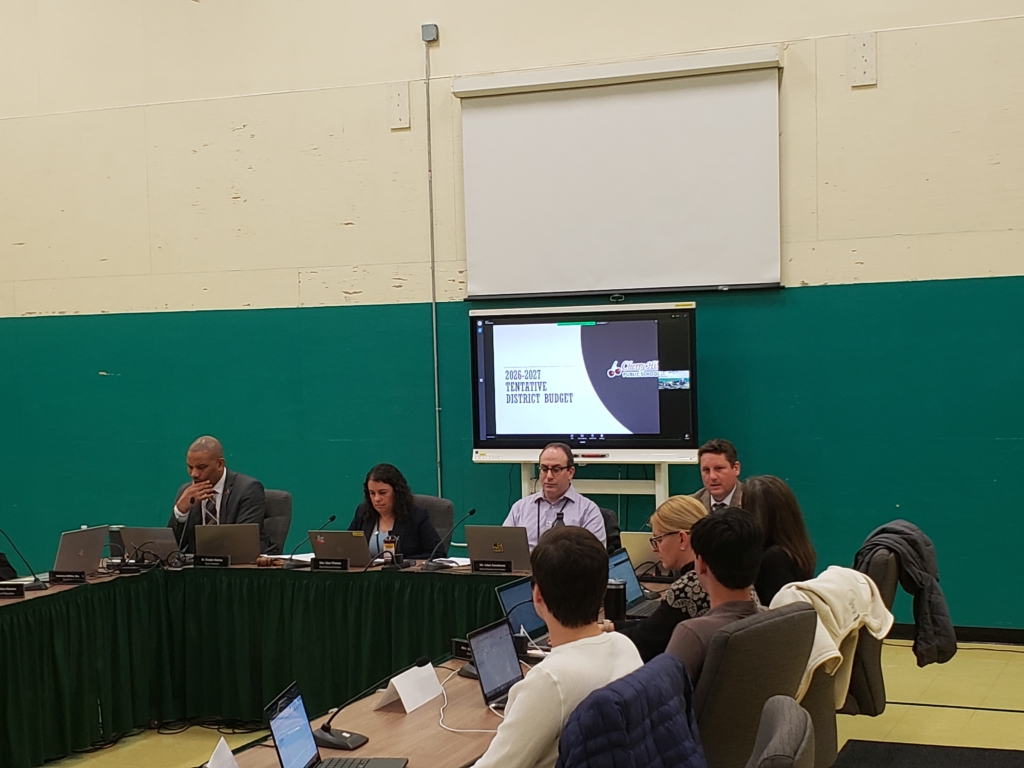
Business Administrator Jason Schimpf said at a board of ed meeting that the district started from the ground up to consider what it could cut.
The township board of education unanimously approved a tentative 2026-’27 budget at its March 24 meeting that includes a 7.4% tax increase and $14.5 million in budget cuts, including 72 staff positions.
The final budget will be voted on by the board on Tuesday, April 28.
District business administrator Jason Schimpf gave a presentation at the meeting that addressed the budget process, how the district started from the ground up and how it’s dealing with a shortfall that can’t be financed by taxpayer revenue alone.
“But one thing that became clear within the process, even before the revenues were finalized, was that we were dealing with a structural budgetary problem,” Schimpf explained. “One that’s not driven by waste or necessarily inefficiencies, but is driven by the fact that our costs, our fixed costs, the cost to provide the programs and services and things that the community and the students are accustomed to, are simply growing at a pace that far exceeds our revenue.”
The district has seen large cost increases in employee benefits; transportation; special education; and contractual salary hikes, none of which the district has much control over. While staff cuts amount to $6.5 million, another $8 million are outside of personnel.
The cuts, Schimpf added, could bring class-size increases, but because the board has yet to announce specifics, he couldn’t say to what degree. He also couldn’t elaborate on where exactly the $8 million in cuts would come from, the impact on students or the areas that would be impacted.
Board member Bridget Palmer described the tentative financial plan as a starting point, with improvements she said will come over the next month.
“We have to adopt the budget tonight,” Palmer said at the meeting. “And then it’s our job as a board to work closely with administration to make sure that when we go to final adoption next month, it’s a budget that centers our students, centers the quality of education and is something that we can all live with and look ourselves in the mirror and go to sleep at night and know that it’s the best possible scenario.”
A concern for the board is the decrease in funding from the state; the township lost 3% of that funding this year and more than $8.6 million over the past three. While Schimpf acknowledged the loss has been a factor in the district’s financial challenges, he said it isn’t the main issue.
“State aid is a contributor,” he pointed out. “It is not necessarily the driver of the situation we’re in. We’re experiencing challenges on both sides, from the revenue side and also on the expenditure side.”
Because of the proposed tax increase – and because more than 300 people watched the meeting online – about 17 residents addressed board members with their concerns and asked them to reconsider the cuts.
Marilys Coratolo, a parent and a teacher outside the district, said the schools won’t be able to maintain class sizes if 72 positions are lost.
“I’m looking for clarity on how cutting 72 full-time staff members will be possible to maintain ratios and the caliber of education and student activities that we currently offer our students,” she commented, “part of the reason I moved to Cherry Hill, brought my family here … I want to support other community members coming up saying I am against increasing class sizes.
“It hurts everyone,” she added, “especially inclusion classes and in-class support.”
Christina Musso said that the board shouldn’t be focused on expanding preschool at the expense of most of the district.
“Once again, the Cherry Hill School District is in a dire financial situation,” she elaborated, “one that asks taxpayers to absorb a significant tax increase while we simultaneously make deep cuts … At the same time, the district is expanding the expansion of preschool. Early-childhood education is important, but when resources are limited, we have to be honest about tradeoffs.
“If expanding preschool comes at the expense of our K-12 kids, then we need to reassess our priorities.”
Schimpf responded that the district did consider cutting administrative positions.
“I would say everything,” Schimpf concluded, “anything that has resources dedicated to it, every program, every line item was looked at and reviewed.”

