Medford’s Woodford Cedar Run Wildlife Refuge is a 24/7, 365-day nonprofit wildlife refuge. At the refuge, which has been in operation for nearly seven decades, there is a nature center for visitors, housing for in-need wildlife and a bustling wildlife hospital that primarily serves wild animals in the Pinelands.
Cedar Run is the busiest wildlife hospital in all of New Jersey, and 2025 was its busiest year, caring for 7,973 wild animals. Of those animals, there were about 150 to 175 different New Jersey-native species. As of early October, Cedar Run has seen more than 7,500 animals, leaving 2026 on track to potentially beat last year’s record.
Since Cedar Run is a drop-off only establishment, it has a 24-hour drop-off window where people, like local Samaritans, emergency response personnel and animal control officers, can drop off injured or in-need wild animals.
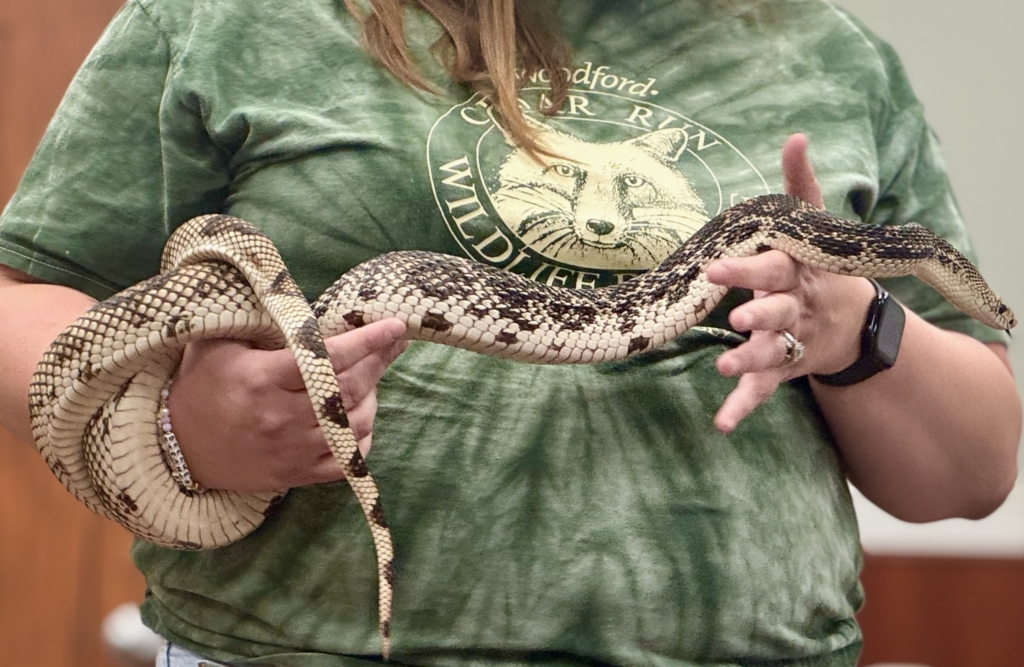
Oren, a northern pine snake, who lives at Cedar Run Wildlife Refuge.
The refuge and hospital specifically cares for wild animals. Domestic animals like cats and dogs, farm animals like horses and cows, and large animals like chimpanzees and zebras (which just should not be loose in New Jersey) are not accepted. Additionally, Cedar Run is not permitted to care for large deer, because they are considered potentially fatal animals, and bears, since there are not many in this area. They also are not permitted to have animals like beavers and bats for long periods of time, since these animals require more specialized care.
Alicia Garrett, one of Cedar Run’s educators, shared this information and more with local adults on October 8 during an educational event titled “Living with Wildlife” at Washington Township’s Margaret E. Heggan Free Public Library. The event brought in a room full of people curious about nature, wildlife and the Pinelands.
While Cedar Run’s “number one goal is to get every single animal released back into the wild,” it is not always possible, Garrett said.
“If there is an animal that we deem unreleasable, and if we have a home for them, we will definitely keep them with us at Cedar Run and give them a safe home,” she said. “If it’s an animal we don’t have space for or we don’t have the permits for, we will work within our system to find the best home for that animal.”
At its nature center, Cedar Run permanently houses about 50 animals, as they cannot survive safely on their own in the wild. Garrett said most of these animals have some kind of injury — like a bird with a broken wing that never healed properly, so they cannot fly — however, some of their animals were raised around humans, despite being wild animals, so it is unsafe for them to be released into and live in the wild.
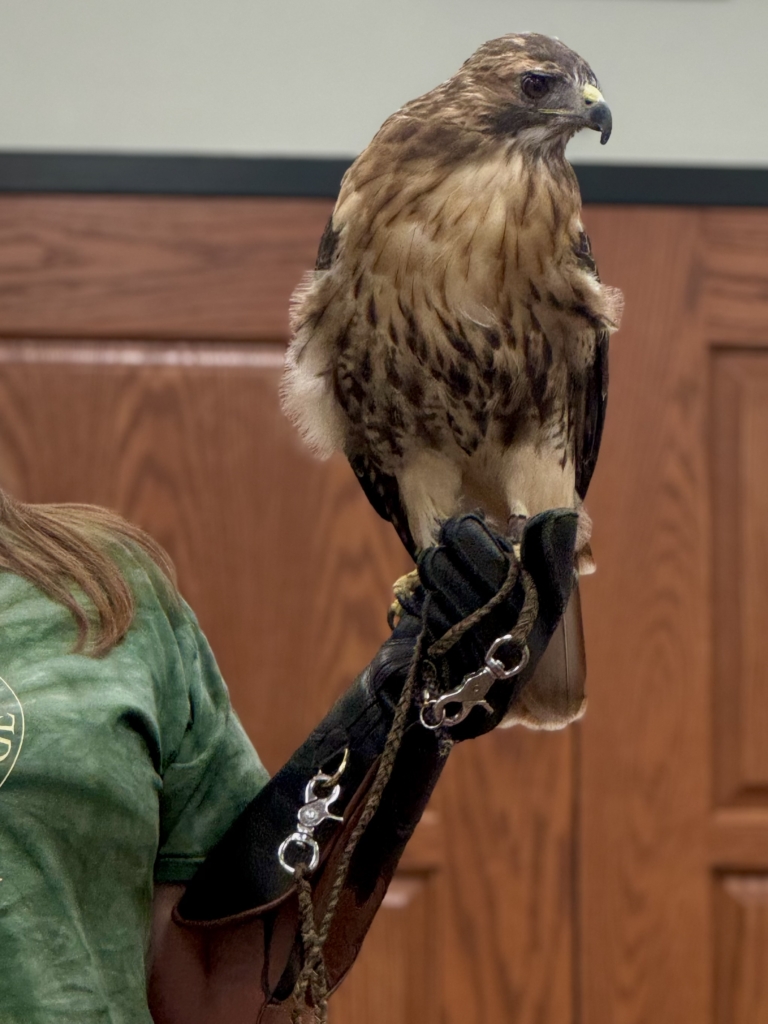
Aldora, a red-tailed hawk, who lives at Cedar Run Wildlife Refuge.
Garrett brought three of Cedar Run’s residents with her. She calls these three wild animals her “education ambassadors,” as they are frequently used for educational opportunities at the refuge and for off-site events. She showed off each animal for the group to look at, and she shared information on the species and how each specific animal ended up at Cedar Run.
First, Garrett presented Tommy, an eastern box turtle. Tommy, who is expected to be about 40 years old, first arrived at Cedar Run in 1994. He is missing a back leg, and marks in his shell also suggest to the team at Cedar Run that he has early signs of metabolic bone disease. Garrett said this disease can affect a lot of reptiles who do not meet proper dietary and lighting requirements.
Then, Garrett introduced the group to Oren, a northern pine snake. He hatched in August 2016, and he arrived at Cedar Run less than a year later in February 2017. Garrett said he was born illegally into pet trade, even though this kind of snake is not permitted to be a pet in the state.
Lastly, Garrett welcomed Aldora, a large red-tail hawk. He came to Cedar Run on Christmas Day 2001 after a car accident that left him permanently blind in his left eye. Aldora, who works closely with Garrett, was the first raptor to be glove trained for educational presentations.
Garrett also had a spread of wildlife artifacts on a table for attendees to hold and observe, which were a hit. The attendees also enjoyed participating, asking questions and sharing personal stories with wildlife throughout the event.
“At the library, we try to offer many different types of programs to adults at in the hopes that we can accommodate the many different interests of our community,” said Jacob Crofoot, an adult services librarian who has been at the library for two years. “The last time Cedar Run came, (the) event was for children. But I find that the interests you foster early in life, will generally follow you into adulthood.”
“During the program, many of the patrons added stories from their experiences, especially from their childhoods, of seeing some of the species (the box turtles especially),” he continued. “I think it’s important to foster that curiosity, especially as adults. And sharing these moments with each other really helps the community to grow and connect.”
For more information about Cedar Run, go to www.cedarrun.org. For more events at Margaret E. Heggan, go to www.hegganlibrary.org.
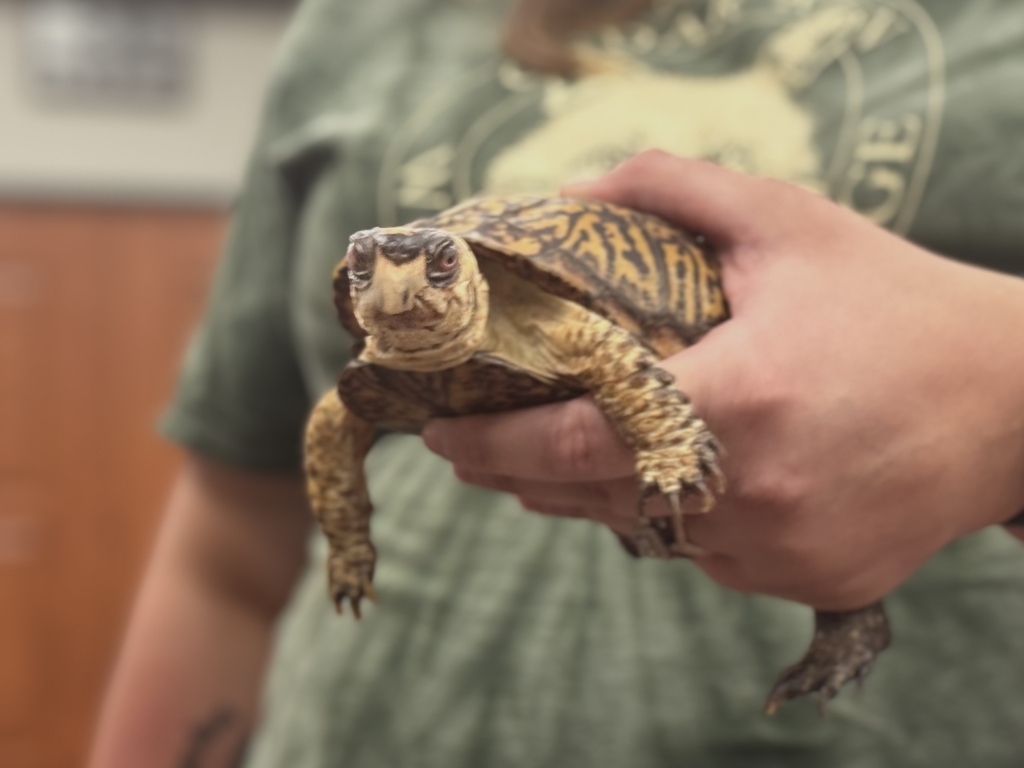
Tommy, an eastern box turtle, who lives at Cedar Run Wildlife Refuge.

