One animal’s story demonstrates care and compassion when people come together to help the voiceless.
Snow, a blue-eyed Siberian husky, arrived at Mount Laurel Animal Hospital earlier this summer with traumatic facial injuries believed to have been caused by a severe bite wound. The trauma had left extensive damage to the right side of her face, including tissue surrounding her right eye. The wounds had become significantly infected, and the extent of tissue loss raised serious concerns about whether reconstruction would be possible.
“It’s rare that the eye is the only piece of the puzzle; you have to consider the whole patient,” said veterinary ophthalmologist Dr. Andrew Enders. “She had such extensive injuries in itself, and then the sequelae (after-effects of a disease, condition or injury) of those injuries with the infection really put her at risk, and it is always difficult when you have an idea of what could be done versus what is actually possible.”
Once stabilized, Snow underwent anesthesia so the full extent of her injuries could be assessed. Veterinary surgeon Dr. Katie Heidgerd determined that reconstruction was possible despite the severe damage. The degree of the infection, the exposure to different bone structures and the sensitivity of Snow’s eye being involved were extreme in nature, Enders explained, all of which could impact her adoptability.
“The cosmetic outcome of the case is secondary to the pet doing well and returning to full function,” Enders noted. “The loss of an eye or the loss of vision on one side may also tie a role into what is the adoptability of (a) pet? Is (the) pet going to be looked over by potential future owners? …
“The goal was not only to get (Snow) through this crisis but ideally to set her up for a future with a home that’s going to care for her indefinitely.”
The injury extended into tissues surrounding Snow’s eye, making collaboration between specialties essential. Enders joined the surgical team to help preserve ocular health, eyelid function and long-term comfort. He and Heidgerd developed a complex reconstructive plan utilizing advanced surgical techniques designed to rebuild the damaged side of Snow’s face.
Her eyeball had been spared from the entirety of the injury, but intervention had to be both substantial and acute in nature, according to Enders.
“The goal was never simply to close a wound,” Heidgerd noted. “Our objective was to restore comfort, preserve function and give Snow the best possible quality of life moving forward. Cases like this require careful planning, because every decision can impact healing, appearance and long-term function.”
During Snow’ surgery, infected and non-viable tissue was carefully removed while healthy tissue was preserved. Using an advancement flap reconstruction technique, healthy tissue was mobilized and repositioned to fill the defect while maintaining critical blood supply. With skin flapping, the goal is to return not only the form but also the function, Enders added.
Throughout the procedure, special attention was given to minimizing tension across the surgical site, preserving delicate structures surrounding the eye, and restoring the natural contours of Snow’s face. The procedure represented a collaborative effort that involved surgery, ophthalmology, anesthesia, emergency medicine and nursing teams.
With the facial reconstruction surgery, they all trusted each other’s judgement but knew where their own limitations existed, Enders explained.
“You have to know where your own limitations exist, where you can say, ‘This is the part that I can contribute to the equation, but it’s not the whole equation,'” he pointed out. “It will be (us) all together doing this and each adding in (our) own individual experience to add to the mix,” Enders said.
Following surgery, Snow entered a closely monitored recovery period. To protect the reconstruction and support healing, a closed suction drain was placed, and she wore a protective Elizabethan collar. Veterinary nurses and clinicians carefully monitored comfort, incision healing and overall progress.
Throughout the healing process, swelling decreased, tissues healed appropriately and the reconstruction remained healthy. The surgical team successfully preserved Snow’s eye and maintained eyelid function, allowing her to retain comfort, ocular protection and a natural facial appearance.
“What makes cases like Snow’s so rewarding is seeing the transformation,” Heidgerd related. “When she first arrived, the injuries were severe and the future was uncertain. Watching her heal and regain comfort reminds us why collaborative specialty medicine is so important.”
Snow is currently up for adoption through Homeless to Home Husky Rescue, whose mission is to save huskies and other northern breed dogs in shelters or surrendered by citizens to find forever homes. The organization works with shelters in Pennsylvania as well as other states.
Snow is described as affectionate, sweet and docile, and judged a great companion who would be compatible with kids and other dogs, but above all, she’s resilient and has an infectious enthusiasm for life. More information on Snow and other huskies up for adoption through the organization can be found at www.hthrescue.org.
“Snow has shown us incredible resilience every step of the way,” stated Sharon Fritz, president of Homeless to Home Husky Rescue. “Now we are hoping someone will see what we see, a wonderful dog who deserves a family of her own. Watching her overcome so much has been inspiring, and we can’t wait to see her start the next chapter of her life in a forever home.”
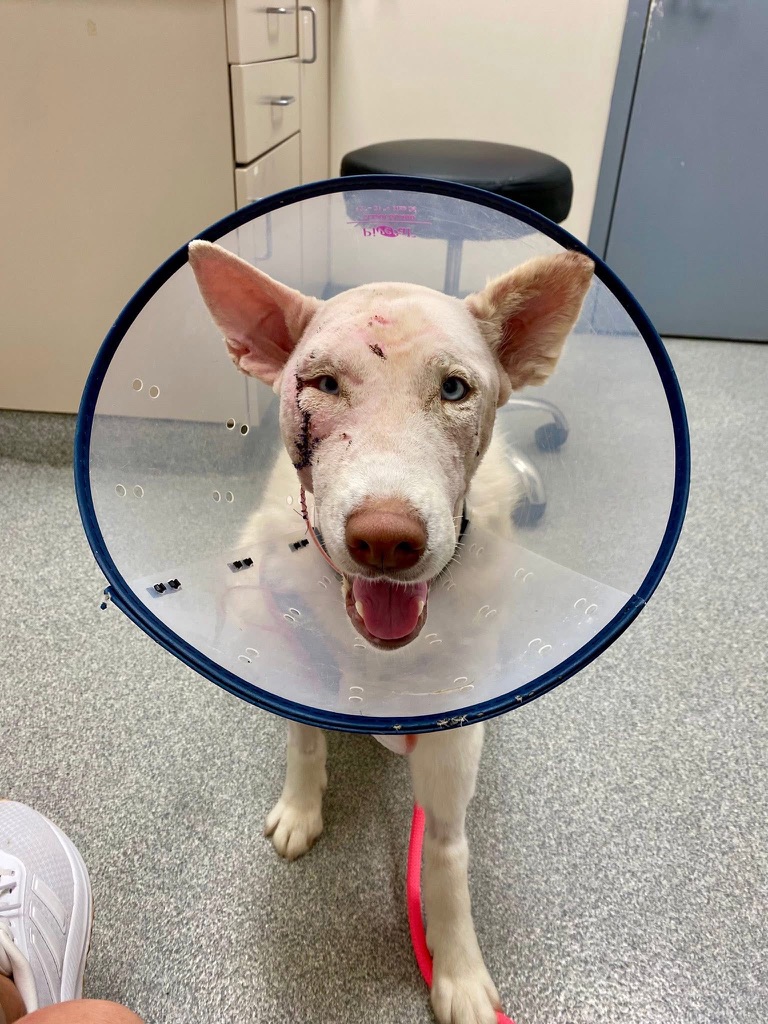
Snow, a Siberian husky, arrived at Mount Laurel Animal Hospital earlier this year with traumatic facial injuries believed to have been caused by a severe bite wound. Her facial reconstruction surgery was a collaborative effort that involved several doctors.
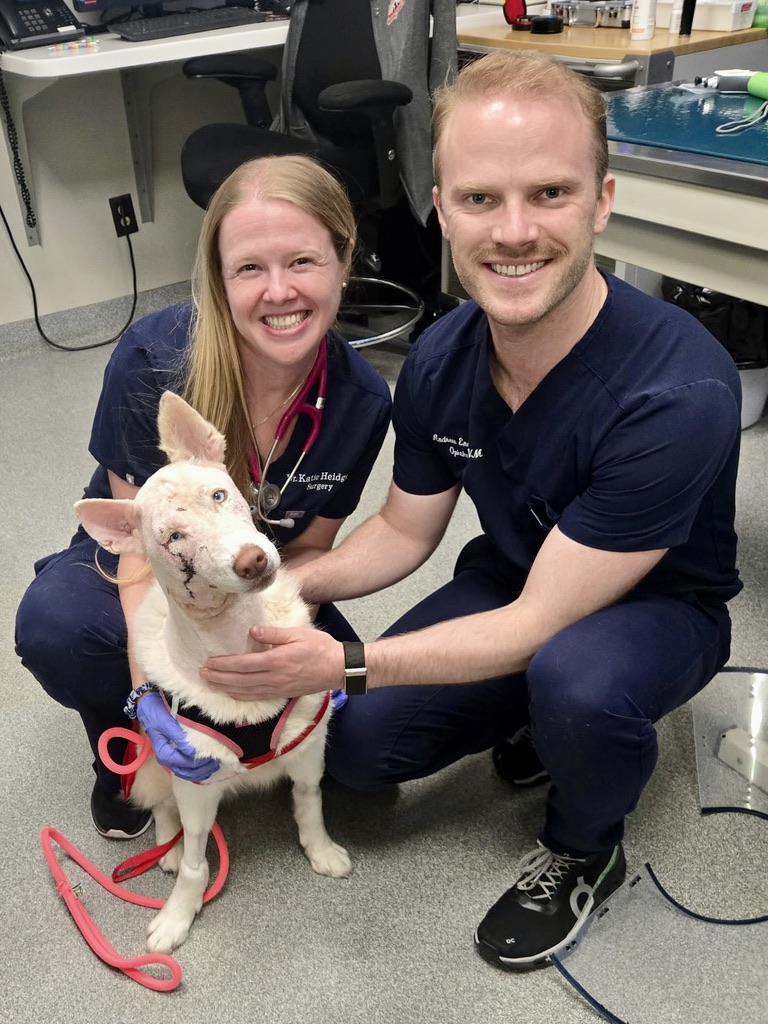
Snow pays a visit to Drs. Katie Heidgerd and Andrew Enders, who helped with her recovery.

