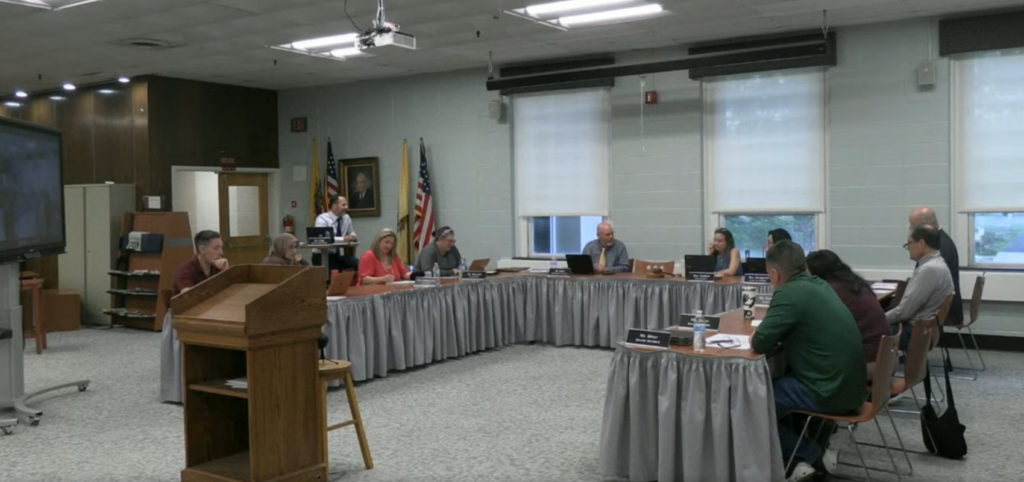
The Haddonfield Board of Education discussed earlier this month what it’s 2027-’28 and 2028-’29 calendars will look like after getting feedback from the community.
The 2026-’27 calendar is already in place, so the board didn’t discuss any changes to it. Superintendent Chuck Klaus addressed some of the data his board team collected, as well as sample calendars that included versions with no religious holidays.
They board got 109 emails of feedback – 20 from its members, administration and staff and 89 from families – including messages that thanked the board for seeking feedback and offered calendar suggestions for 2028-’29. Among issues is a policy that states if the district doesn’t take a holiday like Rosh Hashanah off, the custodial staff nonetheless can’t work that day and the district would have to pay more for maintenance.
While there was disagreement over the start date of school, a majority of survey respondents suggested spring break the week after Easter and a compromise on what holidays to include.
The arguments for and against having school start either before Labor Day – meaning the year would end sooner in June – or after Labor Day revolved around ending the year earlier to align with summer camps pre-Labor Day, or making summer longer post-Labor Day.
Several respondents independently reported that they would accept the school year starting early if it meant a longer spring break. As for holidays, while some wanted to be inclusive by having more of them, the majority opposed adding any because of school disruptions and child-care issues.
There were also complaints in the survey that in previous board talks about the calendar, Passover did not come up, given it’s a holiday without a fixed date. Klaus also proposed two snow makeup days, Feb. 21 and Feb. 18., with the professional development day scheduled for the latter moved to spring break.
There has also been some discussion at the state level about a bill that would create a uniform standard for spring break dates across the state. Klaus explained that such a bill would most likely be a recommendation and not a requirement.
Board vice president Linda Hochgertel wanted to know if scheduling random winter and spring breaks would mean earlier dismissal. Klaus responded that it would mean school ending in the first or second week of June, something for which Hochgertel and board member Stephanie Benecchi expressed support.
Board member Megan Hollingworth wanted to know how excluding religious would impact teachers. Klaus answered that Jewish teachers, for example, tend to take personal days to celebrate their holidays.
“If you were going to say we’re going to put a non-religious spring break in,” the superintended said, “you would still drop it around Easter, because that’s a child-care issue for staff.”
Klaus said it’s important to keep in mind that too many consecutive days off in a row could interfere with instruction.
“There’s such an imbalance in how we do this,” he observed. “So how do kids build stamina in this, right? Because they’re break, break, break, break, break – and then all of a sudden, we look at this stretch here.”
In the end, Klaus recommended that school start either the third week in August or earlier to give students more time to study and prepare for college admissions that are happening earlier each year.
“Our kids are taking U.S. History AP … at the same time as some guy in Texas is taking it,” Klaus pointed out. “They start in school Aug. 4. That’s a month more to study for the test. Same thing with NJSLA testing: We get more time on that.
“If you got in two weeks before Labor Day and you had your guidance counselors available to you, that’s a significant difference in prepping there.”
The board agreed to further discuss the calendar and put it to a formal vote either next month or in July.