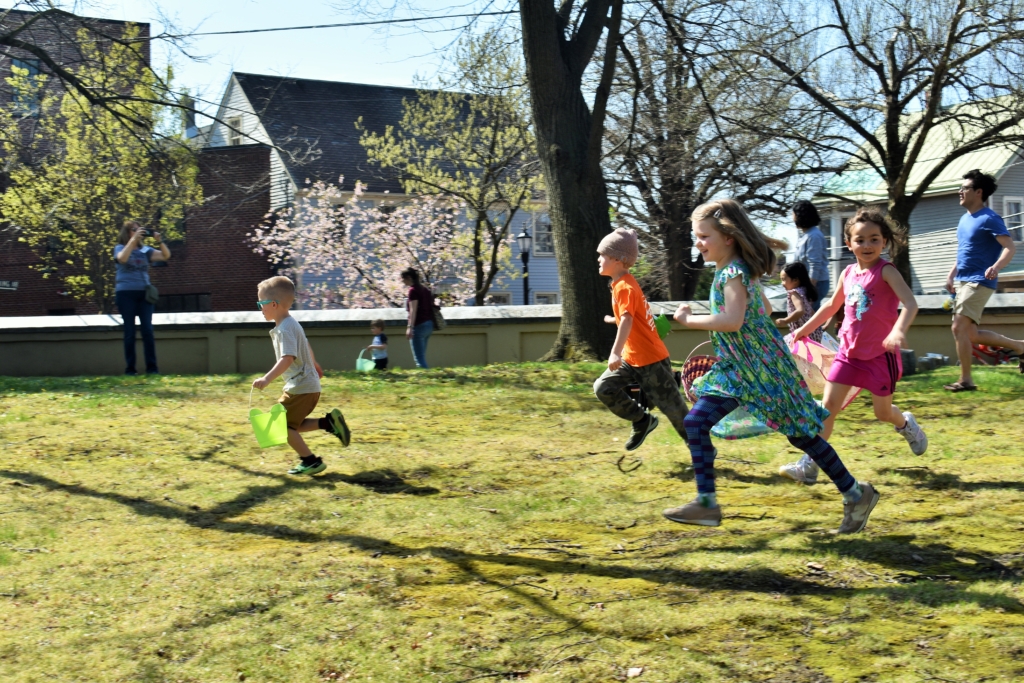
Enthusiastic kids raced into the Friends’ graveyard to find about 300 plastic eggs during the organization’s Easter egg hunt on April 4.
In the heart of the busy, bustling downtown, the Haddonfield Friends Meeting graveyard is a serene space for quiet reflection.
But on the warm morning of April 4, the sun was bright through ancient trees and the burial ground came alive with the sounds of excited children looking for Easter eggs.
“This is our first Easter egg hunt open to the public,” said Friends’ clerk Ty Drago, who – with volunteers Jeannine Powers, Annabridget O’Connor, Linda Lotz, David Biehl and Deirdre Gavel – hid hundreds of eggs across the hilly grounds of the 300-year-old graveyard.
“We’re having a little problem with the squirrels taking the plastic eggs,” Drago admitted as he watched more than 100 children and guardians arrive for the hunt. “We decided to hold the Easter egg hunt as a celebration of new life, re-birth and the beginning of spring, and to remind the community that we are here.”
“I’m excited,” Quaker Linda Lotz said. “It’s a beautiful day. We used to do egg hunts for the children at the Meeting on Easter Sunday. This year it is open to the community.”
The registration table was at the Haddon Avenue entrance to the graveyard, which abuts the borough fire station. The oldest grave there is that of Anthony Sharp, who was buried in 1697 and was the older brother of the county surveyor Thomas Sharp, Drago offered.
“I was born and raised in Meeting,” he recalled. “We have been Quakers for many generations, and I’m probably related to one-quarter of the people in the graveyard.”
Powers was also the organizer of the event, where she gathered all the children – baskets and buckets in hand – and instructed them before the hunt. The youngsters then screamed excitedly as they scattered across the grounds looking for eggs, continuing a tradition started by Martin Luther in the 16th century.
The founder of the Lutheran Church in Germany, the Protestant reformer organized egg hunts for his congregation. The men would hide the eggs for the women and children to signify that the empty tomb of Jesus was discovered on Easter morning by three women, including Mary Magdalene.
In many pre-Christian societies, eggs held associations with spring and new life, and early Christians adapted these beliefs, making the egg a symbol of the resurrection.
“To Quakers, every day is special,” Lotz explained, adding that the Meeting likes to have non-competitive activities for children. “This is more cultural. It is a sign of spring coming and new life.”
Drago was thrilled by the turnout.
“We have planted a seed and it has taken root,” he said.
It’s hard to say if any of the children were thinking of the history behind the hunt, but they were obviously looking forward to the treats and surprises in the plastic eggs. The older ones raced all the way down the hill toward the Meeting House, while the youngsters stayed close to Haddon Avenue and smiled every time they found another egg.
Parts of the Friends Meeting graveyard are known to local children who sled there, Lotz noted. The gravestones are low and modest, with earlier Friends’ names and dates.
The first Haddonfield Friends Meetinghouse was a log cabin built in 1721 on land gifted by John Haddon, now the site of the fire station. During the Revolutionary War, the Friends property was used to treat the wounded and the graveyard became the final resting place for many soldiers in unmarked graves.
For information, visit haddonfieldquakers.org.
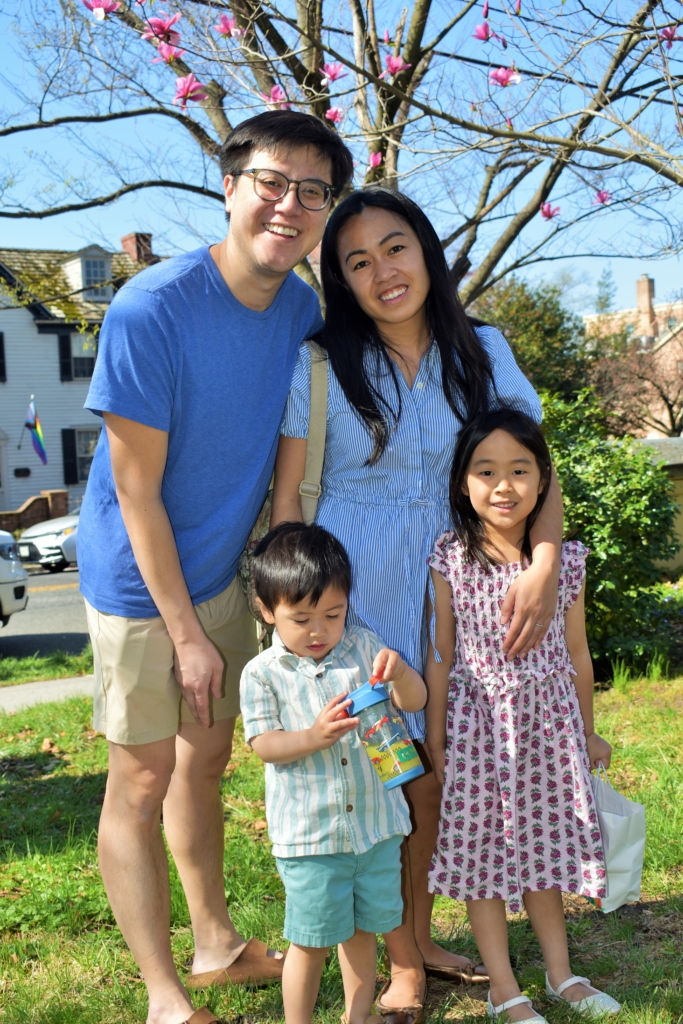
Waiting for the event to begin were Benjamin Lee, Melanie Soriano, Audrey Lee and Oliver Lee.

