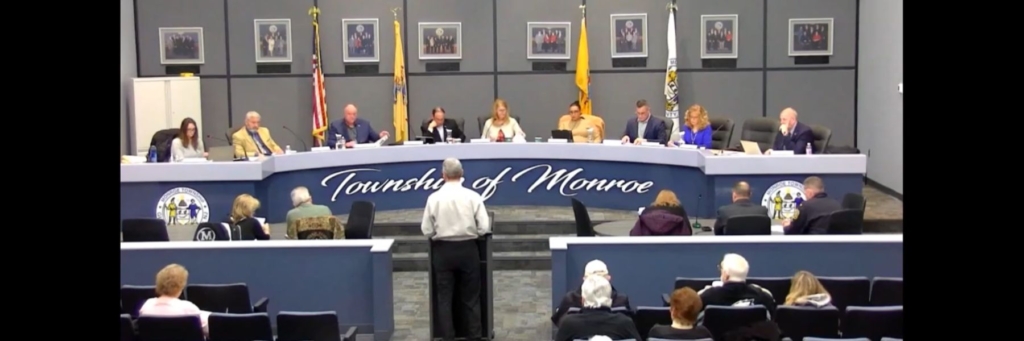
Joe Henry gave his annual safety presentation to township council during its meeting on Feb. 25.
Joe Henry of Hardenbergh Insurance Group gave his annual “safety on the agenda” presentation during the Feb. 25 Monroe council meeting.
This year’s topic was the importance of public safety with regard to service dogs and emotional support animals. To illustrate that, Henry used the example of a wolf belonging to an unidentified man in Wildwood who brought the animal onto the city’s boardwalk last August.
“Now we all know there are good wolves and there’s bald wolves,” Henry said. “And there’s places the bad wolves aren’t allowed to go, and the Wildwood boardwalk is one of those places. As a result of this, people saw the wolf and, obviously, caused a skirmish.”
To avoid a similar situation, Henry laid out for council what classifies as a service animal: It is defined as one trained to perform certain tasks to help someone with a disability.
“Some of the examples of tasks that they will perform is that they can guide blind people,” he explained, “alerting people who are deaf, to pull a wheelchair. They can help people with PTSD, and one of the most amazing things I’ve come to find out is that they can … alert and hopefully protect a person that’s going to have a seizure. They can sense it come on.”
Such animals have legal rights, while their owners are federally protected under the ADA (Americans with Disabilities Act), according to Henry. The pooches are officially recognized as medical equipment in these cases and can enter most places where they are not normally permitted. Exceptions include a medical environment, inside a swimming pool – though the animals are permitted on the deck of one – a boarding school that has rules to protect people who may be allergic, and a zoo.
“There are only two things you may ask if you have suspicion about a service animal,” Henry noted. “Is the dog a service animal, required because of a disability, and what work or task has that dog been trained to perform?”
There are also questions an animal’s owners can’t be asked.
“The nature of a person’s disability for a demonstration of a task, for certification, licensing or identification card (for the dog),” Henry outlined. “No such thing exists. There’s nothing that they carry that says this is a trained service dog. Typically, they’ll all have those jackets on identifying them as service dogs. And how and when the dog was trained.”
The handlers must ensure their animal stays near them at all times and they can be responsible for any damage a dog may cause.
Emotional support animals, meanwhile, are not classified as service animals. They don’t assist with tasks and their public access rights are not covered under the ADA. They are covered under the Fair Housing Act (FHA), in which case a letter from a mental-health professional would be required for the animal’s acceptance in certain housing situations.

