“Measure your life in love,” a famous lyric from the song “Seasons of Love” in Jonathan Larson’s musical “Rent,” is a line Ana Catarrivas, a Marie Kondo master certified professional home organizer, lives by.
It also is a message she tries to instill in her clients and attendees of her decluttering workshops. She wants people to know that the most important things in life are love, memories and experiences.
Catarrivas, who has lived in Princeton with her husband and three children for nearly 10 years now, used that quote to open her presentation titled “Simplify and Downsize: Declutter Your Home with Care and Joy” at Margaret E. Heggan Free Public Library in Washington Township on September 24. The talk drew in a predominantly senior crowd, which is typical for Catarrivas’ presentations and services; however, her advice spans across generations.
“I always tell my seniors that when you look back – decades of life behind you, and hopefully decades of life coming to you in the future – we need to measure that time in love. Everything that has moved us and all these experiences…we are grateful to have enjoyed,” she said, stating that we are grateful for the actual experiences and memories, not the objects we have.
Catarrivas, whose professional organizer company is coined as Tidy Nerd, has spent more than 1,700 hours tidying people’s homes. She uses the KonMari Method, a tidying and home organization technique from famous Japanese professional organizer and author Marie Kondo, who gained popularity back in the early 2010s.
Kondo has become an influential force when it comes to organizing, tidying and decluttering, a skill that many people struggle with in their day-to-day lives. One of Kondo’s most notable pieces of advice for decluttering is asking yourself if an item sparks joy. This message is a thread throughout her work and, thus, the work of Catarrivas and hundreds of other organizers across the globe, as well.
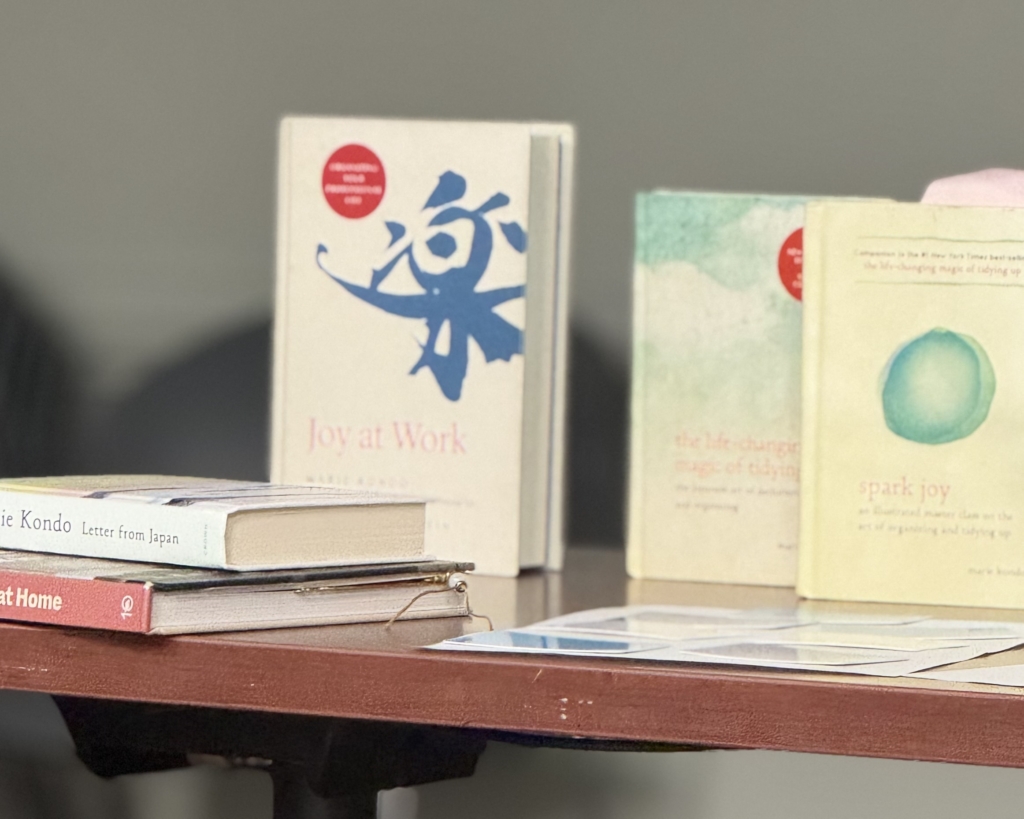
A few of Marie Kondo’s books on tidying and organization.
Catarrivas shared the main methods found within Kondo’s several books to the presentation attendees, as well as her own personal experiences with tidying.
The basics to the KonMari Method are the following: commit yourself to tidying, imagine your ideal lifestyle, finish discarding first, ask yourself if it sparks joy, focus on your items first, tidy by category not by locations, and let go with gratitude.
“Like any change you want in your life, you need to commit to it,” Catarrivas said. Committing to what you want is also part of imagining your ideal lifestyle and living space, as you can only reach that ideal space with commitment and intentional work.
Additionally, the KonMari Method suggests working in the following order: clothing, books, papers, Komono (miscellaneous) and sentimentals. This order naturally moves in an easiest to toughest fashion, with the ability to learn how to be comfortable making decisions by the time you reach more meaningful items.
“You decide what you want, not what you might need (or) maybe or sometimes (need),” Catarrivas said. “It is what you like…(and what is your reality).”
Discarding, Catarrivas said, is more about decision-making rather than tossing things in a dumpster. It is the process of deciding if the items you own are making you happy and serving a purpose, then deciding what to do with it. For items you decide to get rid of, discarding can mean making a pile of things to donate, sell or pass on to loved ones. Sometimes, discarding can mean just throwing it away, too.
And now, discarding is about getting rid of things that may have served you or brought you joy in the past, but no longer does. Catarrivas used a personal example to better explain this.
She said she used to own around 25 pairs of heels before she decluttered her own home. Back when she worked in an office where heels were part of her daily attire, it made sense to have multiple pairs. However, now she rarely ever needs or wants to wear heels, even though there are still some times where a part of her feels like she needs to keep them. For her current life, it makes the most sense to only keep one pair and discard the rest.
On the flip side, another woman may be a new mom who is returning back to work, so she may no longer need 25 pairs of sneakers for casual days out, but rather needs to get back into making space for heels for the office.
“This is just an example of how it really needs to suit you,” she said.
In addition to asking yourself if an item sparks joy, Catarrivas said it is important to only focus on your own belongings when you are first decluttering.
“You can only decide on your items. We’re not going to make decisions on someone else’s items, she said. “It will damage your relationship – and again, we value our relationships more than our stuff, right?”
She went on to share how she has seen this mistake happen, and it just causes a cycle to repeat rather than dissipate. Someone may throw out something their husband hoards or collects, but he will just end up going out and buying more of whatever was tossed.
“There’s not a conversation there. There’s no gaining progress. There’s just an invasion of the person’s right to make their own decisions,” she said.
A “crucial” point Catarrivas made is tidying by category, not location. She said that tidying by room or shelf is a mistake that can lead you just working in circles.
Instead, she and Kondo recommend gathering all of the same categorized items across the entire home, putting them in one place, then organizing them. For example, she said you can gather all your towels – bathroom, kitchen, beach, holiday, etc. and go through them all together, not by where they are stored in the home. You then can evaluate how many towels you actually need by considering things like how many people live in the home daily, how many do you actually need and how often do you actually use them.
Lastly, and one of the most important points, is learning to let go with gratitude.
“Being grateful for an item that is no longer serving a purpose really eases the guilt of discarding it,” Catarrivas said.
She emphasized that we often feel immense guilt over discarding items we have not “used” enough or something we have not “gotten our money’s worth,” though it is okay to still get rid of something if it is no longer needed or serving us. It staying in the home is offering more of a hindrance than help.
“You don’t need to punish yourself by spending the money (on the item) and also having to look at it all the time. So we are going to let it go by appreciating what we have learned,” Catarrivas said, using the example of a woman who recently told her she felt guilty getting rid of an expensive hair product, even though she hated it.
“First of all, we (learned) we don’t like this brand; it doesn’t work for us. I thought it did at the time, which is why I decided to buy it. I am not a crazy person; I thought I was making a good decision. It turned out I didn’t, so I’m going to accept that and say ‘thank you’ and let it go,” she said.
Decluttering and downsizing are not easy things, but there are ways to learn how to do it in a way that works for you. Kondo’s books are readily available at libraries in the area and there are resources available online.
Additionally, Catarrivas, who was born and raised in Mexico City and moved 23 times in her life before settling down in Princeton, regularly offers talks, workshops and services in New Jersey. Recently, she shared a similar presentation at the Mount Laurel library; she currently teaches courses at the Princeton Adult School and hosts online workshops on decluttering and digitizing photos and files.
For more information on her events and personalized services, go to www.tinynerd.com.
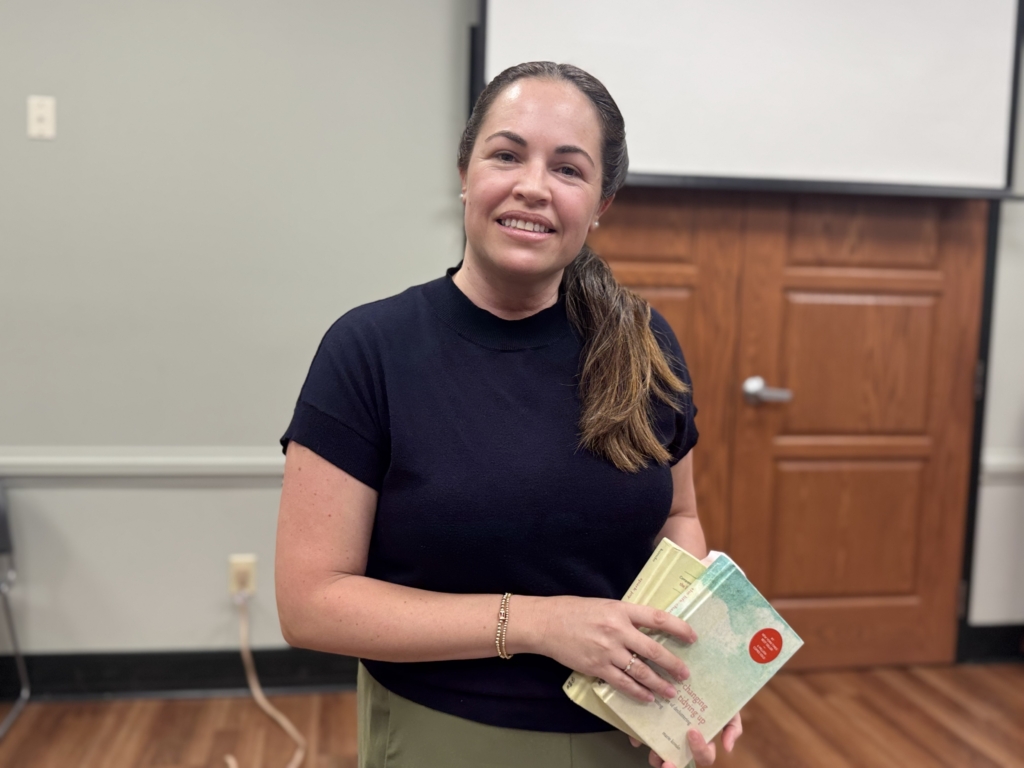
Ana Catarrivas, a Marie Kondo master certified professional home organizer, at her decluttering presentation at Margaret E. Heggan Free Public Library in Washington Township on September 24.

