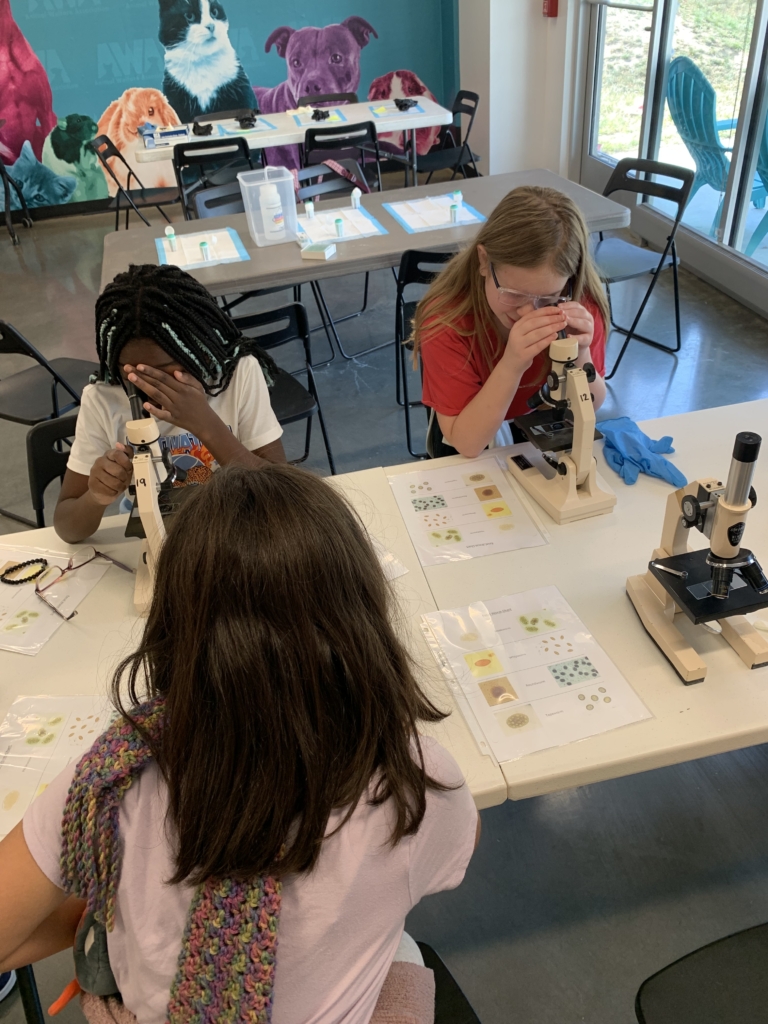
Students explored animal-focused STEM activities during the Animal Welfare Association’s recent STEM Day, including building sturdy enclosures for toy dogs and creating plates of safe and unsafe foods.
The Animal Welfare Association brought science to life on Nov. 15, as students in grades K–12 took part in the organization’s first Interactive STEM Day, a hands-on educational experience designed to blend science, engineering and animal welfare into one immersive learning experience.
Held at the AWA’s Voorhees location, the event featured multiple activity stations where children explored veterinary medicine, animal nutrition, engineering concepts and animal behavior through an animal-focused STEM lens.
For Kendyl Fauscette, the AWA’s education programs manager, the idea for STEM Day grew from a desire to create a program that went beyond the organization’s beloved “fun-ducation” activities.
“ … We wanted to create a program that, while still fun, is more education focused,” Fauscette explained. “STEM is becoming widely popular, and we knew we could take a different approach to it by relating all the topics back to animals. Vet medicine, animal nutrition, and animal behavior are all science-based areas of study …
“There is so much to be learned from and about animals in the world of STEM.”
Fauscette emphasized that STEM Day impacts the the AWA’s mission of promoting animal welfare and education.
“STEM Day supports AWA’s mission by allowing us to directly educate and impact the next generation of animal advocates,” she noted. “We are accessing a child’s empathy and compassion at a young age … A more empathic, compassionate and educated pet owner will ensure their animals have the best care and potentially be less likely to surrender their pet back to the shelter system.”
By connecting scientific learning with real-world animal care, the AWA hopes to create informed, compassionate future pet owners and even inspire some students to pursue careers in veterinary medicine or related fields.
Designing STEM stations for students ranging from kindergarteners to high-school seniors required significant preparation.
“The planning process is extensive,” Fauscette said. “Our lesson topics aren’t typically taught in schools, which means we’re starting at a base level of knowledge that is similar across grade levels.”
Sessions were divided into K-to-5 and 6-to-12-age groups, allowing each station to deliver appropriate content while exploring big-picture STEM concepts. Among the most popular was the engineering enclosure-building activity, where students constructed homes for toy dogs after learning about animal engineers like beavers, spiders, and honeybees.
“The goal is two-fold,” Fauscette pointed out. “Students must flex their engineering skills to build an enclosure that is sturdy while tapping into their compassion to decide how much space to give the dog and what other features to include.”
At the nutrition station, children learned to distinguish safe from unsafe foods, a lesson Fauscette said is crucial for young pet owners.
“Learning about safe and unsafe food for pets can be lifesaving,” she observed. “Teaching this information in a fun and accessible way means students can take home this valuable lesson and incorporate it into their daily lives.”
The veterinary medicine station was a crowd favorite. Students used microscopes to study parasites, practiced suturing using felt and plastic needles and took on the role of budding veterinarians.
The hands-on nature of the activities also gave students a realistic look at careers in animal care.
“Vet medicine and animal care, while incredibly rewarding, can be gross, emotionally taxing and physically draining,” Fauscette said. “Hands-on activities give students a more realistic look at working with animals so they can properly decide if this field is for them.”
The AWA’s goal extended beyond teaching STEM facts.
“I hope students walked away from the AWA’s STEM Day with a deeper understanding of animals and the important role we as people play in caring for them,” Fauscette related. “If we were able to spark their empathy and inspire a genuine sense of compassion towards animals … that’s when I feel we’ve truly made an impact.”

