By Tony Klock, CU Maurice River
The male summer tanager is a brilliant red. It is sometimes confused with a scarlet tanager, which has dark black wings and a thicker and stouter bill than the smaller, more delicate bill of a scarlet tanager. All photos by Tony Klock
Cumberland County, New Jersey is fortunate to feature a variety of landscapes which provide habitats for many species of birds and other wildlife. Our Delaware Bayshore beaches are renowned for the annual horseshoe crab spawning, providing a critical food source for migratory shorebirds en route from South America to the Arctic for breeding. Cumberland County’s extensive saltwater marshes are also home to a multitude of wading birds like herons, egrets, and railbirds. Along with the waders in the marshes are other birds like sparrows and waterfowl as well as raptors like ospreys and eagles.
Moving inland, one encounters the upland forests of primarily oaks and pines as well as other deciduous hardwoods. Down Jersey’s many forests provide critical habitat for breeding songbirds such as warblers, thrushes, sparrows, and flycatchers; many of these migrate here from elsewhere to mate and rear young. Every spring the woodlands ring with the musical calls of songbirds, including the summer and scarlet tanagers. Like many of our breeding songbirds, the tanagers are neotropical migratory birds, which means that they spend part of the year here in New Jersey but most of the year in migration or on their wintering grounds in central or South America. The summer tanager is one of the more sought-after of the species for people birdwatching in our county.
Until 2009, both tanager species occurring in our region were classified as true tanagers, in the family Thraupidae of the Order Passeriformes, or perching birds. However, modern DNA studies have indicated that the North American tanager species of the genus Piranga are actually more closely related to cardinals and other grosbeaks than to the New World tanagers. One example of this is the striking summer tanager (Piranga rubra). More often heard than seen, the summer tanager’s clear sing-song, oriole-like vocalizations contrast with the scarlet tanager’s hoarse “robin with a sore throat” song. The easiest way to differentiate the two is by their chip calls. Both male and female summers readily vocalize the “pickytuck” call as opposed to the scarlet’s “chik-bur.” Males will sing from high up in the canopy, seeking to attract a single mate and establish territories.
Summer tanager is more robin-sized and vividly colored. Males are solidly red whereas females’ plumages range from pale yellow to a slightly pale green. Adult summer males do not molt to a nonbreeding plumage like the scarlet does. Summer tanagers also lack the dark wings and bill of scarlet tanagers. The summer’s stout pale bills are broader and more blunt. Summer tanagers feed mainly on bees, wasps, cicadas, moths, and other invertebrates which they capture in flight. They will also glean insects from leaves and branches, and will often beat their prey against a branch and remove any stingers before consuming them. In addition tanagers will feed on fruits and berries from native trees and shrubs, particularly during migration.
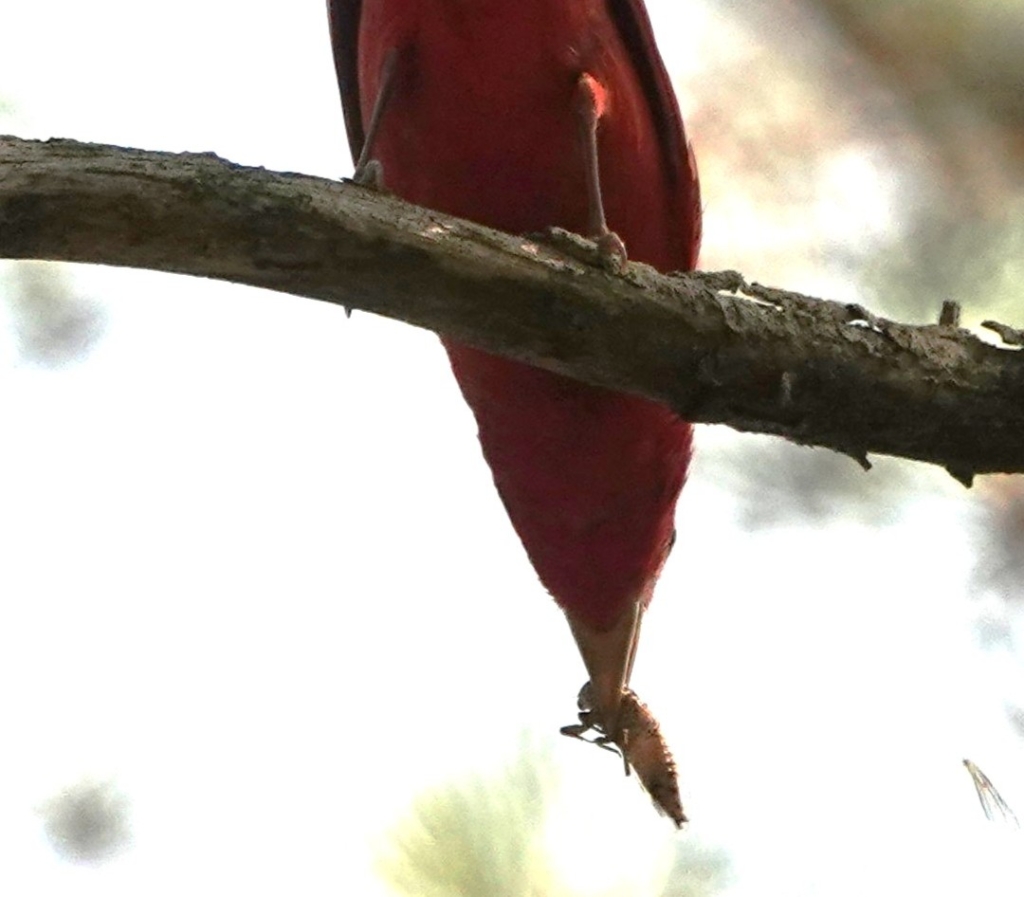
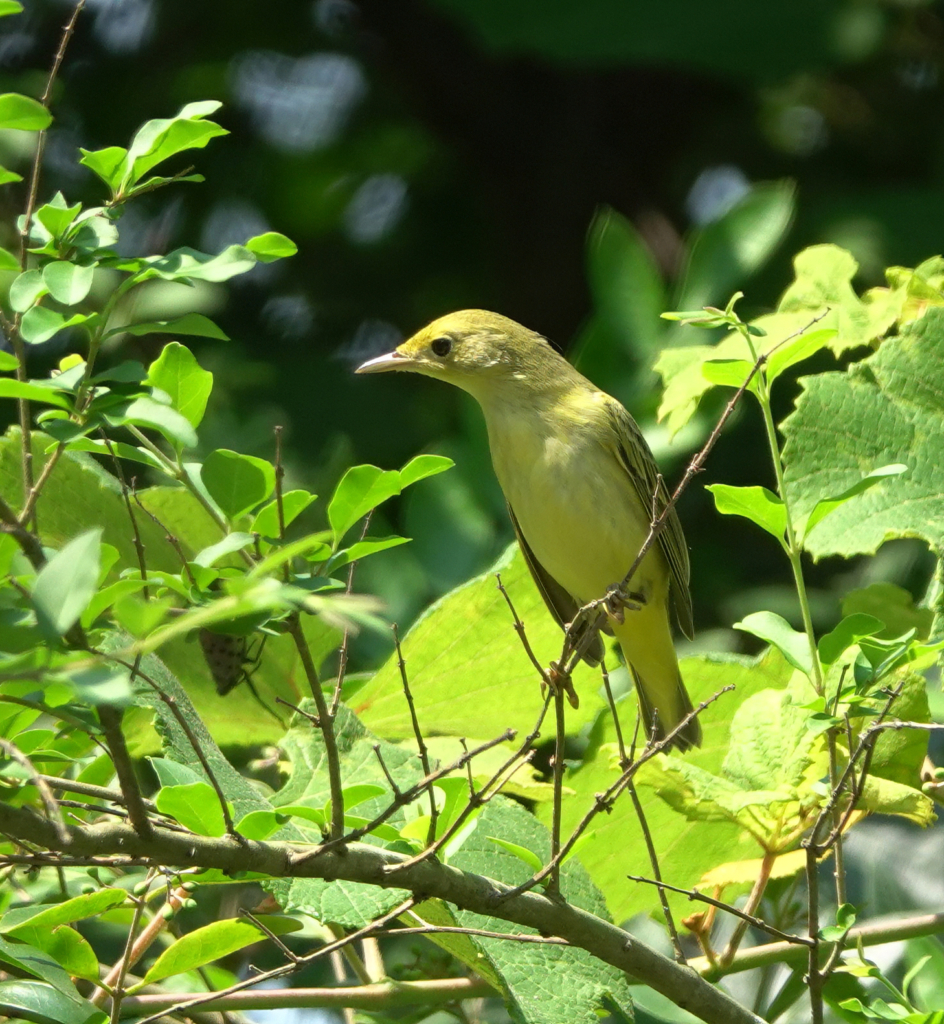
Summer tanagers are nicknamed the “bee bird” because of their propensity for eating bees and wasps. They can catch them in mid-air or even tear open a wild wasp hive to eat larvae. This male is likely taking this bee to the nesting female. RIGHT: Although summer tanagers eat mainly bees and wasps they also forage on berries and fruit trees.
Summer tanagers’ loosely constructed nests are built by the female, and are often located adjacent to an opening in the woods, such as a stream or a powerline cut. The monogamous pair may produce a clutch of four pale blue/green speckled eggs. The incubation period lasts from eight to 12 days, during which the male may or may not bring food to his incubating mate. Nestlings will fledge 10 to 12 days later. Both parents gather insect protein for their offspring. Upon fledging, the young are not strong fliers and must continue to be fed by the parents. Some pairs may attempt a second brood, particularly if unsuccessful the first time around.
Southern New Jersey is near to the species’ northern limit, as summer tanagers are found south and west to northern Texas where they occupy riparian landscapes. In Cumberland County, the first summer tanagers arrive in our forests from late April to early May. Adults commence fall migration beginning in late July, and continue through early August into November. They have a very wide distribution in their nonbreeding territories and it is thought that the western population of summers migrates over land through Mexico to Central and South America, whereas those living in the Southeast U.S. migrate over the Caribbean, sometimes island-hopping to the South American continent.
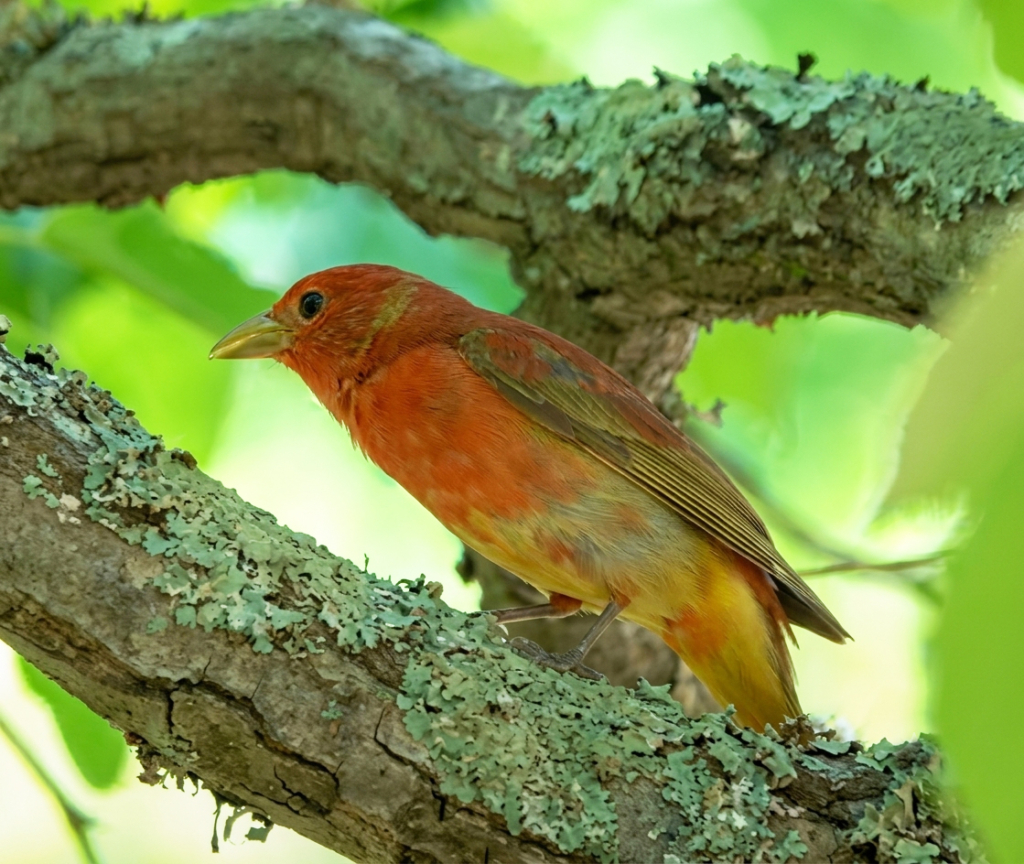
A first-year male summer tanager is red with a patchy mix of red, yellow, orange, gray and yellowish-olive feathers.
Like most neotropical passerines, summer tanagers migrate at night, avoiding predators and taking advantage of the less turbulent nocturnal air. Additionally, migrating songbirds avail themselves of prevailing fronts to aid in their arduous journeys—southwest winds in the springtime and cold fronts from northwest in the fall.
Summer tanagers have shown some declines in the more disturbed parts of their range; overall they score a nine out of 20 on the “Continental Concern Score,” which denotes a low conservation concern rating. There are many sites in our region to spot these beautiful birds including Bevan WMA, especially along Ackley Road; Peaslee WMA above Route 49; as well as Belleplain State Forest. Parent birds are finishing up this year’s brood and will soon begin to move south, so get out into the woods before they’re gone until next spring.
Sources:
Pete Dunne’s Essential Field Guide Companion, Pete Dunne
The Sibley Guide to Bird Life and Behavior, David Sibley
https://www.audubon.org/field-guide/bird/summer-tanager
https://mdc.mo.gov/discover-nature/field-guide/summer-tanager

