In New Jersey, Nature Serve Explorer shows spotted wintergreen, Chimaphila maculata, as being primarily secure. Note that the range in which it is considered secure (navy blue) is limited. USDA mapping shows New Jersey occurrences in every county.
Spotted wintergreen brightens the forest floor this time of year.
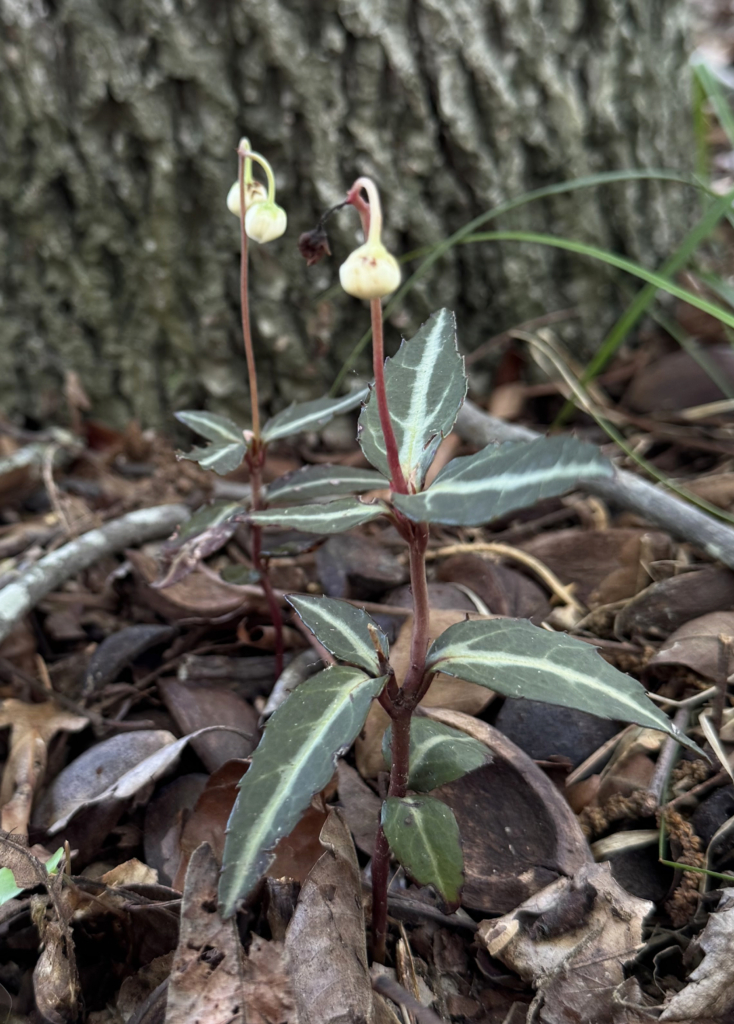
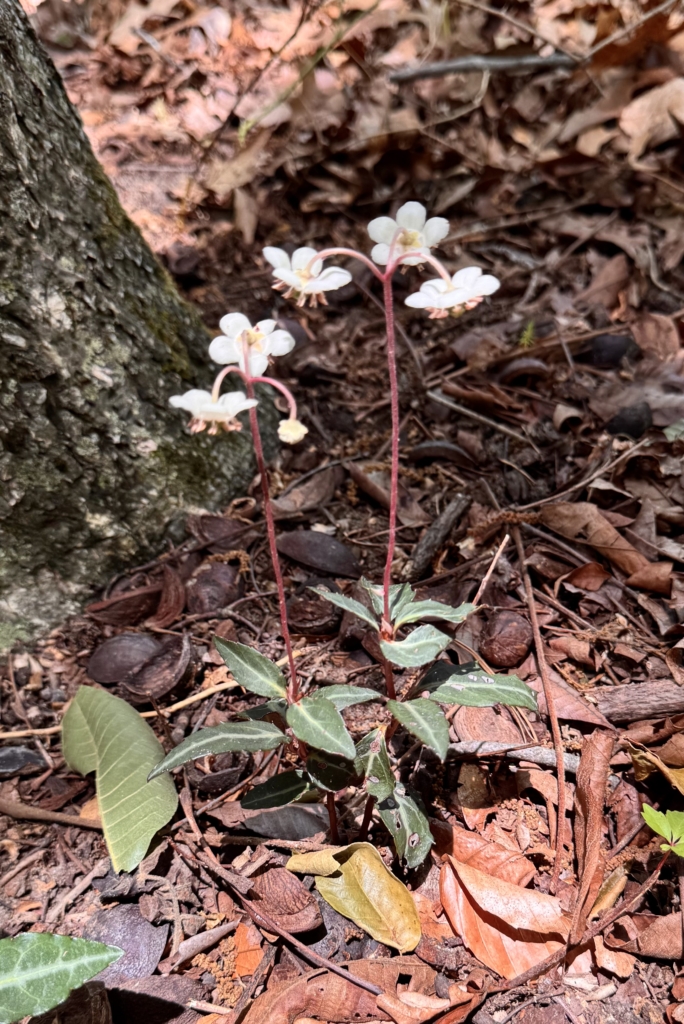
Chimaphila maculata (spotted wintergreen) has variegated, lance-shaped leaves with a striking white stripe running right down the center vein (midrib). RIGHT: Spotted wintergreen and C. umbellata (Pipsissewa) both have nodding headed blossoms. Pictured: spotted wintergreen. Photos: J. Morton Galetto
While searching for invasive plants to eradicate in the wooded area of our property, my husband Peter discovered that one of the wintergreen species was blooming—spotted wintergreen or Chimaphila maculata, which is often mistaken for prince’s-pine/pipsissewa Chimaphila umbellata. To be clear, the problem lies in the common names of the two species.
Spotted wintergreen has a distinct white streak along the midrib of each leaf, while pipsissewa does not. They are related and have an overlapping blooming time, spotted being June-August and pipsissewa July-August. Some sources swap the common names around. Haywood/Monk identify these plants as noted above, while the Newton Conservators and the University of Tennessee give the common name for Chimaphila maculata as striped prince’s-pine or pipsissewa. The Committee on the Status of Endangered Wildlife in Canada calls C. maculata spotted wintergreen. The USDA gives striped prince’s pine as the common name for maculata and pipsissewa as umbellata.
The Canadians clearly call out differences and identify them as follows: “Spotted wintergreen is similar to common pipsissewa; the two species appear to have similar habitat requirements and often co-occur where their ranges overlap. They differ in that Common Pipsissewa has very shiny solid green oblanceolate leaves, which lack the diagnostic central white stripe and white veins on the upper surface. DNA barcoding techniques are available to successfully distinguish among the five chimaphila species globally.”
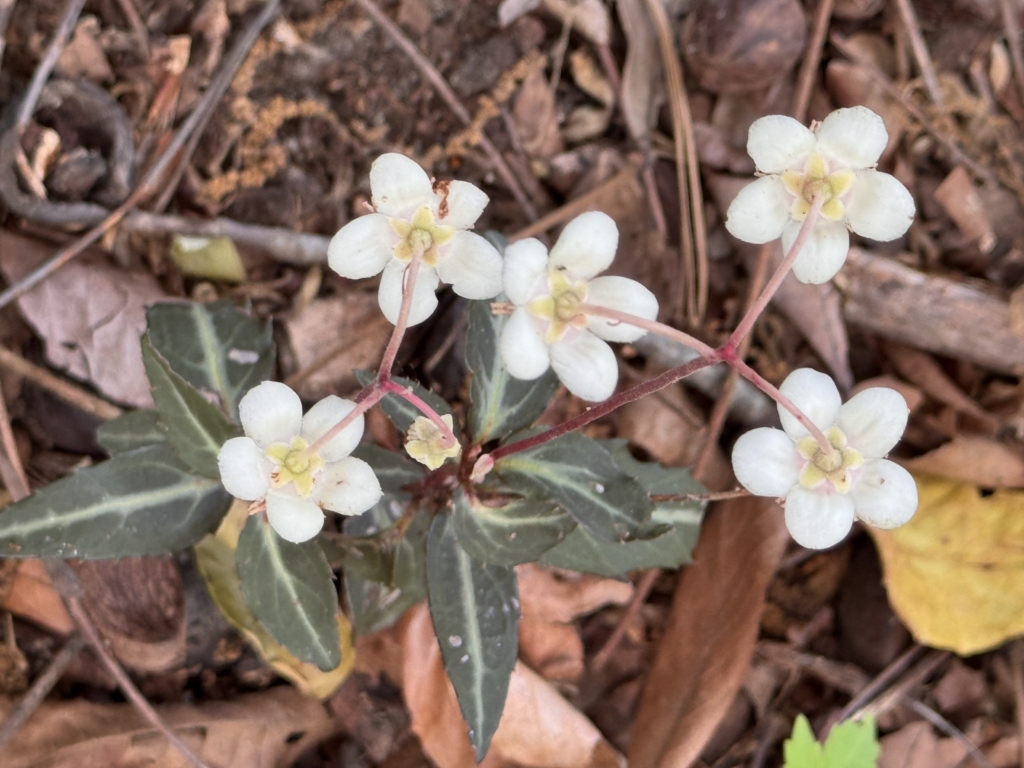
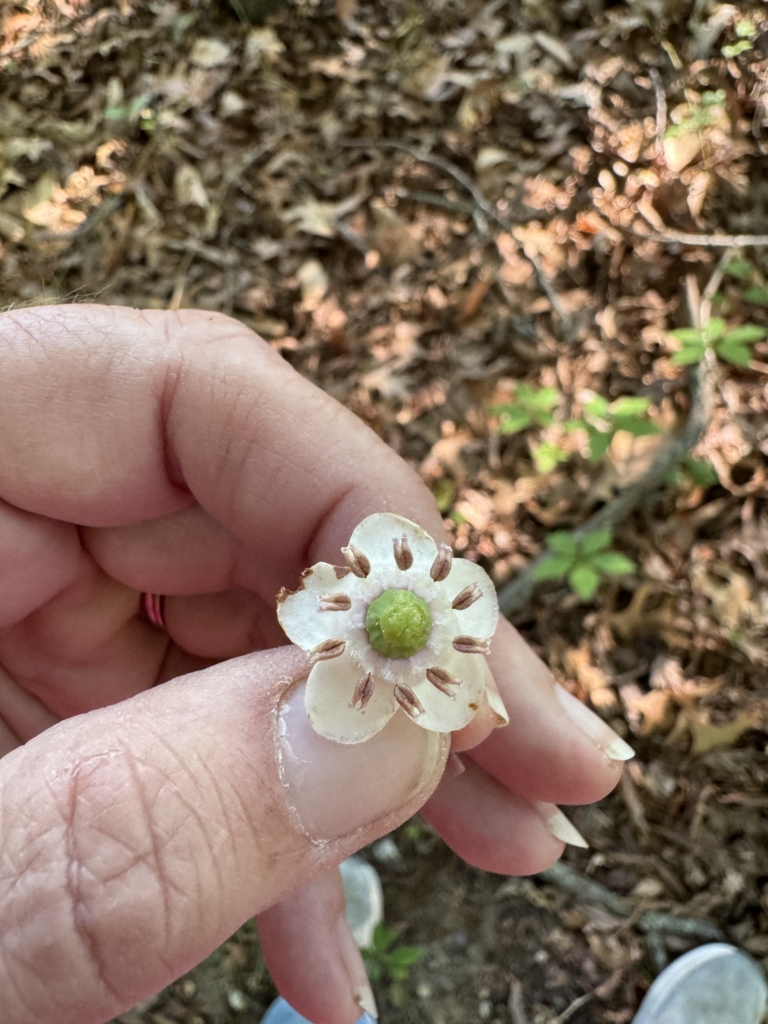
When we look down on the plant, C. maculata blooms you see on the five waxy pedals. The blossom must be inverted to see its 10 prominent stamens. Photos: J. Morton Galetto
Thus the importance of scientific names. Common names are plentiful and more easily remembered—but can be very confusing. In the case of these species, we will need to use scientific names. However it is worthy of mention that the derivation of pipsissewa comes from the Native American name, which means “breaks into small pieces.” Both species were employed by Native Americans in ethnobotany with colonial adoption of the uses as well.
Chimaphila is Greek for “winter-loving,” cheima—winter and philein—to love. It thrives in a dry acidic forest and stays green during even the coldest months. The plant’s ability to remain green in winter is the basis of the scientific name. At the cusp of summer, nodding umbrella-like blooms emerge. These are what caught Peter’s eye. Both plants have bent-over blossoms; the cousin’s scientific name is umbellata.
Haywood and Monk identify at least six wintergreen species (two in the chimaphila species) in neighboring Pennsylvania; all of these are also in New Jersey but only two, Chimaphila maculata and C. umbellata, are commonly seen. The other four are rare in our state although more likely in northern New Jersey. I am not a botanist and I share this after an extremely limited dive into the subject. The take-away for now is that we’ll focus primarily on Chimaphila maculata and C. umbellate, which we are likely to come across in our pine/oak woods.
These woodland wintergreens have a perennial rootstock. Their leaves are slightly leathery and they use photosynthesis to produce their own food. However, they also supplement their energy by absorbing nutrients from underground fungal networks, or mycorrhizal fungi. Because they use both food sources, they are mixotrophic.
They spread by rhizomes (horizontal underground stems with lateral shoots) to form colonies. Each stem has a whorl of thick, blue-green, toothed leaves with the aforementioned white stripe. A stalk comes from the whorl of leaves that supports two to five nodding white or pinkish flowers. Rounded seed capsules become erect after flowering, and contain numerous tiny seeds. They reproduce from both roots and seed.
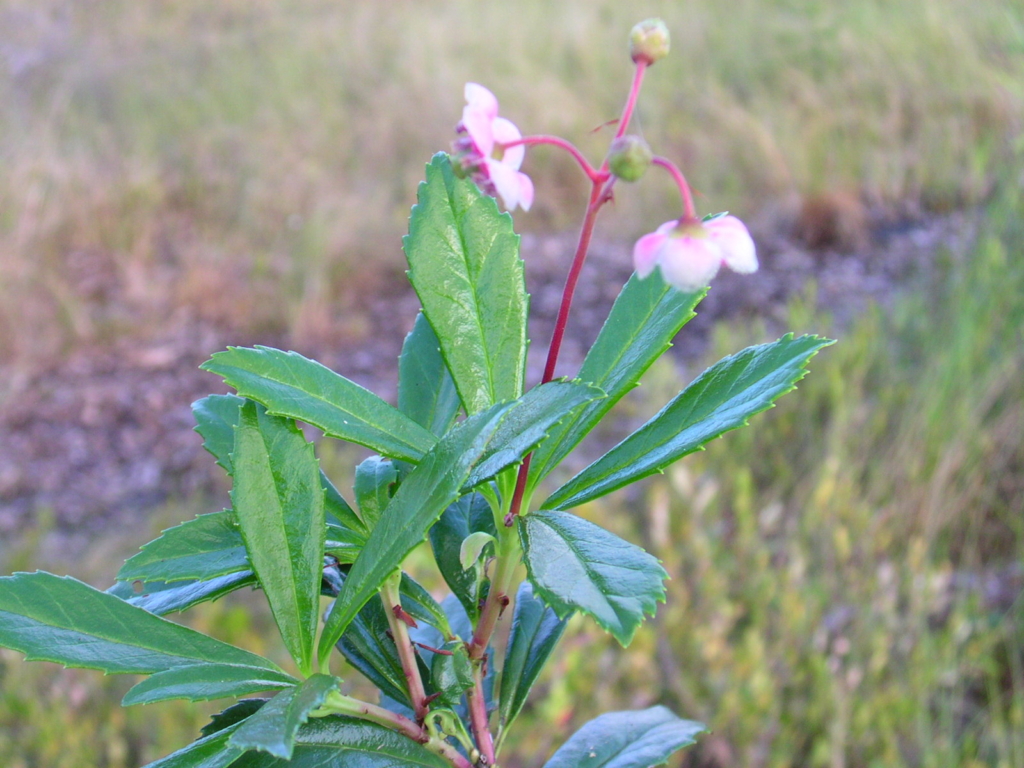
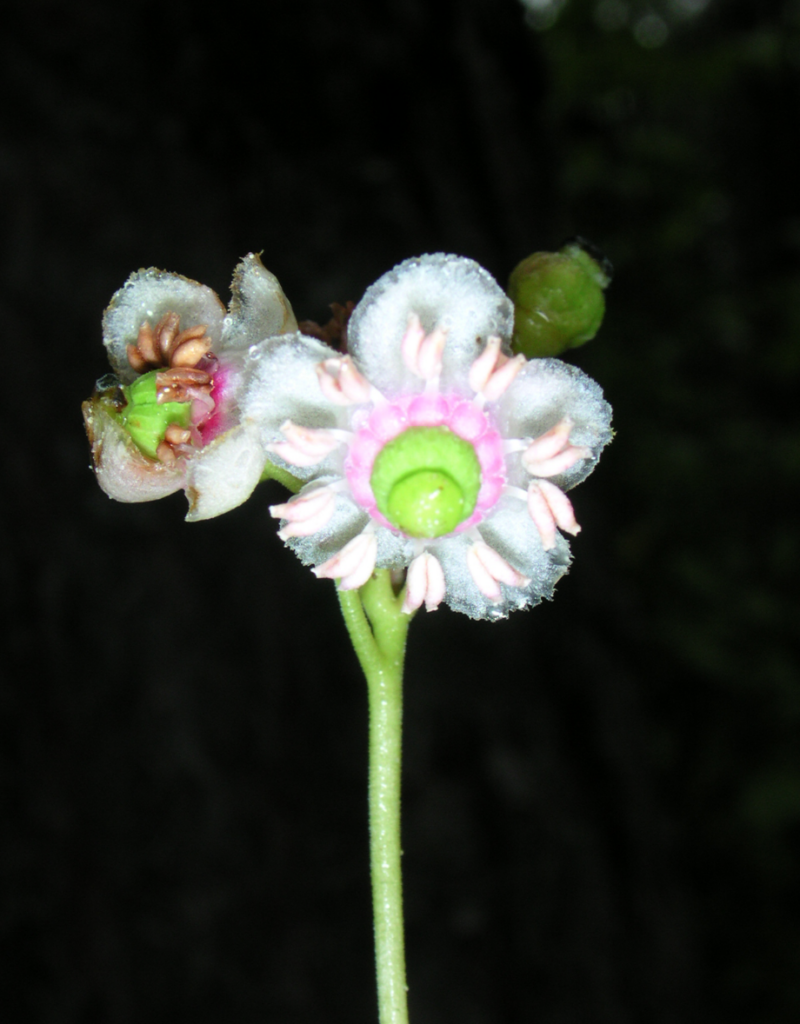
Chimaphila umbellata (Pipsissewa): Features solid, bright shiny green, wedge-shaped (oblanceolate) leaves with no white striping whatsoever. Photos: Superior National Forest
C. maculata’s range is eastern North America, Mexico, and Central America, and in eastern North America it extends from southern Michigan and Ontario east to southern New Hampshire and Maine and south to Mississippi and northern Florida. Historically, spotted wintergreen was more widely distributed in southern Ontario and into southwestern Quebec, but it is now restricted to a few subpopulations in southern Ontario and is considered extirpated in Quebec. It thrives best in an understory associated with dry-fresh oak and oak-pine mixed forest.
C. umbellata’s range is much greater; it occurs throughout most of North America with the exception of a few states. However, its actual locations in each state may be very limited. In New Jersey, there are occurrences in every county (the same is true for maculata). But in some states there may be only a few counties in which it exists.
Blooming dates as you go northward are later in the season. Maculata blooms late July to early August in Canada, where Maine reports June throughAugust.
Both Chimaphila maculata and C. umbellata have a long history of medical uses. Some sources give credence to effectiveness for some ailments and disregard others. In fact, the “breaks into small pieces” name given by the Cree, “pipsisikweu” (pipsissewa), refers to a substance in the leaves that was thought to dissolve kidney stones, today considered inaccurate. Mohegans and Penobscots steeped portions of the plant in water to treat blisters. The Thompson Indians and other tribes ground the plant and applied a dressing to reduce swelling of legs and feet. Moerman found many sources indicating that Native American tribal communities also applied these plants as a diuretic and for kidney ailments, as well as for rheumatism.
Colonists adopted these uses and in fact the United States Pharmacopoeia listed it as a medicine from 1820 to 1916.
Umbellata and maculata extract also have a history of being used to flavor candy and soft drinks, especially root beers.
No matter what name you attribute to the plant, or the flavoring you obtain from it, Chimaphila maculata certainly is eye candy on the forest floor.
Sources
Wildflowers of Pennsylvania, Mary Joy Haywood, RMS, Ph.D. and Phyllis Testal Monk, M. Ed. 2001.
Native American Ethnobotany by Daniel Moerman, 1998.
Spotted Wintergreen, Chimaphila maculata. Newton Conservators.org.
COSEWIC Assessment and Status Report on the Spotted Wintergreen Chimaphila maculata in Canada, 2017.
Magic and Medicine of Plants, Reader’s Digest, I. Dobelis, 1986.
Liu, Z.W., Q.R. Zhao, and J. Zhou. 2013. A test of four candidate barcoding markers for the identification of geographically widespread Chimaphila species (Pyroleae, Ericaceae). Acta Botanica Gallica 160(1): 11-17.
University of Tennessee, Pipsissewa Chimaphila maculata, taes.tennessee.edu.

