The robin snipe card caught the eye of our columnist on an auction website,
and it was the impetus for this article.
History shows that corporate America can influence public opinion with its marketing decisions.
It should come as no surprise that I collect artifacts that capture the essence of the Delaware Bayshore’s natural history as it relates to people and resources. These items range from paintings and oyster baskets to antique soda bottles and vintage decoys. While searching an auction site for a shorebird decoy, I instead stumbled upon something entirely unexpected—a tiny Arm & Hammer trading card depicting a “Robin Snipe,” the old market-hunter’s name for the red knot.
The process, at the time these cards were made, of taking a detailed nine- to 12-inch painting and making a copy that could be mass produced in two- to three-inch cards is complicated. It is believed that the cards were chromolithographs. Flux Art Conservation was hired to restore some of the original artworks for the Church and Dwight Art Collection. To learn more about this complex process see Flux’s web article on the Collection (cited in sources).
The red knot would have been among the species killed by market hunters prior to the United States Federal Migratory Bird Treaty Act of 1918. It was enacted due to rising public sentiment regarding the need to protect birds, not only from market hunting but from plume hunters as well.
Stumbling upon the small collector card led me to a flood of unexpected information. Back in 1888 the Church and Dwight Company, manufacturer of Arm & Hammer, introduced a series of trading cards that would be produced for nearly 90 years, called “Beautiful Birds of America.” At one point two separate companies existed: Arm & Hammer Baking Soda, and Dwight’s Cow Brand Saleratus, both of whose products included such cards.
Possibly some of our readers were involved in the household’s purchase of baking soda and remember the cards, which were still in production in 1976. While growing up Arm & Hammer was a household staple for my family, and one box lasted us a very long time. While I have no recollection of a trading card being in the sodium bicarbonate box, perhaps it was because the card was extremely small (two to three inches), which is about two-thirds the size of a typical baseball card.
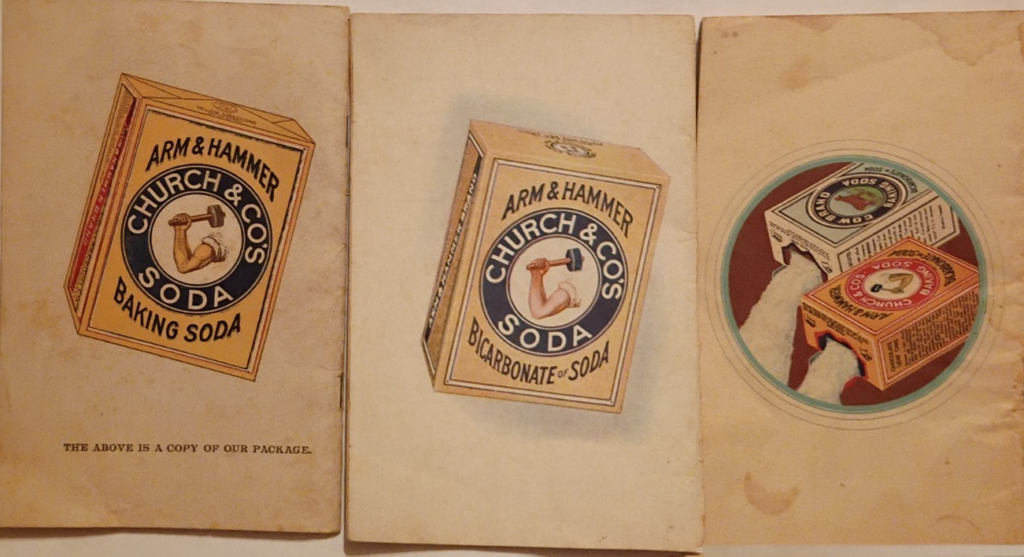
Church & Company was a family-owned company that had splits in ownership, but today’s branding remains familiar.
At first all of this seemed unremarkable to me until I delved into the Company’s endeavor further and thought about the time frame. These cards were released during a period when many wild birds were being killed for food, or for feathers to meet the demands of the millinery trade. And birds of prey were also killed by farmers, hunters, and trappers. In 1888, 40 percent to half of all Americans lived on farms or grew their own food. At the turn of the century, far more Americans hunted for food than today, and birds were commonly viewed as commodities or pests rather than as wildlife worthy of protection.
It is in this context that Church and Dwight’s cards were bravely themed, “Useful Birds of America… For the Good of All, Do Not Destroy the Birds.” This was approximately 17 years before the National Audubon Society was formed in 1905. Church and Dwight (brand name Arm and Hammer) was following the example of other manufacturers that were including trading cards as a marketing tool. But the difference was that Arm and Hammer’s had a significant conservation element.
The best-known use of cards to sell a product are the baseball cards used by gum manufacturers. The first of these was introduced in 1869 by Peck & Snyder, followed by tobacco companies in the 1880s who employed many themes.
In total, Arm & Hammer Baking Soda and Dwight’s Cow Brand Saleratus made over 6,232 different trading cards; this takes into account all the series plus their multiple releases and variations, which were produced in 15, 30, or 60 cards per set (Flux).
Arm & Hammer obviously assumed that their consumers had an interest in birds, and therefore thought of them as a worthy theme for a marketing strategy. A number of sources also stated that the company’s leadership firmly believed in the preservation and protection of nature, and of birds in particular. Therefore the cards had a dual purpose, fortunately for the birds!
The card I purchased was No. 1 in a series of 30 designs. At the time this card was introduced by Arm & Hammer, Church & Company New York included its logo in the design. It pictured Robin Snipe on the front painted by John Henry Hintermeister, and had this description of the bird on the back: “1 Robin Snipe (Tringe canutus).” And although it did not include the often-used verbiage “Do Not Destroy the Birds,” you will note the inferred conservation message. It read “The knot or sandpiper of our coasts. His Latin name is derived in part from that of the King Canute who defied the waves with less success than attends this speedy little beach comber. Snipe hunting with candle and sack, now a favorite pastime of the practical joker, was once the means by which thousands of these unsophisticated birds were butchered.” This card was introduced in 1908, a decade before the Migratory Bird Treaty Act.
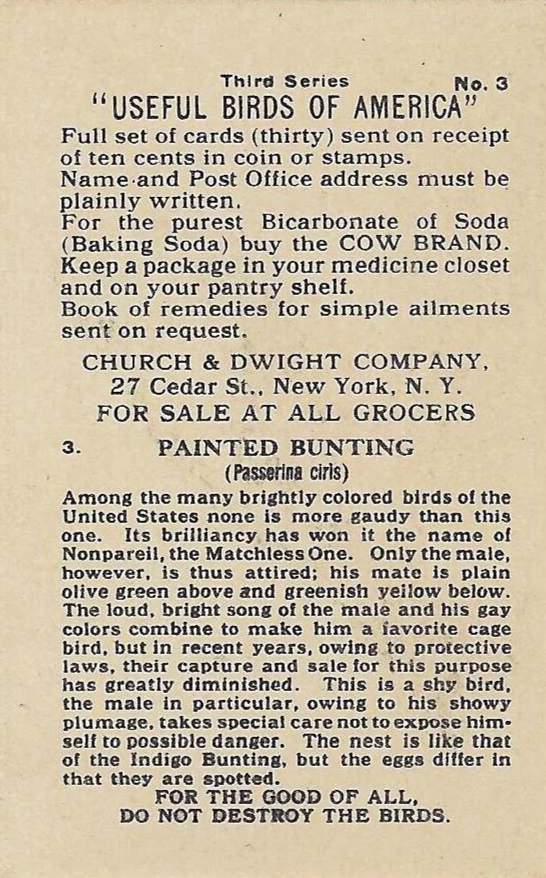
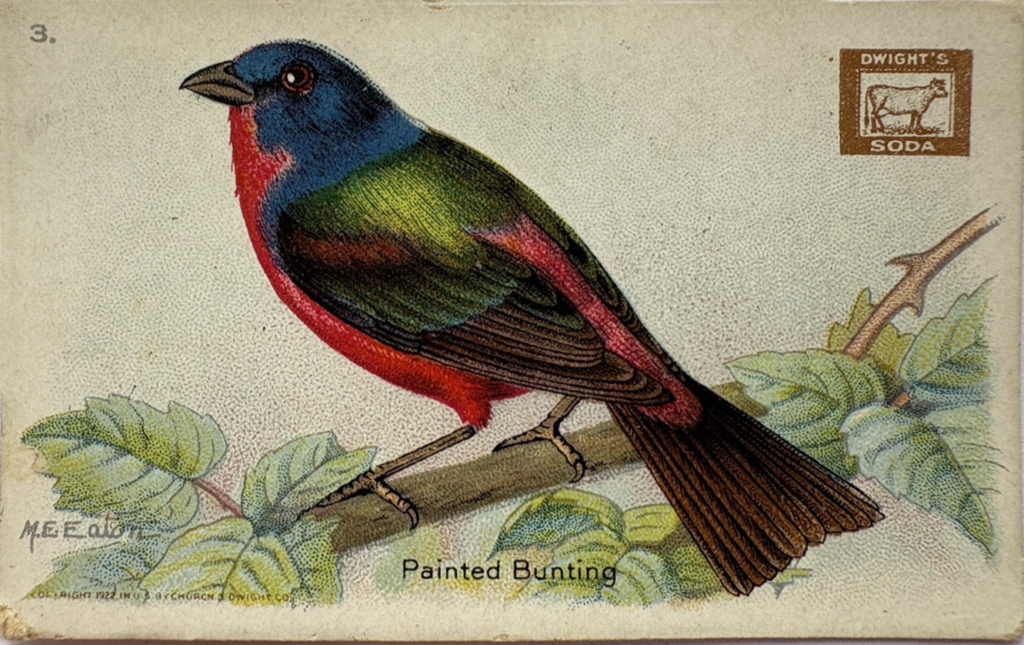
The painted bunting was the first card released by Dwight’s Soda (later Arm & Hammer) in 1888 as part of a 60-card set “Beautiful Birds of America.”
The card also informs the holder that, should he wish to acquire the entire group, “A set of these cards (30 in all) accumulated in the ordinary course of buying housekeeping supplies, will form an interesting collection. Should all the cards be desired immediately, (six two-cent stamps) will about pay the cost of postage and upon its receipt with your name and Post Office address, we shall be pleased to mail a complete set of cards.” I’d be embarrassed to say what I paid for the tiny beauty I purchased!
A number of now-famous wildlife artists were commissioned to draw the birds. Louis Agassiz Fuertes painted some 90 species. His images of birds of prey were vaulted in the early 1900s and not circulated because of the public’s negative view of these raptors. It wasn’t until their last set of cards in 1976 that a collection of 10 hawks, owls, and a bald eagle by Fuertes was finally released (Laura Erickson).
Mary E. Eaton, a botanical and wildlife illustrator, was commissioned to create at least three sets of cards, totalling 75 species, in the 1910s, as well as at least 10 other individual cards that were incorporated into other sets.
Famed artists Hintermeister and Gustav Muss-Arnolt created a 30-card set of birds (five by Arnolt). Arnolt also painted a collection of domestic dogs—the 1902 Champion Dog Series. There were only two sets of cards that featured dogs and these were drawn for the Dwight’s Cow Brand Saleratus boxes (prior to the Arm and Hammer branding).
The Church & Dwight Company has shown conservation leadership in other areas. In 1970, Church & Dwight Company was the sole corporate sponsor of the first Earth Day (company claim). Furthermore, in the 1980s they developed dry sorbent injection solutions to reduce air pollution from factory stack gases.
It is encouraging to reflect on the difference that corporate America can sometimes make with what at first glance seems to be a modest marketing decision. Theirs was a gesture that likely ran against the prevailing attitude of the day, yet Arm & Hammer’s actions helped advance bird conservation in the United States, demonstrating how even modest corporate decisions can have lasting environmental impact.
More than a century after someone tucked that little Robin Snipe card into a box of baking soda it found its way onto an online auction site, where it reminded me that conservation history isn’t preserved only in museums or archives. Sometimes it survives in the most ordinary household objects.
Sources
“The Church and Dwight Art Collection – A Bit of Background,” by Kaitlin Ammon for Flux Art Conservation.
Company History, Arm and Hammer Performance Products website.
Understanding Hunting Today, Conservation Frontlines
Arm & Hammer Bird Trading Cards, Laura Erickson’s for the Birds, July 6, 2017.
Immigration and the American Industrial Revolution From 1880 to 1920, Charles Hirschman, Elizabeth Mogford, National Library of Medicine.
What’s in a name?
You may have noticed from the back of the red knot card that the name Tringa canutus was used, versus today’s accepted name Calidris canutus.
Carl Linnaeus, the “Father of Modern Taxonomy,” listed the scientific name of the red knot as Tringa canutus in 1758. There are six subspecies of this bird. The current accepted name is Calidris canutus. Tringa canutus derives from Latin; the Ancient Greek tryngas was used by Aristotle to describe a white-rumped, tail-bobbing wading bird (shorebirds are called waders by English speakers).
Canutus is historically associated with the legendary 10th century Viking King Canute, due to the bird’s habit of foraging along a tide line. Canute is said to have attempted to command the tide from a throne on the beach, and when he was unsuccessful he acknowledged his inability to control it by declaring, “Let all men know how empty and worthless is the power of kings, for there is none worthy of the name, but He whom heaven, earth, and sea obey by eternal laws.” He then hung his crown on a crucifix and never wore it again.
The currently used name Calidris also is rooted in Aristotle’s attempt to describe a gray-colored water bird.
Source: Knot, The Wildlifetrusts.org

