The crimsoneyed rosemallow seed pods are large and accommodate about 120 large seeds (each seed is about the size of a peppercorn). All Photos: J. Morton Galetto
Blossoming four to six incles across, the crimsoneyed rosemallow is one of our showiest wetland species.
We have lived on the Maurice River for over 40 years, and during that time I have witnessed patches of rosemallow come up in the shallows of watery ditches and along the river’s edge. There are a number of species of mallow and identification can be confusing. But I’m rather confident that most of what we see is crimsoneyed rosemallow, or Hibiscus moscheutos.
Years ago I spoke to the owner of a native plant nursery and she told me that mallow is easy to propagate. I broadcast seeds but had no success; possibly the area was too dry, or my failure to scarify the round hard seeds before sowing them might explain their failure to prosper. Often the surface of hard seeds must be scratched in order for them to germinate.
Whatever the case, they like a wet substrate and don’t tolerate drought. Thus, they prefer to grow in swampy forest, wet meadowlands, and wetlands. They do well in moist soils in the garden or on wetland borders, preferring sun to partial shade. A wet place in a yard, a rain garden, or pondside would likely provide a good habitat for the plant. I’ve seen areas where it can become very abundant so I suppose you would want to be sure that such an outcome wouldn’t be an issue for your landscaping.
Last year, rosemallow plants volunteered on a gravelly access by the river at the edge of our property where we used to launch kayaks and canoes or take an occasional dip. I was elated to have it show up. Its seeds are dispersed by high tides over long distances; their thick coating makes them buoyant. Waterfowl and soil-hauling machinery also transport them.
This perennial forb/shrub is a beauty. Its four-to-six-inch flowers vary in color and it grows to about five feet across and just as tall, although it can reach heights of eight feet. Last year it was only about three feet across. It blooms for about a month between July and September. I first noticed the blooms at the end of July. On the Maurice, once fully bloomed most look very white with a cast of pink, and the larger the blossom opens the whiter it appears. Before the blooms unfurl, they look a soft pink. Articles state the species comes in pink, white, red, and burgundy. I’ve not seen the latter color in the wild in our region, but I suppose it may occur.
Daniel Moerman wrote a compilation of many sources citing Native American uses of different plants. He shows only one tribe using Hibiscus moscheutos for medical purposes—the Shinnecock. This tribe is one of the oldest self-governing clans in the State of New York. Its aboriginal homeland is around the Town of Southhampton on the eastern end of Long Island. In their Algonquian language, the Shinnecock name roughly translates into English as “people of the stony shore.” They used the mallow for urinary aid, concocting an infusion of dried stalks that were applied for inflammation of the bladder.
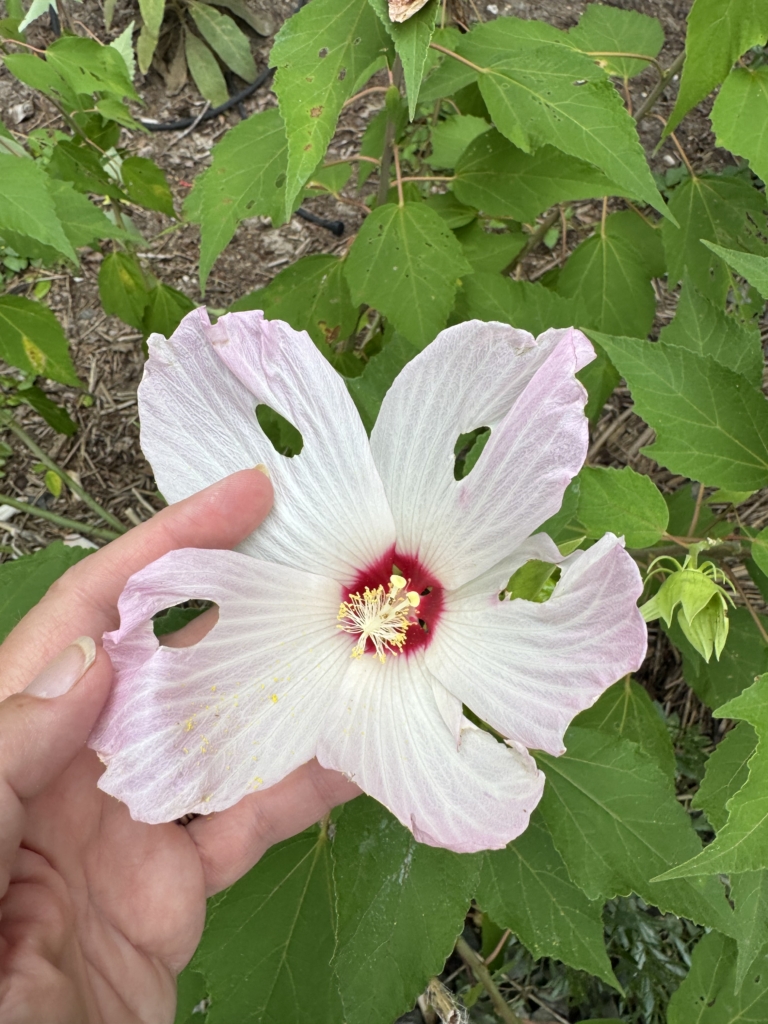
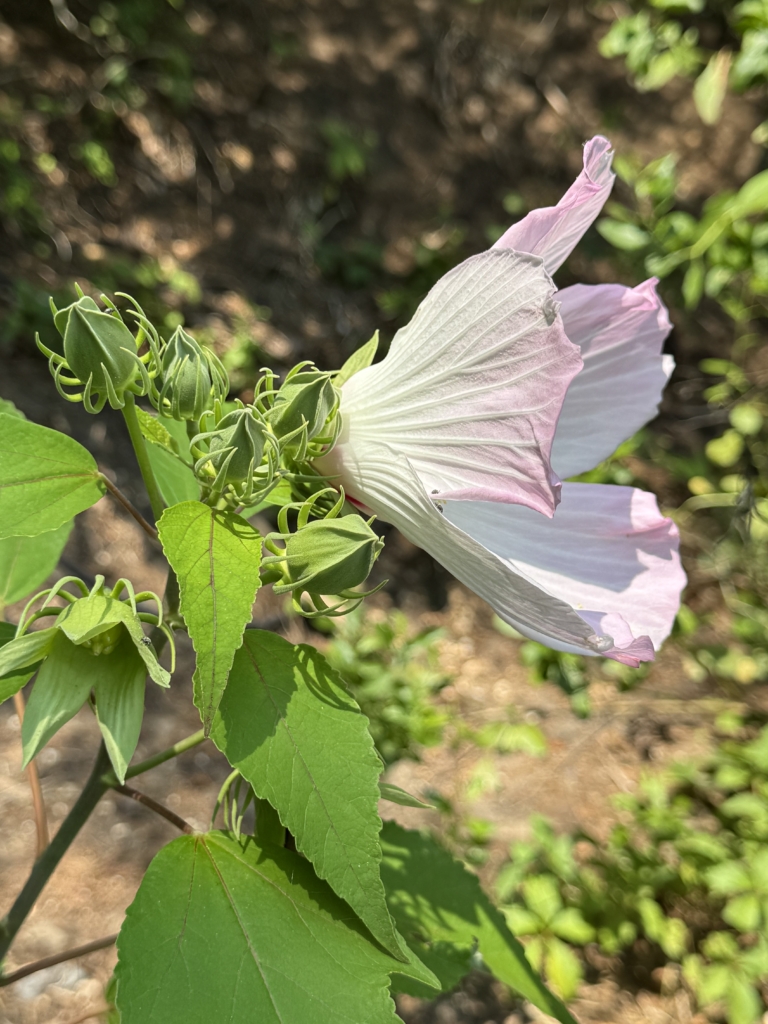
The blossom of the crimsoneyed rosemallow has pink highlights. At left, note the carefully removed ovals from each petal, used by a leaf cutter bee to line the walls of its nest. Not to worry, though, the leaf cutter is a beneficial pollinator.
The common names for Hibiscus moscheutos can be confusing; the USDA uses crimsoneyed rosemallow, but other common names include swamp mallow, swamp rose mallow, marshmallow hibiscus, and crimson-eyed rose-mallow.
There is another hibiscus called Althaea officinalis that has the common name of marsh mallow. An introduced species native to Europe, Western Asia, and North Africa, it was widely cultivated as an ornamental. It is best known for the sugary confection “marshmallow”—yes, the sweet that you roast on a stick over a campfire. The mucilaginous thick sap of the root was boiled and whipped with sugar and honey to make the original confection. Today marshmallows are made with sugar, corn syrup, water, air, and gelatin.
Compared to the crimsoneyed rosemallow, the Althaea officinalis plant has many smaller and more numerous blossoms, one and a half to two inches wide, and the seed head is shaped differently. So two different plants, Althaea officinalis and Hibiscus moscheutos, share some common names. Thus folks will say Hibiscus moscheutos is a plant that was used for the confection marshmallow when it was not. Both are in the mallow family, but the genus and species differ.
In nature many pollinators make use of the flowers. Each blossom has a diverse little army of inhabitants on its prominent staminal column, with many anthers issuing from it, topped by conspicuous stigma. A bee known as Ptilothrix bombiformis (common names rose mallow bee, hibiscus bee, or eastern digger) specializes in mallows and was documented in Maryland as pollinating the majority of these plants.
When examining the petals of the flower, I noted that a leafcutter bee had meticulously carved an oval from each petal to line its nest. These bees use round foliage for the base of each cell and ovals cutouts for the walls. The tiny sheets are placed in a pre-existing cavity in grasses, a twig, or other narrow openings. The female places some pollen in a chamber and lays an egg, and then she walls the cell shut.
The female leafcutter repeats the process, continuing to cap individually-stacked cells. She can actually control the sex of the offspring by withholding sperm from male eggs, which are placed closer to the entrance since they hatch sooner than females. When the young grubs emerge they eat the pollen. Once the pupae molts into adult bees, it chews its way through the foliage end wall, but it must wait for the last laid sibling to emerge before it can leave. Picture a straw filled with medicine capsules made of small leafy sheets. Each capsule has a developing pupae that escapes out the end of the tube once it becomes an adult. But they can only emerge in the order of last laid to first laid.
Other wildlife species make use of Hibiscus moscheutos. Butterflies and moths also feed on crimsoneyed rosemallow, including checkered skipper, gray hairstreak, io moth, and pearly wood nymph. Hummingbirds will nectar on the plant and eat insects as well. Quail, blue-winged teal, pintails, and wood ducks consume the seeds. Red-winged blackbirds nest in the mallow.
I look at the beauty of crimsoneyed rosemallow and wonder about its future and the future of other wetland-dependent species. The Supreme Court has made a recent decision that seriously affects isolated wetlands, meaning swamps that are not connected to a regularly flowing source of water. The ruling removes protections traditionally given under the Clean Water Act of 1972. Plants such as this mallow are reliant on periodic reflooding, and some plants require continually wet conditions.
In past articles we have discussed the importance of wetlands for species use, clean waters, flood protection, removal of contaminants, fish production, and, yes, beauty. The weakening of federal laws threatens not just the beauty that surrounds us but our very survival.
Sources:
Go Botany, Native Plant Trust
Candy Bites: The Science of Sweets, by Richard and AnnaKate Hartel 2014.
A Field Guide to Coastal Wetland Plants of the Northeastern United States, Ralph W. Tiner, Jr.
Source: Carr, Lloyd G and Carlos Sestey, 1945, Surviving Folktales of Herbal Lore among the Shinnecock Indians. Journal of American Folklore.
The Xerces Society (2016), Gardening for Butterflies: How You Can Attract and Protect Beautiful, Beneficial Insects, Timber Press.
Leafcutter Bees, Rutgers.edu, Integrated Pest Management
Native American Ethnobotany, Daniel Moerman
Hibiscus moscheutos, Fire Effects Information System, USDA and US Forest Service.

