After rescheduling twice due to snow, the Preserving Black Haddonfield History Project hosted its second “What Would Martin Say?” forum on April 6, two days after the 58th anniversary of Martin Luther King Jr.’s assassination.
The event featured a panel of four experts in Black history moderated by P. Kenneth Burns, who covers New Jersey for WHYY. They were Joel Rosen, a former magistrate judge and senior counsel for the Montgomery McCraken law firm; Adrienne Whaley, director of education and community engagement for the Museum of the American Revolution in Philadelphia; Skyler Gordon, a historian and project manager of history at Princeton University; and Synatra Smith, project manager for the New Jersey Historical Commission’s Black Heritage Trail.
Adrienne Rhodes, curator and founding president of the history project, was a child when King was assassinated in 1968, but she can remember how it felt to grown-ups around her.
“Even though I was a toddler in the 1960s, I remember the day Rev. King was assassinated and how it affected the adults at home,” she recalled. “I could see and feel their pain. I still feel it every year. But today, as a silver-haired lady, I feel encouraged by the lyric of a galvanizing folk song of that era.”
That song was “We Shall Not Be Moved,” by Mavis Staples.
In his opening remarks, Burns shared that King’s legacy should be more about his life than his death. He pointed out that what King was doing around the time of his death – opposing the Vietnam War; lending support to striking sanitation workers in Memphis, where he was killed; and working on his Poor People’s Campaign – should be part of any discussion.
“Another item I had not thought of until this past week, what else happened after his assassination?” Burns noted. “We all know about the riots that took place, mostly in the mid-Atlantic where we are, Baltimore, Wilmington, Trenton, the Midwest and the South … but in Memphis, four days after his death, Dr. King’s widow, Coretta Scott King, and her four children, went to Memphis to march in silence for (her) husband and to support those sanitation workers.”
Whaley presented a slideshow that included a lengthy list of prominent African Americans who made an impact on history during and after the Revolutionary War, including sailor James Forten, spy James Armistead, baker Cyrus Bustill and poet Phillis Wheatley.
“When we’re thinking about this story, we just have to remember that, if you’ve ever heard someone say, ‘Oh, it’s revisionist history to talk about people of African ancestry in the American Revolution,’ no it’s not,” Whaley insisted. “One out of every five people in British North Americn was a person of African ancestry.
“Removing them from the story – that is revisionist history.”
Rosen, who did legal work during the civil rights movement, said that despite progress, there are issues now that threaten to undo all the work of the ’60s.
“Limitations on voting, early voting, mail-in voting, IDs … these are challenges that I thought were on the road to solving these problems, but here we are again,” Rosen said. “Which indicates pretty clearly that we have to stick with it. Keep marching. Keep protesting. Peacefully of course.
“And as Dr. King instructed us, the arc of the moral universe is long, but it ultimately bends towards justice.”
Gordon described a proposed park in Trenton that would honor 19-year-old Harlen Joseph, who was killed in 1968 during the riots in Trenton after King’s death.
“Keep kids safe and occupied,” Gordon urged. “Encourage different kinds of small talk. Be a place for all to just exist. And that whether they knew of Harlan Joseph or not, his namesake will be an honor and a history lesson for the neighborhood …
“Black history,” Gordon added, “embodied in Joseph in the 1960 uprising, the peace park encouraging neighbors, is like any issue. A kitchen table full of questions inviting us to sit down and answer them together.”
Smith talked about radical rest, a term she heard from colleague Portia Hopkins, a historian at Rice University. The idea is exemplified in a picture of King at the then-segregated Chicken Bone Beach in Atlantic City.
“The federally – and in some cases, locally – legislated rights that our civil rights movement forebearers secured for us are actively being stripped away through executive orders, state-sanctioned violence both physical and symbolic and resource scarcity,” Smith explained.
“Yet somehow, we all found time to learn how to get our boots on the ground and line dance the pain away, even for just a fleeting moment.”
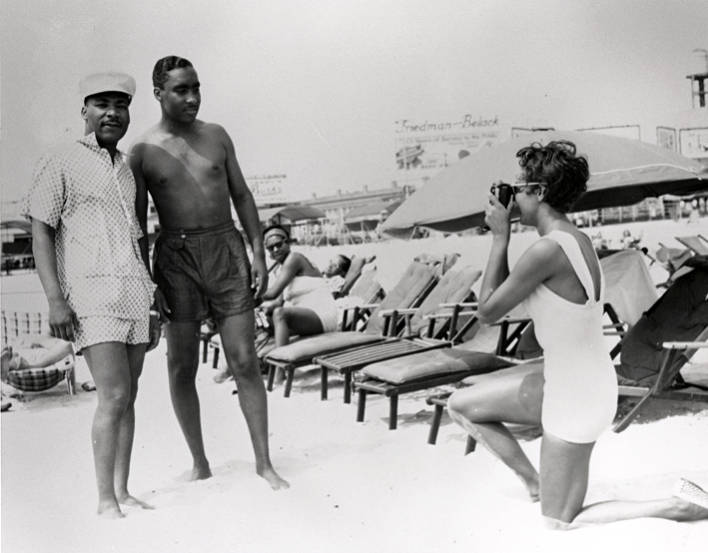
Martin Luther King (left) with a friend at the then-segregated Chicken Bone Beach in Atlantic City.
During a Q and A at the end of the “What Would Martin Say?” forum, Rob Goetz asked how the panel members would address what’s currently happening in America.
“Without getting overly political, we’re facing fascism in this country,” Goetz pointed out. “And I would like to hear people directly address that.”
Burns pointed to the large state turnout in last year’s gubernatorial election, which saw 51.44% of voters cast ballots, the highest percentage in a New Jersey governor’s race since 1997.
“Think about what it took for that many people to go out to go for governor,” Burns emphasized. ” … You basically had people who were pissed off by the current president in real time that motivated them to go out and vote.”
Smith said it felt rewarding to honor King’s memory with events like the forum. Her mother and grandmother both worked at the Martin Luther King urban center in Kansas.
“So then, having this kind of full-circle moment of, now I’m doing things in honor of MLK day, has been really rewarding for me, because I’m always thinking about where I came from,” she observed. “My grandmother has an eight-grade education. She’s from a farm in Arkansas. I have a doctorate in anthropology. Two generations and here we are.
“It’s kind of a huge deal.”

