The Haddonfield Board of Education discussed upcoming guidelines on June 4 regarding the amount of screen time that’s best for district students.
“It seems like we’re arguing about trying to make school lunches healthier when kids are going home and eating Doritos for all their other meals,” said board member Mike Nuckols, using the snack analogy to address screen time. “The problem of that 333 minutes dwarfs the problem of what we’re doing in school.”
That 333 minutes – according to the American Academy of Pediatrics – puts a number on the problem: It’s the average amount of time children from 8 to 12 years old spend on screens every day. Most of it, 60%, is spent on TV and streaming, and another 26% on video games.
Board member Nousheen Sadiq believes the district needs to find a balance between computers and pencil and paper.
“Our kids don’t know school without COVID,” Sadiq explained. “They don’t know school without a Chromebook. It’s such a disservice to them. So if we have this opportunity, all this research that Gino (Priolo, the assistant superintendent) is doing, if we could find that balance, I think that would be great. I also think it’s going to benefit our teachers.”
Board vice president Linda Hochgertel emphasized that the district can only do so much.
“We have no control over what happens with screen time outside of this building,” she said. “And we’re really just focused – the only thing we can truly focus on – is screen time within the buildings.”
Priolo gave a presentation at the meeting on what recommendations he’ll make going forward. According to him, as students move to their next grade, they use screens more. A first-grader spends on average 3.5% of the school day, or about 14 minutes, on screens, while a fifth-grader spends 13%, or about 52 minutes.
The programs used by students as they advance in grades changes as well. A first-grader uses Lexia and i-Ready myPath Math for 40 and 30 minutes a week, respectively. A fifth-grader spends 30 minutes on IXL ELA; 40 minutes on i-Ready myPath Math; 32 minutes on Frax; 30 on TCI social studies, 30 on Typing Agent and 100 minutes on general work, including Google docs, slides and sheets.
Priolo noted that it’s better for technology in the classroom to be guided by a teacher rather than students.
“What the research is telling us, is the impact of the physiology of this is quite different for a student opening up a Chromebook and (then) told to just go ahead and do some research for the next hour-and-a-half or class period,” he observed, “compared to something that’s more direct, systemic and targeted and guided by the teacher.”
Citing an advisory from the U.S. Surgeon General, Priolo pointed out the negative impacts of social media in features like infinite scrolling and likes and notifications on cognitive development. In a response to board president Jaime Grookett, he said the district will seek input on the screen time issue from the community.
Board member Stephanie Benecchi said it’s important for both kids and adults to care about screen use.
“I’ve noticed I have to be intentional in how I’m engaging with different resources,” she acknowledged, “and whether I’m writing on a tablet or paper versus typing, making those choices intentionally. So it’s not just our kids I think.”
When Priolo does issue his guidance, he anticipates it will include screen time limits for each grade; a decision on whether or not Chromebooks should be brought home; how much screen time will be allowed during free periods; when students should write or type; and more guidance on using educational technologies.
Screen time is prohibited for district fifth-graders and under during recess or down time.
Grookett offered that if students did have to leave Chromebooks at school, it would get teachers to assign more paper homework assignments, something she supports.
An early draft of the screen time recommendations will likely be discussed at the board’s July meeting, followed by focus groups in July and August. Final recommendations will be adopted in September.
During public comment at this month’s meeting, five people spoke in favor of reducing screen time, including Lauren Zonies, who representated the group Schools Beyond Screens Haddonfield. She would like to be involved in district discussions of screen time.
Zonies also believes that students are too dependent on screens both at home and in school.
“It’s being used as a crutch, and then that turns into the inability to be bored at home,” she argued. “It turns into the expectancy and dependency upon the screen and the dopamine hit at home. So while we have responses from many folks that say, ‘We don’t even have a television at home,’ I know that’s a limited extreme.
“But we’re sending our children to you for eight hours a day, and if three of that is screen time, that is something that we cannot overcome.”
Another speaker in favor of less screen time was Annie Jacobs, who agreed with Nuckols’ analogy of computers as Doritos.
“But if they’re getting Doritos at school on Chromebooks,” she stated, “they’re not gonna want plain chicken at home. All these parents are stopping it, they’re gonna want the Doritos … They come home and they’re used to being on Lexia and Prodigy and all these games. They’re gamified … and it’s an addiction.
“It’s a fight.”
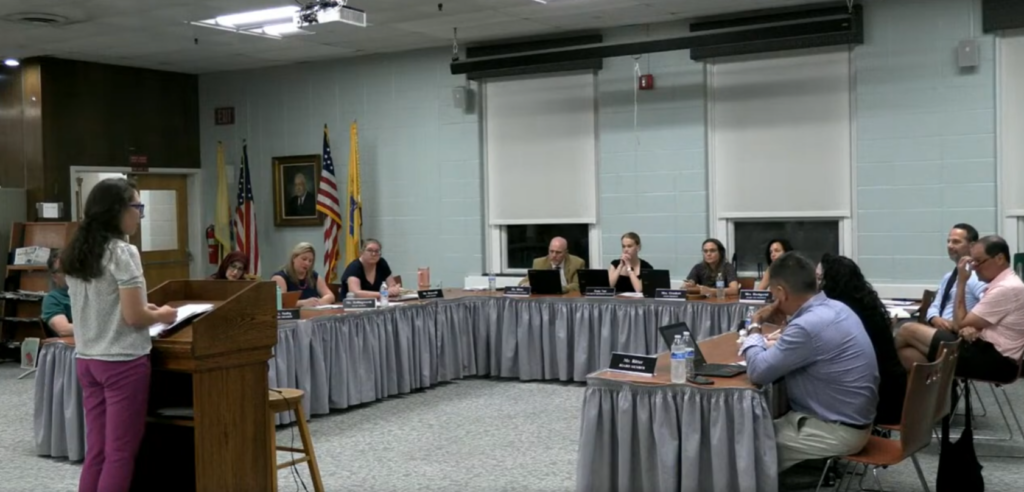
Lauren Zonies (at lectern) addressed the school board on June 4 regarding what limits to put on student screen time.

