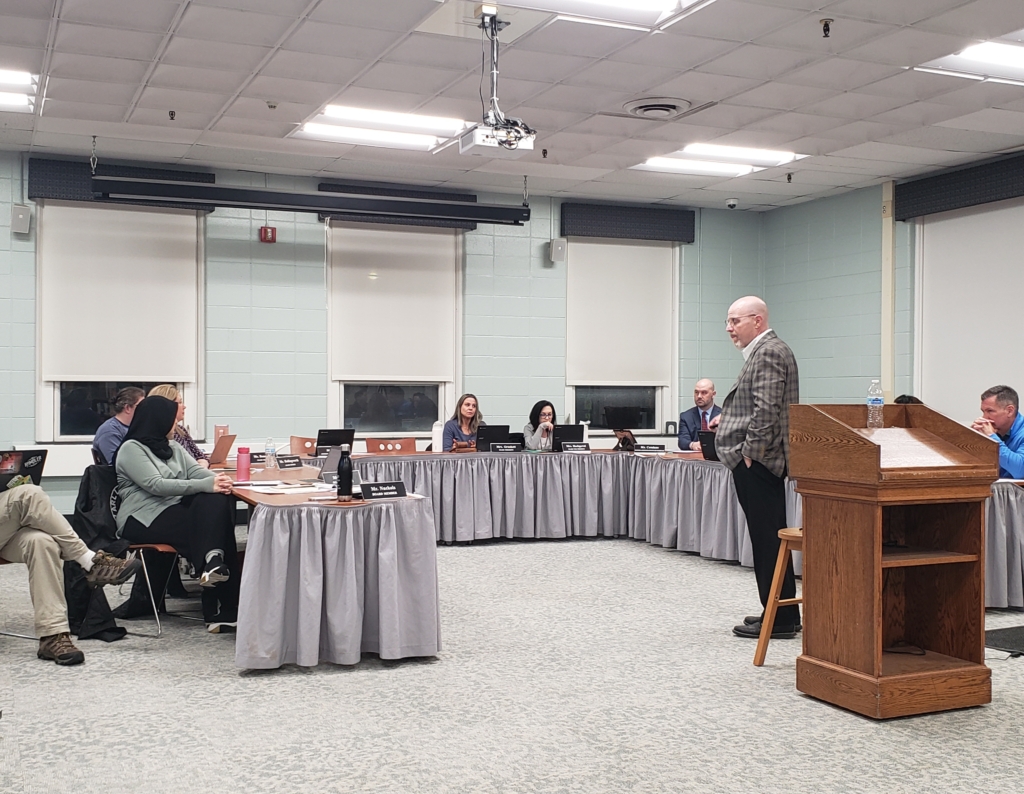
The borough school district has closed its AI survey. Now begins the hard work of deciding what direction the board of education will take in regulating the technology.
Assistant Superintendent Gino Priolo said the survey garnered 395 responses, 261 from parents, 77 from students and 54 from staff. It’s unclear why the number is three short of the survey total.
“We’ll break down the data, try to understand what our stakeholders are telling us, what they’re asking us to do,” he explained. “I’ll also be doing follow-up focus groups with students and staff who expressed interest in that.
“It’s a work in progress.”
The survey had questions for students, staff, parents and administrators, including what kind of AI software they use – such as ChatGPT, Grammarly or Google Gemini – and how often. Administrators were the only respondents asked about their confidence level in using AI – and using it ethically.
Everyone in the survey was asked about what level of AI integration should exist in the district, when students should start using it for assignments and if the district should have an approved list of AI software.
Priolo said the results of the survey will be publicized sometime in spring.
At the board of ed’s meeting on Feb. 19, Vice President Linda Hochgertel addressed the recent addition of Open Claude software, which uses AI to make code.
“Things are getting much worse if you know what Open Claude is, and some of the things people using AI don’t realize (are) that there’s code being generated,” she maintained. “The smarter AI gets, there’s injection that’s happening where people trusting the AI are like, ‘I guess that’s fine.’
“(What) you don’t know about that can be very very dangerous.”
Board President Jaime Grookett revealed that the district has had AI training, but advised not blindly trusting it, an opinion she put into practice.
“My Gmail was not recapping what I should respond, and now I open up an email and it says ‘You can write,’ and it drafts what I should say,” she noted. “I don’t follow it, because I don’t think I would anyway, but the training made me aware you should not just be following … what it says to do.”
Board member Stephanie Benecchi warned about relying on AI without a basic understanding of it.
“I think the only way to evaluate whether or not it’s doing a good job is to have a base of knowledge to begin with,” she advised. ” … We want to get the base of knowledge.”
After Priolo hosts focus groups, he’ll draft either an AI policy or guidance that can be shared with the board’s policy committee, which will then continue the discussion.
“Things are evolving so quickly with this that we may need something that’s a little more flexible and adaptive,” he stated. “I mean you just look at what happened; what’s that Claude product that came out that codes now? That wasn’t available four weeks ago. And now people are using it to build websites.
“So I don’t know where it’s quite going to take us yet.”
The process for implementing a policy takes, at minimum, three months, with a committee meeting and first and second readings. Because of the longer process, Priolo said, if the board wanted to change course, it would take more time to adjust a policy, as opposed to a guidance
“So if there is an issue with AI policy that’s brought to my attention,” he pointed out, “I can’t make any changes to it unless we go through that formal cycle … Guidance are suggestions, guardrails. Policy are more like a safe.”
Priolo’s proposal for the board, he said, will take into consideration what other school districts are doing, along with guidance provided by national organizations like the National Education Association and American Association of School Administrators.
The district has yet to get specific guidance from the state or Strauss Esmay, the firm that advises the board on AI policy.
“(The firm) came out with a policy framework last year that was essentially, ‘Here’s something you should consider, how it’s going to affect student test taking,’ and then it was blank,” Priolo recounted. “And then it was up to you to work with your constituents.
“So nothing yet.”

