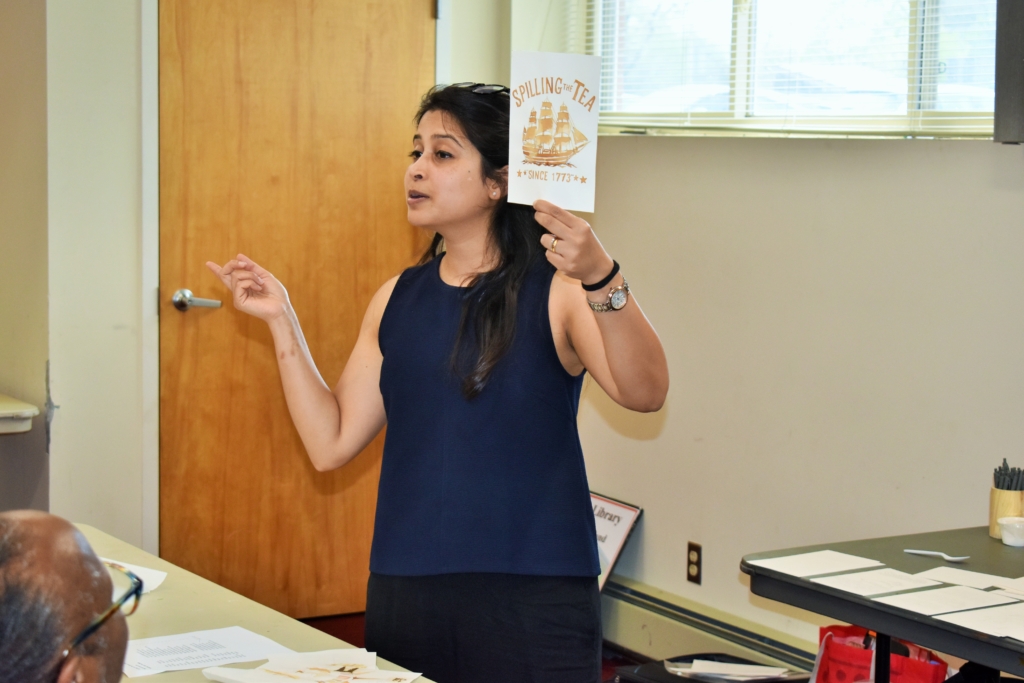
In honor of the country’s 250th anniversary, Smriti Sangal displayed a tea painting that depicts the Boston Tea Party during a workshop on April 14.
While construction crews were busily building two new bathrooms on the main floor, a collaborative tech space and a dedicated teen area at the township library, local artists gathered in a basement meeting room on April 14 to learn how to paint using tea.
“This is the first time I have painted with tea,” said Rob Richter, one of 14 participants during a workshop celebrating the country’s 250th anniversary, particularly the political triumph achieved by the Colonists at the Boston Tea Party. “I have painted with instant coffee.”
The artists all received two brushes, tea leaves, instant chai tea, water and a pallet of watercolors to create paintings of the British ship whose cargo was thrown into Boston Harbor, or the face and crown of the Statue of Liberty.
“Painting with tea is slightly lighter than painting with coffee,” explained Smriti Sangal, a visual artist, educator and leader of the Steeped in History: Painting with Tea workshop who showed how to mix the tea leaves with water and use just the tip of a brush.
She then used a black ballpoint pen to give the Spilling the Tea artwork an outline before filling it in with tea paint and fading it out to the desired hue. For the Statue of Liberty, Sangal mixed instant chai with water to fill in the crown – “just like you would with watercolors,” which she used to highlight the points of the crown to add a little color.
“I did bring coffee, but it would be better to work with the tea before you work with the coffee,” Sangal told the artists, who then started on their paintings at three long tables in the library. “The coffee is much darker and dries shiny. Tea dries matte.”
After earning a bachelor’s in fine arts from Delhi University in India and a master’s – also in fine arts – from the University of Arts London, Sangal moved to the U.S. in 2003. She taught an after-school arts program in Bedminster, New York, and then at a public school in New York City.
“I enjoy interacting with people and introducing them to art,” she noted.
Sangal has now conducted eight library painting workshops throughout the county.
Tea was first used in Chinese art during the Song Dynasty (960-1279) to create sepia tones for aging paper and calligraphy. It has become popular recently for use as a painting medium that is eco-friendly and accessible, and prized for its soft, sepia-toned effect.
Historically, the oldest known paintings in the world were created by Neanderthals 64,000 years ago using a common red ochre pigment and depicting ladder-like symbols and hand stencils discovered by archaeologists in Spanish caves. The oldest known human narrative paintings are 51,200 years old and depict a hunting scene with human-bird hybrids and a pig found in Indonesia’s Leang Karampuang cave.
Her township workshop, however, was more focused on the history of the U.S., allowing local artists to express through art how they feel about the Boston Tea Party and the country’s upcoming 250th anniversary.
Renovations at the library are now complete, and staff celebrated at a ribbon-cutting ceremony on April 17.

