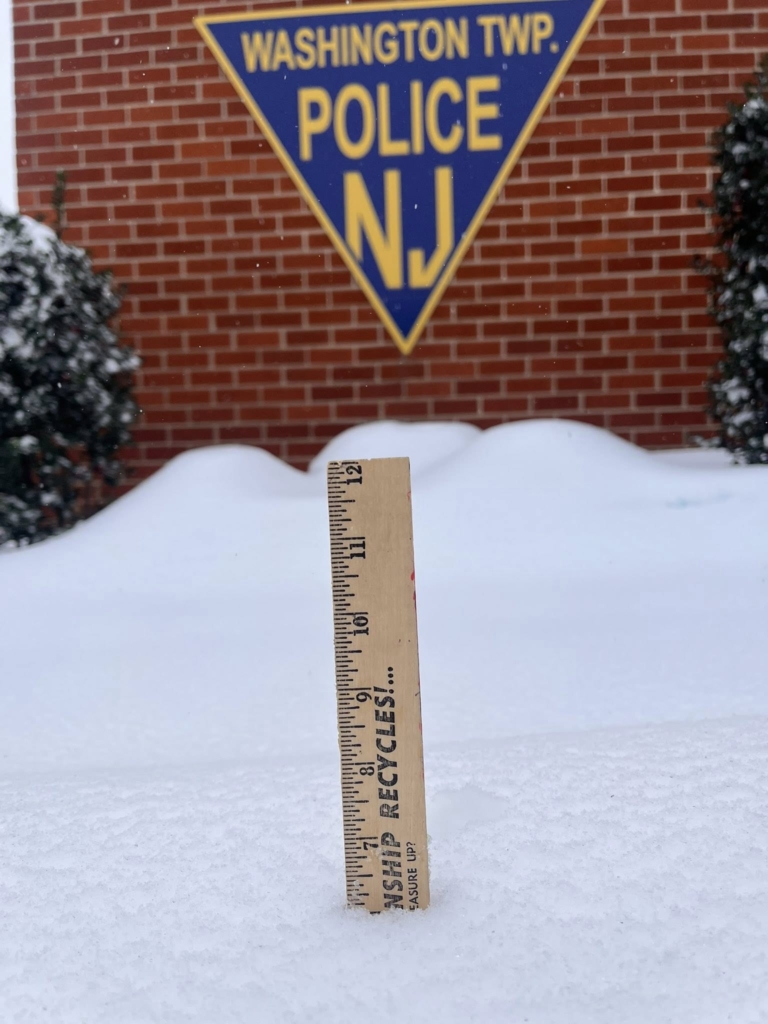
“This was the most challenging job we ever had to do because of the type of precipitation,” said Frank Altamuro, supervisor of municipal services, of the snowstorm in January. “It was the duration of the precipitation.”
Public Works Supervisor Brian McCaffery and Frank Altamuro, supervisor of municipal services, had their work cut out for them with the winter storm that brought not only snow, but freezing rain and extended temperatures below 32 degrees in January.
The township saw an accumulation of 8 to 9 inches of snow that pummeled the Northeast on Jan. 25 and 26.
“We have 700 roads in Washington Township in addition to that 200 courts,” McCaffery explained at a Township Council meeting in February. “That is 170 miles of linear roadway spread across 21 square miles.
“It’s a big town.”
McCaffery and Altamuro made a presentation on the township’s response to the storm.
“The storm we experienced was one for the books,” Altamuro said, adding the snow, freezing rain and temperatures below 32 degrees “made this storm very challenging.”
To plow the roads properly, a truck has to go up and down the road about six times, McCaffery said.
“You’re taking that amount of linear roadway and multiplying that by a minimum of six times because it’s three passes on each side of the road,” he said.
Ahead of the storm, McCaffery and Altamuro released a video letting residents know that driveways would be blocked as they cleared snow and it would take up to 20 hours to get through the entire town one time.
“When we started our full-scale plowing operation it was 1 p.m. on Sunday afternoon,” McCaffery said. “We made our last pass of our first trip of every street at 9 a.m. the next morning so we worked all night.”
All the while, they were responding to calls and touching everything up for the entire week following the storm, which saw temperatures below 25 degrees.
In house, they had 18 people respond to work.
“Every person who came in was in a piece of equipment,” McCaffery said.
They started to clean up the main roads from 7 a.m. to noon before they began their full-scale plowing operation.
In addition to the 18 in-house municipal employees, they brought in 32 subcontractors to help with the cleanup of the roads. This brought in 32 additional pieces of equipment.
Under Maggie’s Law, a subcontractor can only work for 14 hours before they have to come off the road for a period of time, McCaffery noted.
“In a state of emergency, municipal employees don’t abide by that [law],” he said. “They are allowed to stretch that because of the state of emergency. The Public Works Department worked 32 hours straight.”
During the storm, McCaffery was in a plow truck.
“I can tell you some of the challenges we experienced,” he said. “After midnight when it dropped down into the teens, the roads that we hadn’t gotten to yet were completely frozen solid.”
This caused the need for plow trucks to double the amount of trips to clear certain streets.
“I’ve been here 27 years,” McCaffery said. “The only storm I’ve missed, I started in ’97, I didn’t see the blizzard of ’96.
“This was the most challenging job we ever had to do because of the type of precipitation. It was the duration of the precipitation. It fell for 14 hours and the extreme cold.”
During the presentation, McCaffery and Altamuro noted some of the criticism on social media.
Altamuro said he stands by his workforce, who had a long, challenging task before them. He admitted the majority of the workforce were younger and did not have many hours of experience needed to tackle the unprecedented storm.
“The ice and freezing temperatures made it extremely difficult, if not impossible to move,” he said. “We also had additional contractors working in other developments in town. Of those contractors, some have experience, some do not.
“… Can we as a department improve? Absolutely. Do I wish we had 100 pieces of equipment? Absolutely.
“It’s easy for people to judge or make suggestions when they are not in the truck with low visibility and cars parked in the streets
“But as we move forward, we will take the lessons learned from this snow event and strive for a better result.”
On the township website, it explains the township’s snow and ice policy. The township works 24/7 until all roads within the township are passable, which means that a road can be traveled with caution.
The township has a list of 135 main roads that they salt at the onset of every storm. They do not salt every street in town. It is also noted that salt is dramatically less effective in temperatures below 30 degrees. In temperatures below 20 degrees salt is basically not effective at all.

