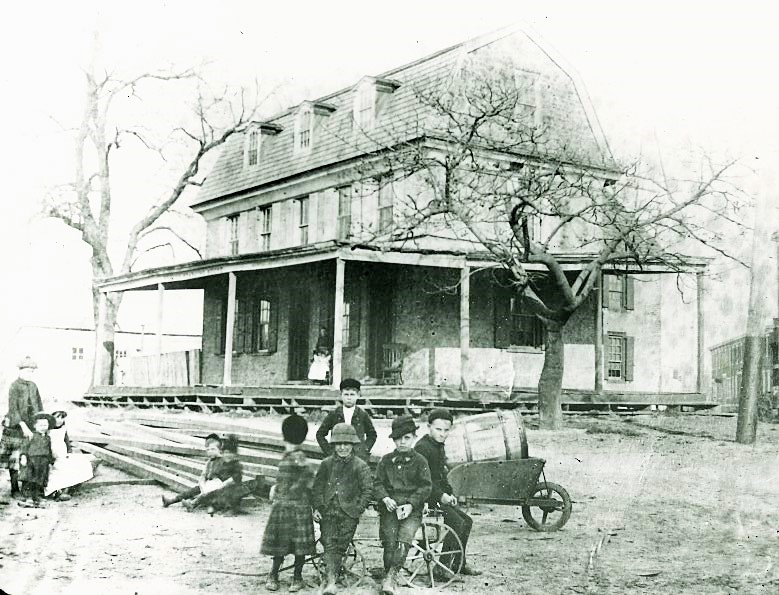
Children are shown at the turn of the 20th century outside the historic Benjamin Cooper Tavern in Camden, when it was known as the Tilton Boarding House. Built in 1734, the tavern has been renovated and will open as the American Revolution Museum of Southern New Jersey on June 20, two weeks before America’s 250th anniversary.
After a nearly 300-year history as a bar, hotel, shipbuilding company headquarters and boarding house, the Benjamin Cooper Tavern has been repurposed after a damaging roof fire.
Thanks to the efforts of the Camden County Historical Society (CCHS), the facility will open June 20, just two weeks before America’s 250th anniversary.
The society has raised money for extensive renovations over the last few years, and the exterior of the 18th-century tavern is almost complete, according to the historical society. The repurposed facility will be known on its first floor as the American Revolution Museum of Southern New Jersey.
The historical society will dedicate the museum to the overlooked American Revolution history of South Jersey. The project will also examine the promise of the Declaration of Independence’s statement that “all men are created equal,” and the struggle for equality to the present day.
The tavern – at 60 Erie St. in Camden – stands above a lonely stretch of overgrown ground along the Delaware River waterfront once known as Cooper’s Farm. It played a major part in the Revolutionary War’s Philadelphia campaign.
The Skirmish at Cooper’s Ferry took place there in March 1778, and the Hessians came through on their way to Haddonfield before attacking Fort Mercer on Oct. 22, 1777, during the Battle of Red Bank. Some 15,000 British troops used the tavern briefly during the evacuation of Philadelphia on the way to the skirmish in Haddonfield and the Battle of Monmouth.
The New Jersey Militia attacked the British encampment there, and 32 soldiers were taken prisoner or killed at the site, historical society executive director Jack O’Byrne said during groundbreaking ceremonies in summer for the $4-million restoration project.
“This is the most historic surviving building in Camden,” explained Chris Perks, president of the society’s board of directors, which secured a 30-year lease for the property and got a $1.4-million grant from the New Jersey Historic Trust to help fund the restoration.
Camden’s founder, William Cooper, retired in 1708 and gave his house, land and Cooper’s Point Farm – plus a Delaware River ferry – to his son, Joseph. In 1727, Cooper’s grandson, Benjamin, obtained a license to operate a tavern at the Cooper’s Point ferry. He bought 200 acres from his father in 1728 and built his house six years later.
Benjamin continued to operate the ferry – as well as an inn and tavern that offered food and beverages to people crossing the Delaware River from Philadelphia – until he retired and moved to another home in 1761. He arranged for Bradford Roberts to operate his ferry and tavern from 1762 to 1765.
He also held auctions of enslaved people at the site. According to historical society records, two of the larger sales of slaves were in 1762, when the slave schooner Sally delivered people from the Western African county of Gambia, and another in 1764 involving a sloop named Jenny.
The site’s history as a slave market has been acknowledged with the installation of several historical society markers in the area. The first in New Jersey was dedicated in 2017 at the corner of Cooper and Front streets, where ferries landed as early as 1727.
Benjamin’s son, Samuel, took over the ferry and tavern from Roberts in 1765. Samuel’s brother, Joseph, moved into the Benjamin Cooper House with his wife, Elizabeth Haines. But during the Revolutionary War, the English commandeered the home as headquarters for British Lt. James Abercrombie in 1777 and 1778.
After the war, generations of the Cooper family owned the site. In 1818, Joseph W. Cooper inherited the house and large farm and added a rear addition. At the time, the house served as a pleasure garden and was open to the public in spring and summer. It served as the last ferry tavern in Camden and as a saloon that in its later years was known as the Old Stone Jug.
Joseph Cooper began selling acreage at Cooper’s Point in 1852 for residential homes, warehouses, shipyards and manufacturing use. He continued to operate the ferry service and leased land to Taylor and Brown to open the first shipyard near the site.
Joseph and his son, Samuel Champion Cooper – who managed the estate – leased the Cooper House to Jacob Schellenger between 1855 and 1890; he operated it as the Schellenger Hotel. The hotel closed by 1891, and the Joseph W. Cooper estate leased the home to a boarding house operator who called it the Tilton Boarding House because it was adjacent to the Tilton’s Shipyard.
The John H. Mathis Shipbuilding Company purchased the house in 1913 and added a one-story addition in 1917 to serve as drafting room and office for engineers doing work for the U.S. Navy during World War I. Mathis built work boats and barges during the war, and after the federal Emergency Fleet Corporation directed an accelerated shipbuilding program in Camden County, the company built 15 sub-chasers and a variety of other vessels, including minesweepers, tugboats, and sea planes.
Camden Ship Repair purchased the property in 1965 and then sold it to a construction company in 1989, which used the site for storage until 1992. The house then became vacant.
Now, the Benjamin Cooper Tavern will be resurrected again as a museum, thanks to a group effort by the historical society and local, county, state and federal agencies. It will continue its life teaching future generations about America’s history.
