The First Oval Office Project came to Locust Street Park on May 16, a once-in-a lifetime opportunity to see a replica of the tent George Washington used on the battlefield and in encampments during the Revolutionary War.
The hand-stitched, marquee tent at the park would have belonged to the general, according to Jennifer Walker, of the Museum of the American Revolution in Philadelphia, and would have been set up anywhere Washington’s troops were encamped. It was a space where he could sleep, conduct business and store his baggage and personal belongings.
The tent is 14-feet wide and 23-feet long, with a total square footage about 300 square feet, Walker said. Even when proper housing was secured, especially during the winter months, Washington stayed in the tent to show his men that he wanted to be in the field with them.
“Even when Washington would have proper housing secured – especially during wintertime – he would still always set this tent up …” Walker explained. “I would imagine that it was important – psychologically – for his men to see that their commander in chief was willing to be in the field with them, even in different kinds of weather conditions.
“So I think it made a difference that he was among his men.”
In cooperation with the Philadelphia museum, the Moorestown First Oval Office Project – an initiative to recreate Washington’s war headquarters – took a year-and-a-half to put together and also featured associated replica tents, camp equipment and furnishings.
The Armed Forces Heritage Museum in Burlington displayed the 10 critical events in New Jersey’s Revolutionary War history and the artwork of students from the Upper Elementary School who participated in a related poster contest were displayed. There were also history presentations and Double Nickel Brewery brewed its product using Washington’s handwritten recipe.
Reenactors portrayed Ben Franklin, Washington and his wife Martha and Betsy Ross.
“It was something that the town believed in and we were able to deliver on it,” noted Linda Vizi, president of the Historical Society of Moorestown. “This town has so much history and has played an important part in the American Revolution, so to be able to bring this and to honor those people that helped make this country what it was, it’s really amazing that we were able to do it.”
The tent was based on the Museum of the American Revolution’s display and built with replicated construction techniques, according to Matt Skic, the museum’s director of collections and exhibitions, who portrayed a member of the Continental Army – specifically a fifer – at the township event.
The tent replica is currently used as an educational tool and travels the nation to inform people of Washington’s military leadership and how an army waged war in that time.
“With this 250th anniversary year, a lot of people are thinking about what the American Revolution is all about, who George Washington was and what he did, and this is a great tool to educate …” Skic pointed out. “These are important, formative moments for George Washington himself and his legacy.”
Writer/researcher John Rees portrayed a wagoneer in Washington’s headquarters for the Oval Office Project. During the war, Rees explained, they were relied on by the army to carry extra food and weapons, ammunition and other necessities. Wagons brought supplies to the army and performed other duties.
“You can always learn about the battles, you can always learn about the bigger events, but you don’t always get the history from the lower levels, and the thing with living history is that you want to know all the details because that’s what living history is made out of,” Rees noted.
“When you get to see a reproduction of the actual tent – which is as faithful as you can make it – we can tell stories of not just Washington, but also his servants with the tent and his soldiers that were with him.”
Justin Cherry, owner of Half Crown Bakehouse and resident baker at George Washington’s Mount Vernon estate, built an oven at Locust Street Park modeled on those used in early 18th-century Georgia. He baked fresh slices and loaves of bread for the township event, with provisions that mimicked war-time rations.
“ … It’s nice to see that people are excited about history, which today is very hard to find,” Cherry observed. “It’s not hard to look for, but it’s hard to find … In the early days of the revolution, we didn’t really know how to provide for an army because we never had an army before that was all united.
“Putting that together was a lot of work, but on top of that, you have to feed them also.”
Funding for the First Oval Office Project came from local sponsors and a grant to the Burlington County Board of Commissioners.
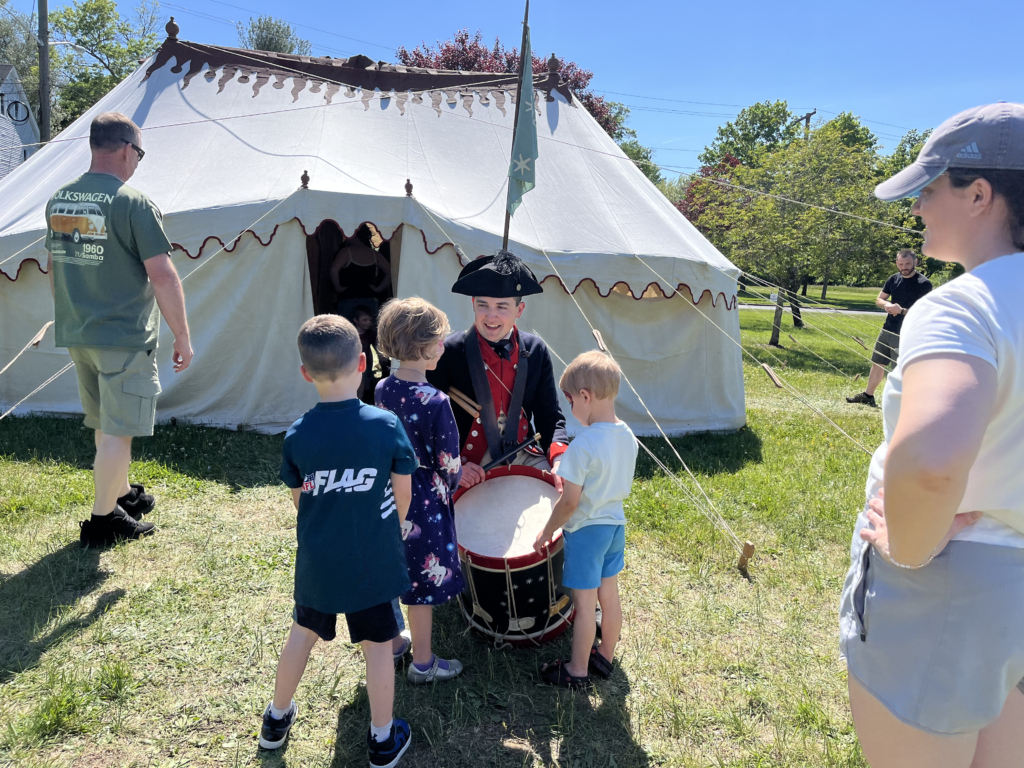
Matt Skic, director of collections and exhibitions for the Museum of the American Revolution in Philadelphia, teaches young residents how to play a drum at Locust Street Park during the First Oval Office Project on May 16.
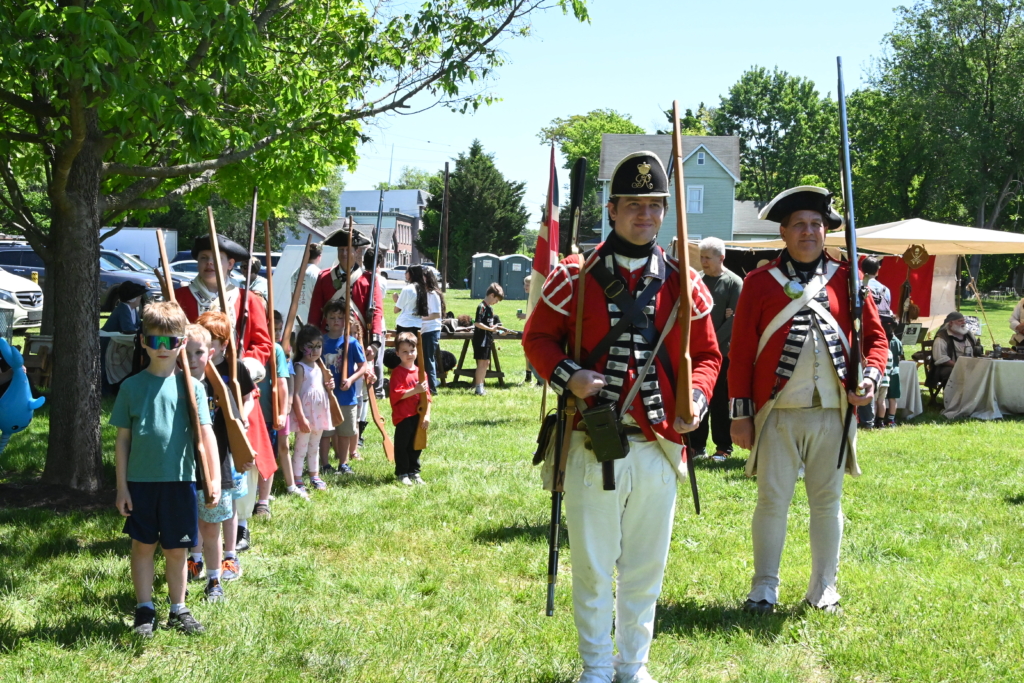
Reenactors at the First Oval Office Project in Locust Street Park.

