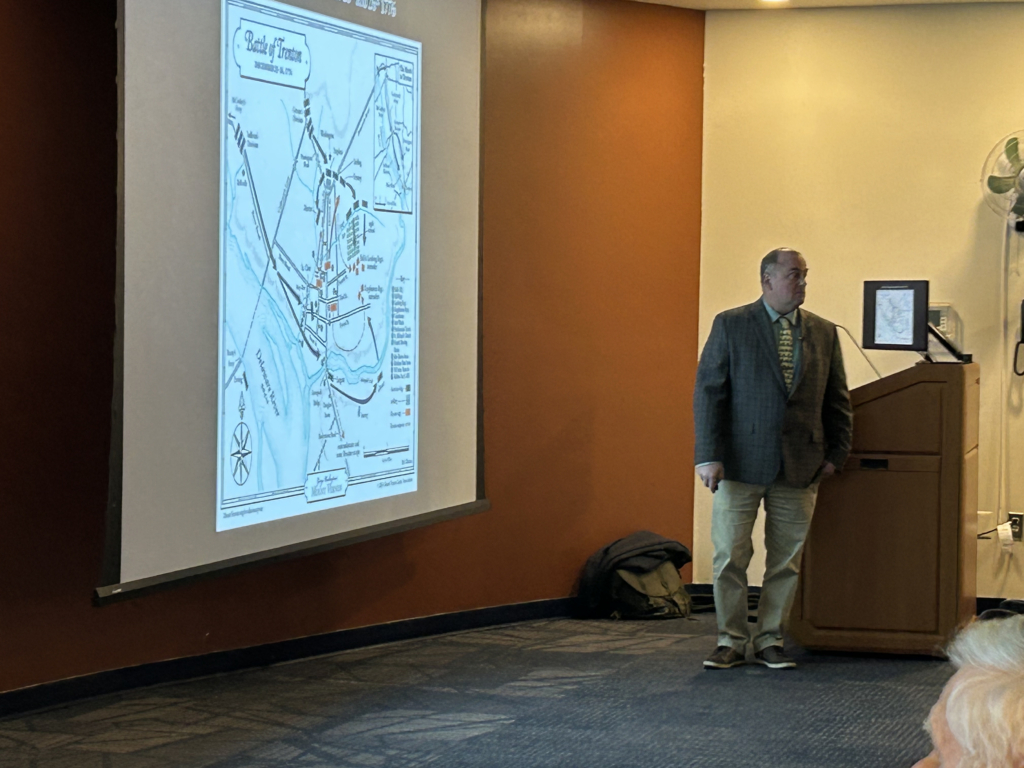
Michael Jesberger displays a map illustrating the Battle of Trenton during his presentation on Washington’s Crossing.
As part of its grant-funded series to commemorate America’s 250th anniversary continues, the township library held a Dec. 3 lecture on Washington’s 1776 crossing of the Delaware River and the subsequent battles of Trenton.
The discussion was led by Michael Jesberger, an independent military historian specializing in the Revolutionary and Civil War periods.
“You know, 250 years is not a lot compared to the rest of the world,” he remarked, “but it’s ours, our 250th So yes, we made it. We should be very pleased and very happy that we made it that far.”
Jesberger started off the discussion with a slide showing the most famous representation of the crossing, the Emanuel Leutze painting titled “Washington Crossing the Delaware.” But he also highlighted its inaccuracies.
“You have George Washington standing upright,” he explained. “Not a good move on a little boat like that with his leg first on the side of the boat. That’s probably not good either. Not good to be mixed in on such a small boat with the rank and file.”
But Jesberger acknowledged that the painting is an artistic representation of Americana rather than historical fact.
As he transitioned out of that and into the story of the crossing, Jesberger stressed that the crossing of the Delaware was a major turning point for the Continental Army during the war, with the summer and fall of 1776 seeing several massive losses among American troops.
“In the summer and fall of 1776, it’s an absolute disaster and total collapse,” he pointed out. “It’s incredible. In the summer of that same year, Washington takes command of an army, a rebel army, of 20,000 men, maybe the highest the army will be at.”
Jesberger explained that while those numbers seem low compared with the country’s modern armies and wars, it’s what Washington had to work with at the time. The British had control of New York, so Washington knew he had to make some kind of move to keep the revolutionary effort going. He formulated the plan for three crossings of the Delaware that would allow for a sneak attack on Hessian forces.
Due to a variety of setbacks and struggles, Jesberger emphasized, the group Washington led was the only one to actually make it across the river, though it faced challenges that delayed the attack, reaching the Hessians only during the day instead of taking them by surprise at night.
Jesberger also highlighted various local landmarks in South Jersey and the Philadelphia area that relate to the battle and the crossing.
“It’s an unbelievable part of your heritage and history here in New Jersey,” Jesberger observed, “and that’s where the Hessians would be.”
Jesberger also explained that at the site of Washington’s Crossing, there is a marker of the unknown soldiers who died.
“As we move into the festive season,” he advised, “we should always remember and reflect on our first veterans, because if we don’t, who will?”

