Photos courtesy of Jack Powers, MHS Digital Photography class, with teacher Rebecca Benson.
Bell to bell phone ban is making a difference in Millville School District.
Weird things are happening at Millville High School.
Check it out: Classrooms without kids on their phones. Lunches where it’s not unusual to spot a student reading a book. Hallways where kids greet their friends instead of walking and scrolling like zombies down B Hall. Wireless headphones? Banned.
Weirrrrrd.
Remember passing notes in class? They’re coming back, baby. Maybe not folded up like a football and flicked across the room. Yet.
Welcome to the new and improved school year. In schools around the state, flashbacks like these come courtesy of the state of New Jersey’s bell-to-bell cell phone ban. What that means is no phones are visible at any time, including in the hallways or at lunch.
When students first arrive, they are directed to put their phone into a Yondr pouch. That pouch is magnetically sealed, then usually stashed in their bookbags for the rest of the school day. They can access their phones at the end of the day, unlocking the pouch with magnets that are installed around the building.
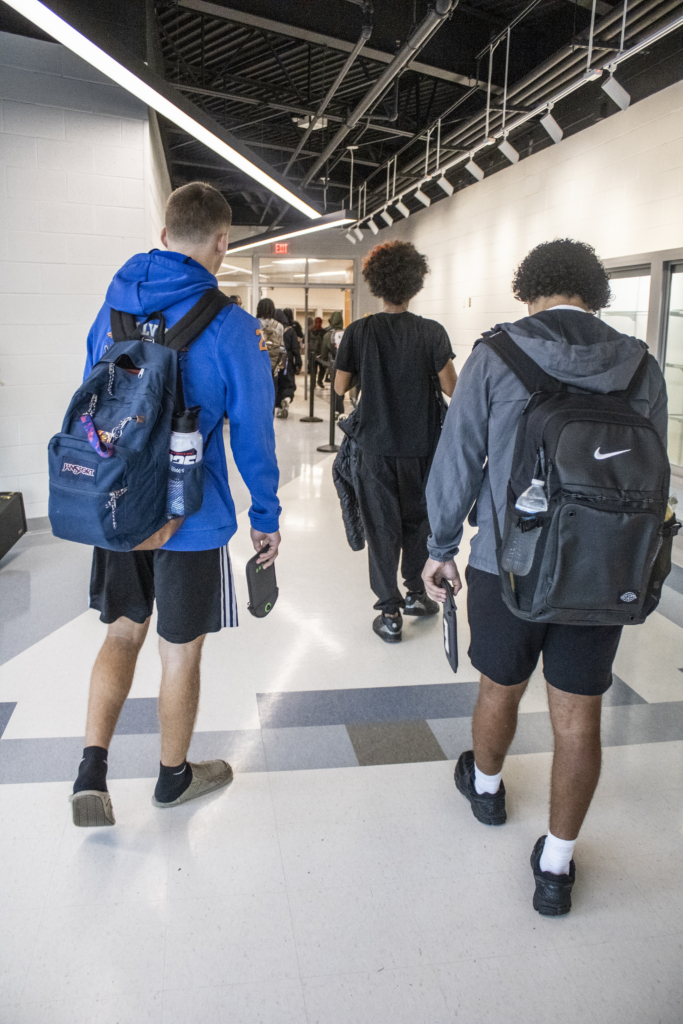
“It’s like we went back in time,” said veteran English teacher Lisa Breakell. “I love it.”
Last year, you could hear a pin drop during her junior class because her students would all do their work in order to use their phones. No one talking, no one looking up. The silence made her sad. That all changed, starting with the first day of school in September.
Breakell said the change reminded her of when she first started teaching in the mid-1990s, when cell phone use in schools wasn’t a thing. Without them, her students seem more focused.
“They want to interact with you. They want to learn. There’s not that awkward silence when you ask them a question.”
Like many teachers at Millville High School, German teacher Graham Gant is happy with the way the state’s phone ban has worked out. He’s noticed an immediate change in the classroom this year with the absence of cell phones.
“They’re here, and they engage with me,” Gant said of his students. “So, it’s worth showing up to work for.”
Before COVID, behavior regarding kids on their cell phones wasn’t perfect, but Gant and other teachers could work with them.
“After COVID, the kids stopped knowing when they needed to put them away,” he said. “Up until then…they knew better. After COVID, they almost seemed offended that you would tell them to put their phones away.
“Some of the apathy went out the windows with the cell phones,” Gant said. “(In previous years) you felt like a comedian whose show flopped. You couldn’t compete with the cell phones.”
What some students think: Students remain unconvinced the policy will work. Some think the state and school districts need to consider the realities of living in the 21st century before restricting access to technology.
Senior Issiah Thomas, 17, said many kids are dealing with serious home emergencies, but want to keep it private.
“I feel like we do need them,” he said. (School administrators) look at it like, ‘he’s just on his phone,’ but we could have a serious situation going on. And we don’t want the school to know. It’s between me and my guardian….”
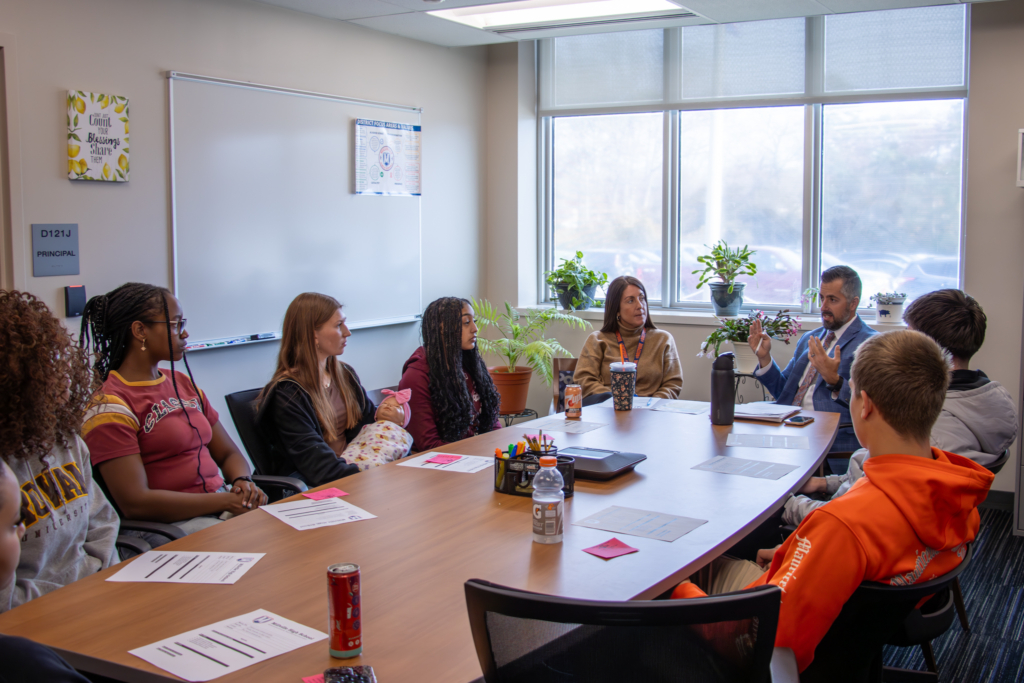
Millville High Principal Jaime Sutton and Millville Public Schools Superintendent Dr. Matthew Mazzoni met with members of the MHS Student Advisory Board in fall 2025 to discuss the cell phone policy. PHOTO: Meg Finney
Thomas would get calls from his mom instructing him on things he needed to do.
“It’s pretty bad because you don’t know what students have going on at home, things that their parents think are important,” he said. “I’m pretty upset about it. My mom tells me stuff that I need to do when I get home. Now, I can’t do that.”
Senior Na’Jay King wanted to spend her last year of high school documenting her memories—lunchroom selfies, everyday life in and out of the classroom, and major events.
Now, she can’t do that.
“I want to record with my friends and take pictures with each other,” she said. “Once we graduate, we will all go our separate ways, and we won’t see each other again. So, that is what made me upset.”
Senior Ayana Parham sees the benefits of controlling cell phone use.
“There are less fights,” she said. “And students are talking more.”
Still, she would have preferred a policy that assigns a Yondr bag for students caught abusing their phones instead of assigning everyone a pouch.
Parham was one of the school’s student leaders asked to observe a cell phone ban at Sterling High School in Somerdale, an early adopter of the cellphone ban that preceded the state’s bell-to-bell policy.
“To be honest, I don’t really use my phone,” she said. “My grades mean a lot to me.” She said that many students like her want good grades and know to stay disciplined.
“It feels like a disciplinary thing for us. Not all students abuse their phones,” Parham said. “We live in a world where we need our phones. And it’s not really teaching us how to manage our phones.”
She does see the state’s point of view on banning phones.
“The phones do cause problems with drama and fighting,” she said. “And everyone is more talkative. The (fewer fights) are a plus, and people being more talkative is a good thing.”
Don’t damage your Yondr bag: In breakrooms and between classes, teachers like Breakell are swapping tales from the trenches. There’s the kid who is asked for the time and absent-mindedly whips her phone out of her pocket in front of a teacher to answer. Another student whose phone goes off in front of Attendance Office staff. Furtive attempts to make phone calls in the bathroom are commonplace, but bathrooms are usually guarded and not all of them are open.
Kids are still sneaking phones into the school, and when they are caught with them, face an eight-step disciplinary chart that becomes more severe every time they violate the policy.
Some kids have tried to open the pouch by wedging pencils into the sides; others try to rip the neoprene fabric. Either way, damage the pouch and you will simply get another one, followed by a bill of $30 to replace the one that was damaged.
Ahead of the trend: Millville was ahead of the curve when it came to cell phones in school, said Dr. Matthew Mazzoni, superintendent of Millville Public Schools.
Before the state put its ban into place, Mazzoni and Jaime Sutton, MHS principal, established a committee with administrators and teachers to study the issue. The committee then met with student leadership. Both recognized the importance of getting ahead of the issue.
“Even before this became law, we identified this as a crucial issue,” Mazzoni said.
After meeting with teachers and administrators, they met with student representatives such as Parham. Mazzoni said research was solid that cells were “having a negative impact on students’ well-being.”
“We didn’t come into it from the mindset that we would ban (cell phones),” he said. “But how can we create a better opportunity for kids to learn, without interference from the cell phones?”
Not long after that, Gov. Mikey Sherrill announced the ban.
“All we see is a lot of positives in this,” he said.
Recently, Mazzoni wanted to see the cell phone ban in practice for himself, touring the school with Principal Sutton. They walked near the large cafeteria, finding a group of students standing in a circle playing that old early ’90s game, Hacky Sack.
“It’s so refreshing to see that,” he said.
Still, it’s an uphill battle, Mazzoni acknowledged.
“Kids are built to test the limits of what we are doing. We’re getting back to teaching and learning and engagement without the interference of social media and cell phones,” he said.
Bottom line: This will take time.
“No environment is perfect,” he said. “But at the end of the day, we are trying to change the culture.”
On the front lines: Dave MacDonald spent 25 years as a Millville police officer. These days, he and his fellow security personnel are in charge of helping the district enforce the cell phone policy. In short, he is one of several on the front lines of the bell-to-bell ban.
Security greets students at the door, ensuring they have their phones in Yondr bags. Missing or broken pouches will send a student to the nearby auditorium. A phone found without a pouch is put into an envelope and taken to the attendance office, where it can be retrieved at the end of the day.
During the day, security guards like MacDonald are tasked with taking students with unsecured cell phones to a vice principal to be disciplined.
The process isn’t perfect, MacDonald said, adding that students are still finding creative ways to access their phones. Still, it’s an improvement over last year. Security guards estimated that they catch several students a day with cell phones.
“You have students who have no problem with it,” said security guard Chemyra Bowman. “Then you have students who are losing their minds. They don’t know what to do.”
The students have all sorts of reasons why they need their cells.
“The funniest one is, ‘I don’t know what time it is,’ ” Bowman said. “I point at the (analog) clock in front of me and they’ll tell me, ‘I don’t know what that clock says.’ ”
Bowman thinks that, with time, it will all make more sense to students.
“As days go on, it becomes more understandable to the students. This is something that will help them, not hurt them.”
From Bowman’s vantage point in the hallways, the policy is working.
“My hallways are clear. Kids are not taking as long in the bathroom. No Tik Toks in the bathroom,” she said.
When the policy first took effect, security collected as many as 30 cell phones, taking them into a secure area in the building, where they were returned after school. Recently, there were only nine.
“I think (the policy) changes the whole atmosphere,” Bowman said. “I find it to be positive.”
“It’s not going away”: Principal Sutton wanted her teachers to focus on teaching, not on cell phones.
“At the high school, we wanted to take the lift off the teachers with having to address cell phones,” she said. “Cells are dealt with at the door. If a student chooses to have a device, we make a call to a vice principal or security and they step in. Now, the teachers can teach and there’s no distractions. We took those distractions away.”
Sutton loves walking through her hallways now.
“There’s more engagement, student to student or student to staff,” she said. “There’s ‘Good mornings!’ and there’s ‘How are you?’ There are conversations happening.”
Lunchrooms are much louder. “But louder in a good way,” she said. “They are eyeball to eyeball.”
Sutton says teachers she’s met with see it as “an absolute positive change,” and she’s been amazed at “how students have adapted and accepted it.”
“I would say right now that it has been the biggest change with the biggest positive impact,” Sutton said. “Not only for staff, not only for students, but for the whole community.”
Some teachers have heard students say they think the cell phone ban can’t last. Sutton is here to disabuse them of that notion.
“It’s not going to go away,” she said.
Lorinda Jarvis is employed as a full-time paraprofessional for the Millville Public School System.
MHS Disciplinary Levels for Cell Phone Violation
1st offense: Device confiscation; parent is contacted and classroom restriction.
2nd offense: Device confiscation; parent conference and parent must pick up device; two-hour detention and signed device agreement.
3rd offense: One-day in-school suspension and parent device pick-up
4th offense: One-day suspension, parent device pick-up and principal conference
5th offense: Two-day suspension, parent is contacted and guidance referral
6th offense: Three-day suspension; parent conference and behavioral contract.
7th offense: Five-day suspension, parent conference and behavioral contract.
8th offense: Referral to alternative education.

