Virginia creeper carpets this rocky surface with autumn color. Photo: John Hall, Maryland Diversity Project
I’ve always had assistance in the spring when it comes time for planting the annual flowers, but in recent years I often have a greater amount of help throughout the growing season as well. Since our yard is filled with native species, knowing what stays and what is considered unwanted is difficult for a traditional American landscaper to discern. Sadly, most Americans see exotic ornamentals as desirable and native plants as weeds.
In fact, a number of folks who have helped us out probably need a quick course in native flowers in order to recognize what we consider to be weeds (in other words, unwanted plants). The problem is compounded by the “good stuff” having names that imply an undesirable garden occupant—butterfly weed, jewelweed, common milkweed, Joe-Pye weed, ironweed, sneezeweed, pickerel weed, and a host of others. It gets even more complicated when I decide that a desirable native species is overly prolific or aggressive and is crowding out the others, such as obedient plant (a misnomer for sure). In this instance, it may need to be thinned or moved to a different location. Natives can tend to flourish beyond our expectations, because they are well-suited to our region and its soils.
I may relay to a helper something like this: “Yes, it’s a desirable plant in this spot, but I don’t want it to be over there where it’s crowding out the wood aster.”
These instructions can sound contradictory and ridiculous, possibly because at times they are, indeed, contradictory and ridiculous. My husband, justifiably, is continually frustrated by my desire to change the location of a patch of plants. Birds and wind don’t make the situation any easier when they redesign my yard by sowing goldenrod everywhere. (Note: Goldenrod supports more than 400 pollinators—but also shows up everywhere).
My helpers surely shake their heads and roll their eyes when I do my Virginia creeper lectures. When this plant appears it’s really a wonderful player, but unfortunately if it is too hardy it may blanket a desired plant beneath it. Or, on the plus side, it may climb up to the heights of a tree and be stunning.
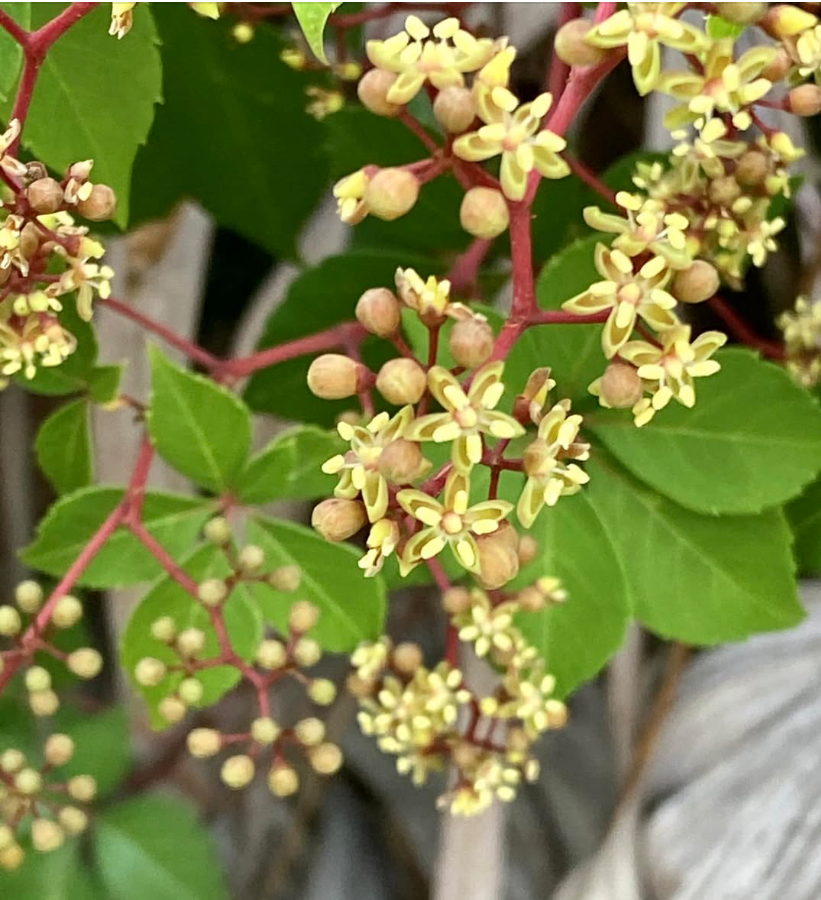
The blossoms of Virginia creeper offer nectar to pollinators. Photo: Jo Anne Gardner, Florida Native Wildflowers •
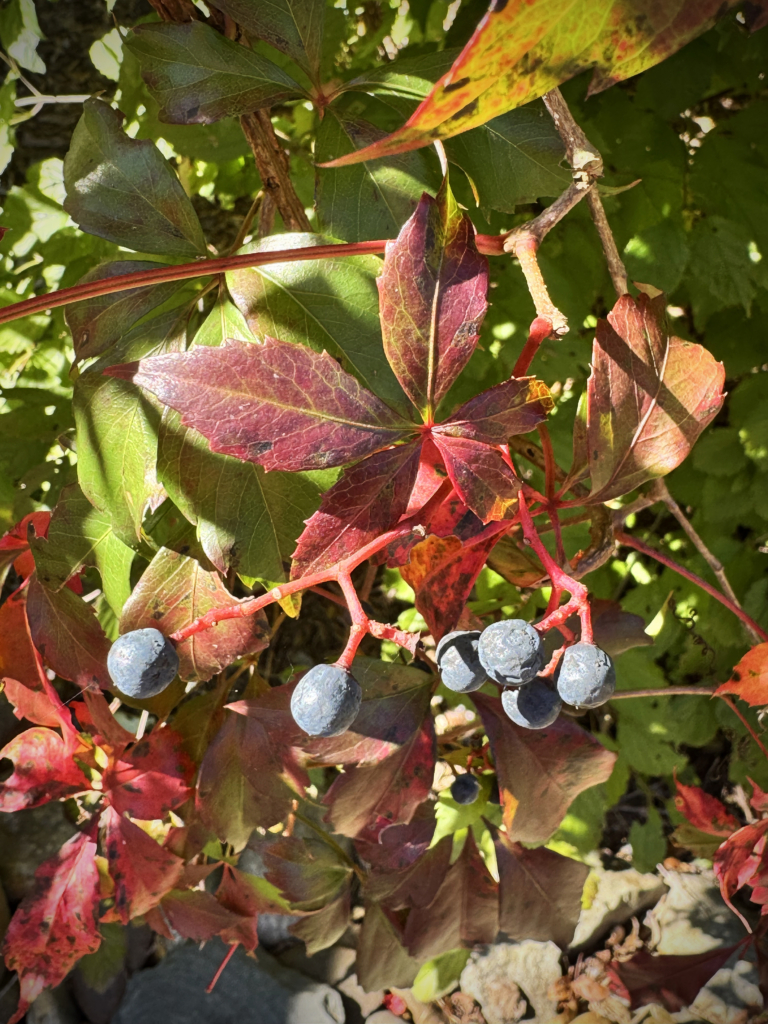
RIGHT: Virginia creeper offers sustenance and color to the garden in fall. Photo: J. Morton Galetto
To add to the confusion, I have to explain continually that it is not poison ivy: “See, it has groups of five leaves and poison ivy has three. Yes, they are both vines but different.” There are two children’s mnemonics to aid in poison ivy identification—“leaves of three let it be” and “hairy vine no friend of mine.”
Then it only gets worse from there: “Yes, poison ivy is beneficial and birds love the berries. But Peter (my husband) is susceptible to getting it very easily. So we need to get rid of it if it is along paths.” The directives are “leave some of the Virginia creeper but let’s remove most of the poison ivy.” Note these instructions can seem very subjective.
Virginia creeper and poison ivy both have tendrils that affix the plants to the surface of bark, brick, stone, or any rough surface, but poison ivy’s are on steroids by comparison—much “hairier.” Neither plant strangles its support like invasive Oriental bittersweet or Japanese honeysuckle, which chokes or smothers trees. Note: Their common names are the first clue that they don’t belong in North America!
So why do people use ornamentals in their landscaping? Well, in part because no self-respecting insect is interested in them unless they too are exotic. For example, the invasive Tree of Heaven and the spotted lantern fly are both exotic and the fly’s larvae rely on the tree’s leaves.
An absence of insects can give the American yard that plastic look—no holes, no brown spots, no deer. Doesn’t it sound lovely? Hint: Please say, “No, no it doesn’t.” To add insult to injury most people spray insecticides just to insure nothing lives. Okay, that is a bit harsh, but actually U.S. homeowners and residential consumers spend approximately 3.3 billion dollars on garden pesticides each year, not to mention the products used to augment the soil because the species aren’t native and many need additives like fertilizers or lime to thrive. Native plants like native soils, and generally those products are not necessary to help the natives thrive, which is a big plus.
Entomologist Douglas Talamy often points out that no one can spot, from the street, the small holes made by caterpillars in your oak’s leaves. So you could save money and time, feed a bird, and help the earth’s health by simply not using pesticides just to make a tree look more attractive.
When we plant ornamentals extensively, we also cheat native wildlife of what it needs to survive, primarily because we aren’t providing food for insects. So what? Well, our own health relies on insects for nearly everything—beginning with the food we eat, but also including the spiritual high we get from seeing a butterfly flit by, or making a wish on a ladybug, or blowing the tiny umbrellas from a dandelion’s seed head, or seeing a bird raise its young.
As homeowners we battle all kinds of plants that other people introduce within who-knows-how-many miles of our properties. The seed can arrive in our yard via bird droppings, by wind, in the soils of the annuals I purchase, on the river, or by who knows what other means. They come to our yard because someone planted them in their own yard. Maybe even from me over 30 years ago before I knew better.
Let’s get back to Virginia creeper. Folks grow all kinds of vines that they somehow think are better than natives, maybe because they paid for them. Most people have no idea how really horrific they are for the environment. Our natural areas become choked with them and they displace desirable native plants that support native species of animals, including those necessary insects as well as many birds we enjoy seeing.
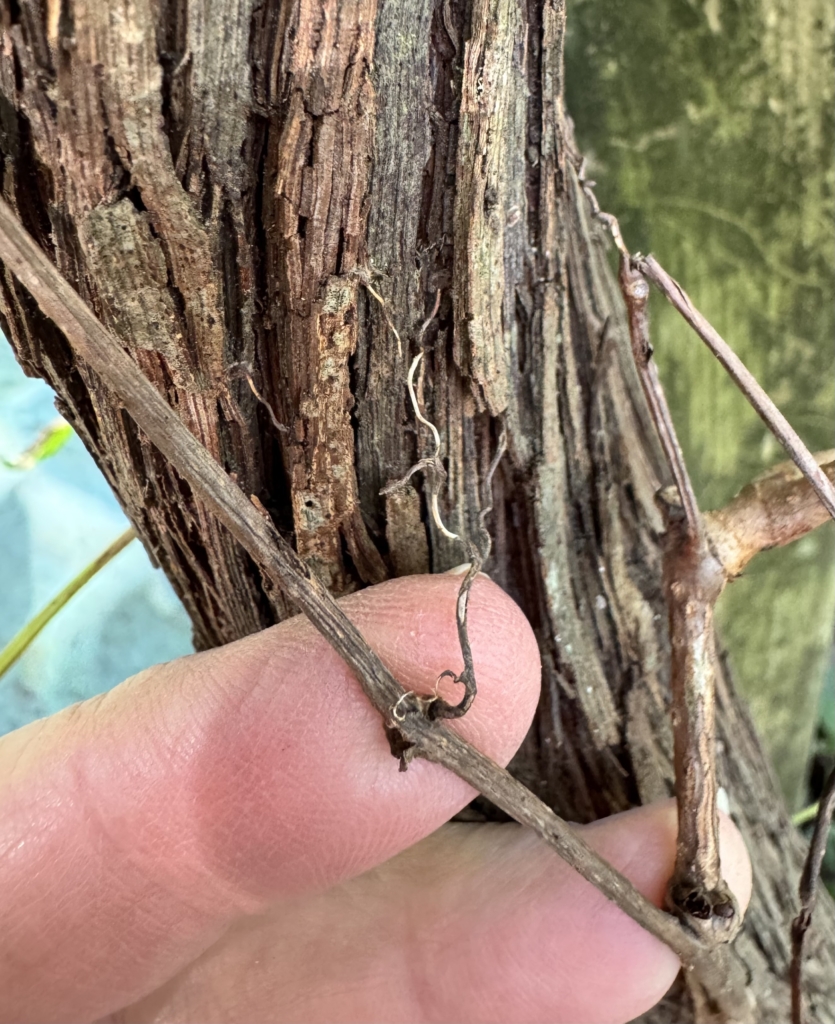
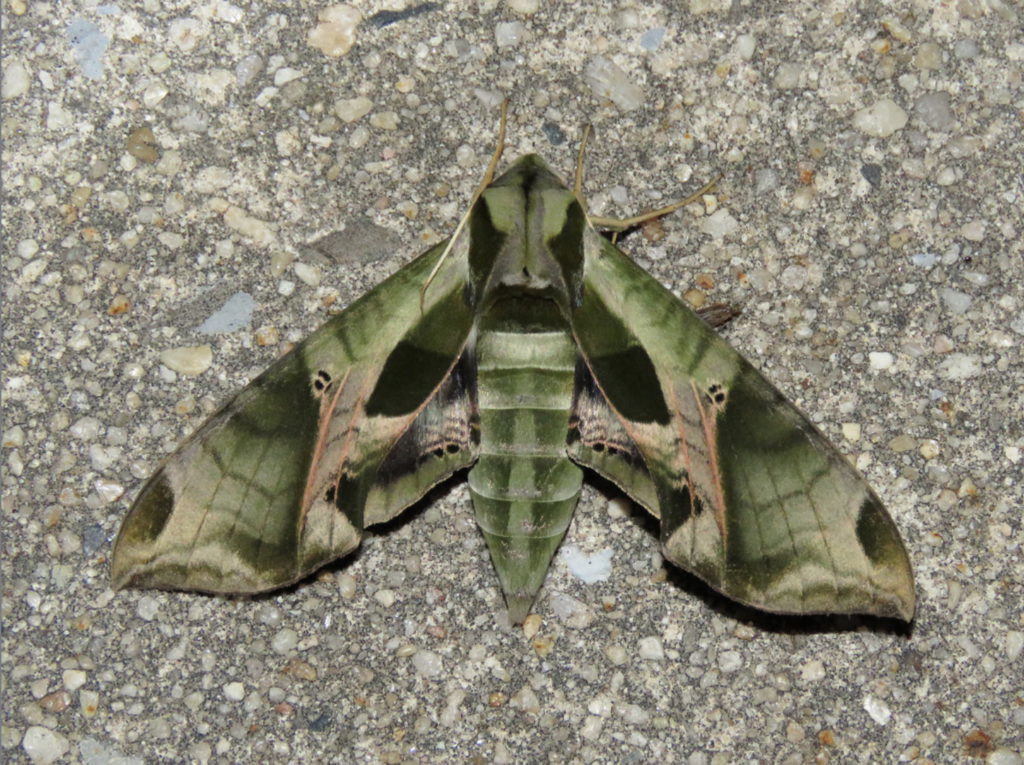
A heavy grapevine offers support to the thin stem of Virginia creeper. Note the tendrils attached to the grapevine. Photo: J. Morton Galetto • RIGHT: A number of sphinx moths rely on Virginia creeper as a host plant for their larvae. This is the lovely Pandorus sphinx. Photo: Brandon Woo
Here are some of the worst non-native vines—oriental bittersweet, non-native clematises, Asiatic tearthumb, mile-a-minute, kudzu, English ivy, Japanese honeysuckle, Chinese and Japanese wisteria, and porcelain berry. A number of folks tell me, “But they’re pretty.” To which I want to reply, “Yes, pretty awful,” as I try to explain why, ecologically, they are a bad choice.
So what vines can well-intended folks plant? There are so many good native alternatives to alien ornamental vines. Some in the Mid-Atlantic region are crossvine, trumpet, virgins bower, coral honeysuckle (not Japanese), Virginia creeper; American wisteria, American bittersweet, moonseed, and woodbine are all native selections. Some grape varieties are winter, raccoon, riverbank, fox and frost. There are others that grow just a bit south of our region that may be good choices as global warming moves species northward. We will leave native alternatives to exotic shrubs and trees for another time.
You will need a reputable nursery dealer to be sure you are choosing a native species of a specific plant and not a similar alien species. Pat Sutton on her Garden Gang website provides lists of native species dealers, and if you join her group she frequently sends posts of plant sales and other useful information.
Virginia creeper is a native species and lots of animals like its berries. The larvae of a number of sphinx moths eat its leaves, including the showy Pandorus. Its foliage offers cover to small animals; in the fall it provides berries, and its foliage offers lovely colors to the garden and woods. Earlier in the year its small blossoms are used by pollinators.
Virginia creeper holds soils and prevents erosion. The Natural Resources Conservation Service, a division of the United States Department of Agriculture, gives instructions on how to propagate it because of its virtues. However, the berries are toxic to people, so don’t eat them.
Although it prefers moist soils it is drought-tolerant and grows well in our low fertility soils so that required maintenance is minimal. It will even flourish in coastal dunes. It also likes borders that offer some exposure to the sun.
Passionate rant aside, I hope this gives you a new perspective on Virginia creeper and the importance of natives in our landscape. Next time you encounter it, don’t just yank it out—give it a second look! With all its great traits, it might just deserve a spot in your yard.

