Musk oxen are very interesting looking, similar to a smallish bison. Their fur is so thick that it’s impossible to feel their skin. They need this coat for protection from harsh climates. Photos by the author
By Christine Ward Garrison, Ph.D., CU Maurice River
Guest columnist shares her citizen science vacation experiences with Earthwatch.
Sandy beaches, shopping, and infinity pools are vacation paradise for lots of people. For me, more active time with unusual experiences in unusual places is the ticket.
My husband and I are especially keen on animals, and to indulge that interest we took many trips with an organization called Earthwatch, which provides wonderful opportunities to engage in citizen science. They offer research-based expeditions in a variety of disciplines around the world. These are organized by caring professional scientists who want to give back to their communities, share their expertise, and help conservation.
The six Earthwatch expeditions we took were all hugely memorable. For example, in rugged Idaho we studied mountain lions. Once I actually held a three-month-old wild cub while the scientists administered his vaccinations. On another outstanding day, Bill and I sat alone beneath snow-decked pine trees waiting for a gorgeous, huge, male mountain lion to wake up from the sedation that had allowed scientists to gauge his health and size.
It was our job to ensure that Lance went uphill when he awoke. Going downhill in the deep snow might have taken him to an icy ravine, whereas going uphill was safe. Of course, when the big cat awoke, he didn’t take my suggestions about that seriously at all, but Bill is noticeably bigger than I and succeeded in herding him in the right direction. Lance definitely seemed to eye him skeptically even as he trudged uphill. I often think of Lance as one of God’s most perfect and beautiful creatures.
The first Earthwatch expedition we took was to Alaska to study the diets of musk ox. These unusual beasts are remnants of the Ice Age and look the part. The research project provided important information to help them survive into the future. The study was located at a research station at the University of Alaska Fairbanks. The facility included both musk ox and caribou, plus laboratories, barns, giant fenced-in pastures, animal shelters, an observation tower, and a house for the eight volunteers.
One way we amused each other was by writing on the white board that was very conveniently located in the outhouse. The theme of the scrawled comments centered on the topic of lime, which blocks odors. “All you need is lime,” “Lime, lime me do,” and other Beatles’ lyrics got us all scribbling. Who knew an outhouse could be such fun?
Our role included general help around the buildings and grounds, plus weighing, feeding, and even socializing the musk ox. They were not domesticated but had to be tolerant of people in order to be studied. I will never forget the terror in the eyes of three young animals when Bill and I helped the little trio become more familiar with people. They were in a stable and backed themselves into the corner, hip to hip, just as their ancestors have done for millennia when threatened. These three were unbelievably cute but they would grow up to be 400 pounds or more for the relatively placid females and up to around 900 pounds of aggression for the males.
An interesting responsibility for the volunteers was to track every movement of the musk ox over three-day periods. The animals were divided into groups, with red or green painted on their backs for identification. Each of us observed and recorded any activity by the animals from the observation tower, in shifts around the clock. Especially during the overnight hours, we felt close to the animals and to the starry, starry nights. We had a tiny radio there and it frequently played the Beach Boys’ song about Aruba, Jamaica, etc.: Bill and I always refer to that as “the Alaska song,” and think of those special times.
When we weren’t helping with the animals or chores, our free time allowed us to explore the Fairbanks area. Our mid-expedition weekend off included a trip to Denali National Park, which provided lots of wildlife viewing. Because we were in Alaska in early October we were also able to see the Northern Lights, which filled the entire sky with unimaginable colors.
Bill and I learned a lot on this expedition and the others, from scientific data collection to the camaraderie of fellow enthusiasts, graduate students, and dedicated researchers. In subsequent years we participated in studies involving wolves in Poland and Minnesota, the aforementioned mountain lions, and even salmon in Washington State.
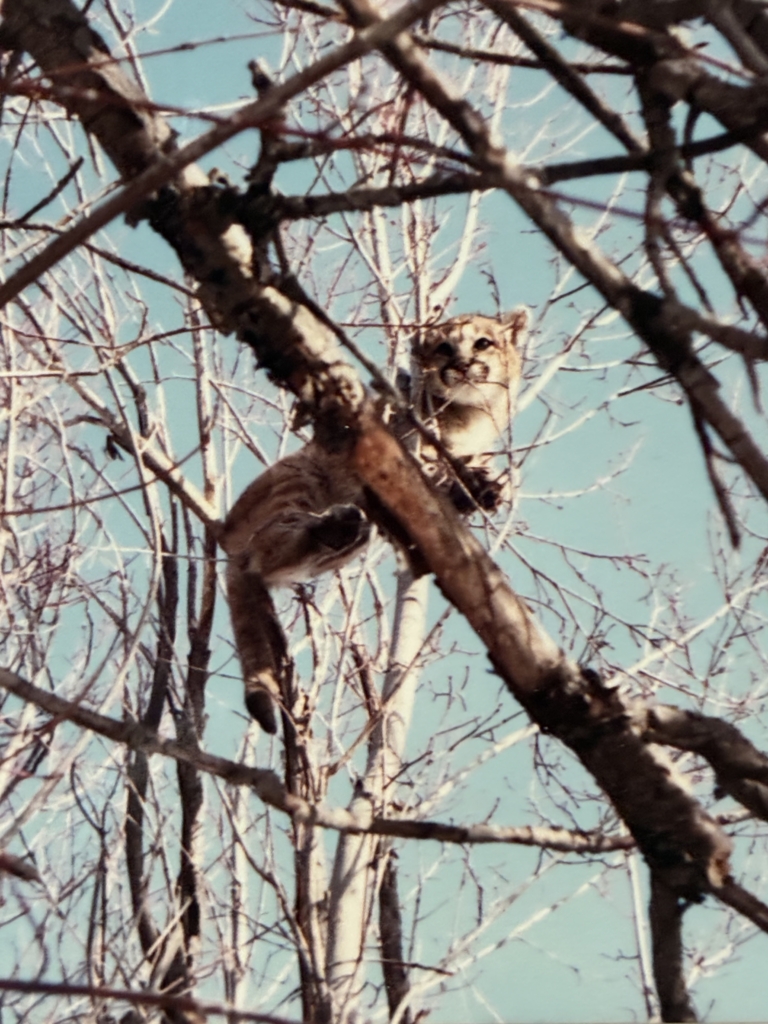
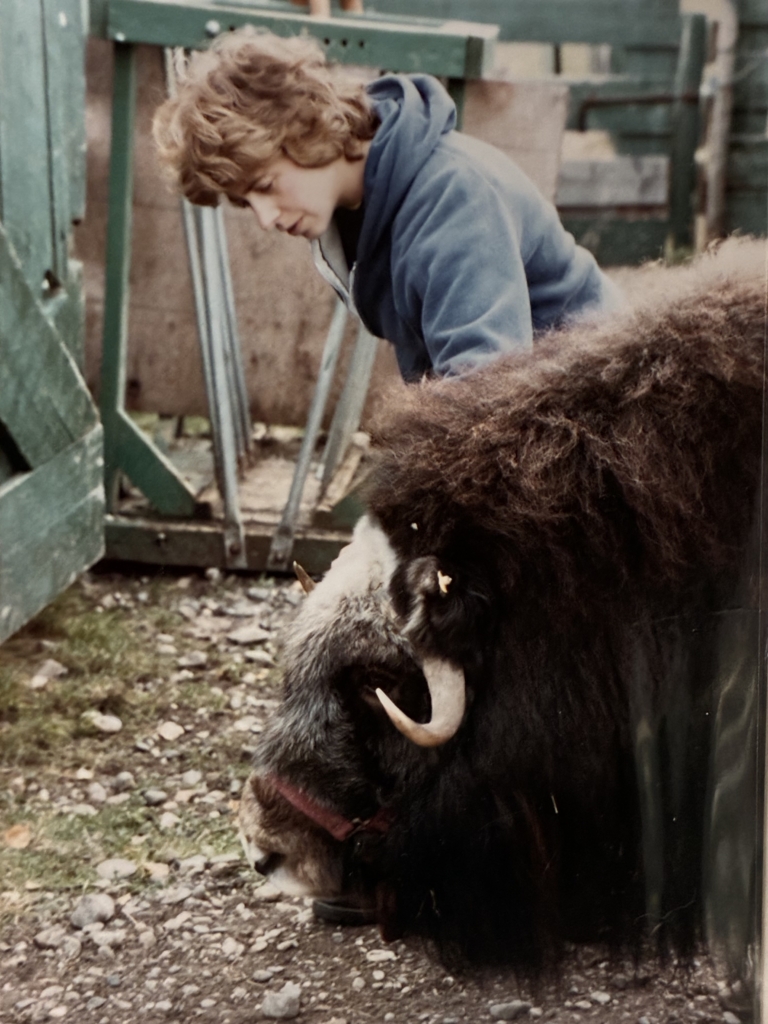
Before Clyde, the mountain lion cub, was ready to be vaccinated, he had to agree to come down from this small tree. He was only three months old and offered little resistance. The incident helped to ensure his future good health. RIGHT: Our (much younger ) author is shown here steering an adult female musk ox in the direction she was meant to be heading. When these adults vocalize, they sound just like African lions roaring. Photos: C. Ward Garrison
Our most exotic trip was called Exploring Dolphin Intelligence. The site was the Kowalo Basin Marine Mammal Laboratory in Honolulu, part of the University of Hawaii. The research subjects were three females and one male bottlenose dolphin who resided on the premises. All of them were quite vocal and obviously enjoyed time with their human friends. It was a joy to be around dolphins, whose capabilities are astonishing. Vocal mimicry, image interpretation, verbal and oral memory, and visual acuity in both water and air are just some of their skills. Once, we observed a training session that involved the dolphins selecting from multiple-choice options to match complicated shapes above the pool deck to underwater shapes behind a screen. One dolphin selected the wrong answer and was visibly and vocally very upset with herself!
As volunteers, we prepared food, collected and entered data, and helped with general upkeep. Our most entertaining—and thrilling—responsibility was practicing the dolphins’ gestural language. We didn’t speak dolphin, but they possessed a large vocabulary of human movements that they could see us make from the edge of the pool. Our commands included somersaults, backward swims, presenting various body parts for medical inspection, and about 35 others! The only limitations were, I admit, ours. For example, we could make a series of gestures that signaled something like, “Go out for a pass, put the ball into the hoop, jump into the air, roll over, and give me a kiss.” They virtually never made mistakes. And dolphin kisses are rather salty.
We felt privileged to try to help animals live their best lives. Since our travels with Earthwatch, the organization has become a sub-brand of Natural Habitat Adventures (nathab.com/Earthwatch). They still support participatory science that helps individuals feel more connected to our planet. The current choice of expeditions is limited but growing rapidly. Earthwatch has also made a conscious decision to upgrade accommodations, meals, and local excursions. Their expeditions continue to aid scientists and our planet while providing a treasure-trove of memories for anyone fortunate enough to experience an Earthwatch expedition.
About the Author: Christine Ward Garrison, Ph.D.
Chris began her career in education, working as a substitute teacher in the Millville Schools starting at age 18. She later worked at Salem Community College, Cumberland County College, and Cedar Crest College, in Pennsylvania. Upon her return to life in Cumberland County, she was employed by local hospitals, most notably at Newcomb Medical Center as Associate Vice President of Community Services. For over 20 years, she worked at the Cumberland Cape Atlantic YMCA, in Vineland.
Her current community activities include serving on the boards of the YMCA and the Cumberland County Educational Foundation. She holds a B.A. from Muhlenberg College, an M.Ed. from West Chester State, and a Ph.D. from the University of Pennsylvania. She and her husband, Bill, live with their superdogs, Holly and Kaiser, near the Manumuskin River.

