Ashley Rosser was 40 years old when she was diagnosed with breast cancer.
Like many people diagnosed with cancer, she never thought she would be the one going to doctor appointments, getting surgery and enduring rounds of chemotherapy, especially while she had a husband and three young children at home.
It was late 2022. The Mullica Hill native and Williamstown resident had only been a few years retired from her career as a registered nurse in the emergency department at the Children’s Hospital of Philadephia (CHOP) and started working full time at Victory Wealth Partners, a Mullica Hill-based firm her father founded that she now is the president and CEO of. She was healthy. She completed a full Ironman Triathlon just a year before.
She had a script to schedule her initial 40-year-old mammogram screening appointment sitting on her counter, untouched, for about two months. It was not until Rosser saw a friend the same age as her post about starting radiation for breast cancer that pushed her to get checked out herself.
“It literally stopped me in my tracks, like it punched me in the face,” Rosser said. “It just seemed so beyond that someone who was my age who I worked with (at CHOP) had been diagnosed with this. Then it was like God reached out right there and was like, ‘You do not go anywhere until you schedule your mammogram.’ So, sitting there with my cellphone in my hand, I picked up my home phone and called South Jersey Radiology, and I made the appointment for the mammogram.”
Rosser then messaged that friend, thanking her for the kick she needed to schedule her mammogram.
“Little did I know that literally a few weeks later, I would be messaging her again that I had breast cancer,” she said.
Rosser said her mammogram initially came back suspicious, and after a biopsy, which confirmed she was stage one ER/PR positive, a hormone that indicated she had breast cancer. Shortly after on January 3, 2023, right after the holidays, Rosser got a bilateral mastectomy, which her surgeon recommended since she was young and there were aggressive features in her tumor.
“We were all very hopeful that I would not need chemotherapy, because everyone kept saying it’s so small and it’s so early,” she said. “The pathology came back and recommended the need for chemo, and not just chemo, but a fairly extensive, aggressive chemo, and that was a result of just the biology of the tumor itself.”
In February, she began her journey of 16 rounds of a kind of chemotherapy often considered “Red Devil” because of how aggressive it is, and it lasted almost six months. Rosser was happy to do whatever she needed to do to treat her cancer, especially since she was fighting for her kids.
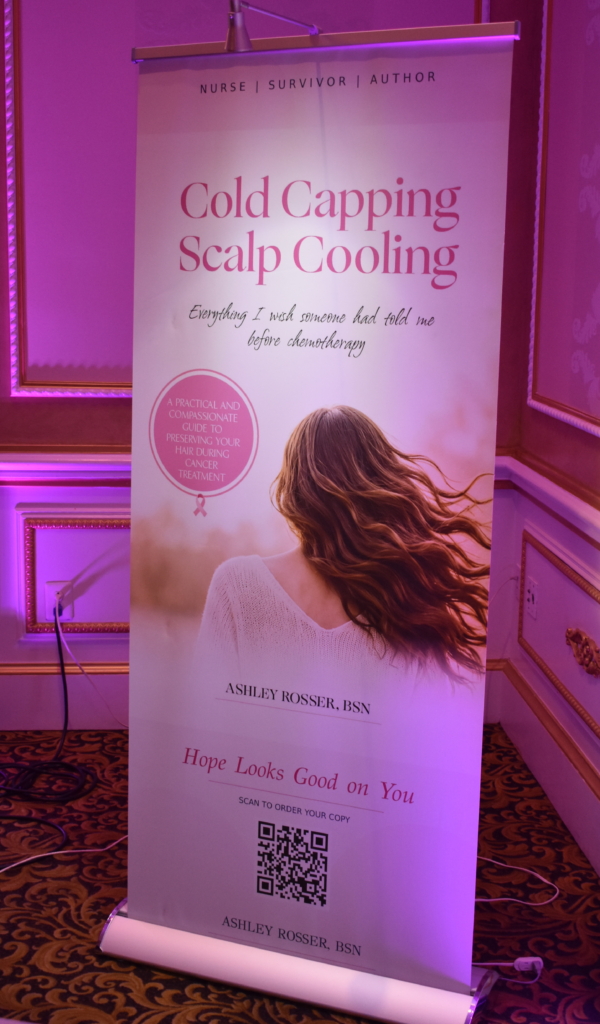
A banner with the cover of Ashley Rosser’s Book, “Cold Capping & Scalp Cooling: Everything I Wish Someone Told Me Before Chemotherapy.”
However, while discussing everything pre-chemo with her healthcare providers, she had a “jarring” moment of pause when they told her, “You will lose your hair. Here’s a script for a wig.”
“It was just so matter of fact,” Rosser said. “I asked about cold capping, and they didn’t really have any information on it. It was basically like, ‘If you can figure it out, you’re welcome to try.'”
Rosser did want to try — she needed to. Her youngest child told her he was incredibly fearful of seeing her without hair. She knew she needed to give cold capping a shot.
So, she did. She spent countless hours researching and learning about all-things cold capping, and she used the company Pengiun Cold Caps during her entire treatment.
Cold capping is a non-invasive and drug-free method that can reduce the percentage of hair loss during chemotherapy-induced hair loss. The cold caps are stored on dry ice and come out to be about negative 32 to negative 40 degrees Celsius, according to Rosser, because the extreme cold will help prevent the chemo from penetrating and damaging the hair follicles often attacked during it. The cap is placed and secured onto the cancer patient’s head before, during and after chemo sessions.
Rosser said in her personal experience and research, patients start cold capping 50 minutes before the initial chemo infusion begins, and then the cap is changed every 25 minutes throughout the session. After the chemo session is over, in the “post-hold” portion, patients will need to continue wearing it. In Rosser’s case with her “Red Devil” treatment, she cold capped in her post-hold for five and a half hours.
Now, at 44 years old, Rosser is a breast cancer survivor who kept 85% of her hair and is sharing her knowledge with others on their own fights with breast cancer.
In 2024, Rosser started her company Compassionate Cold Capping, a Philadelphia-area business that offers information, services and connections for patients looking to use cold capping. She works with Penguin Cold Caps, who she used during her own treatment.
Additionally, Rosser decided to compile everything she has learned, experienced and wished she has known sooner into a resource guide for current and future breast cancer patients.
Rosser’s debut book, “Cold Capping & Scalp Cooling: Everything I Wish Someone Told Me Before Chemotherapy,” was released on October 1, the first day of Breast Cancer Awareness Month. She celebrated the launch with a free Cold Capping & Cocktails gala and book signing at Adelphia’s in Deptford that evening. Members of the community were invited to come, eat, drink, learn, and celebrate life and breast cancer patients, survivors, families and resources.
Her book provides “a practical and compassionate guide to preserving your hair during cancer treatment” and all the knowledge and advice that is most commonly left out of the information healthcare providers share. The book also has a journal portion in the back of the book for readers to utilize during their own journeys.
While Rosser wants to educate and raise awareness to this underrepresented topic, she also wants to lend support. Rosser believes it is incredibly important to spread the message that wanting to protect your hair during cancer treatment is not a sign of vanity; no one should feel ashamed for wanting to preserve this part of them.
“Maintaining our hair allows us to maintain our own dignity. It allows us to maintain our sense of privacy. It allows patients who want to keep their diagnosis private,” she said. “By being able to maintain your hair, it also allows you to just keep the piece of you that yourself.”
Although she went through a very aggressive treatment journey, Rosser said that she never felt super sick, and she attributes that to not looking sick when she looked in the mirror. All she saw was a strong body and mind. And she wants other women to consider this as an option for themselves, too.
“My hope is that women will realize that you know this doesn’t have to like they don’t have to be defined by this,” she said. “(Keeping your hair) can be just one small piece cancer doesn’t get to rip away from you.”
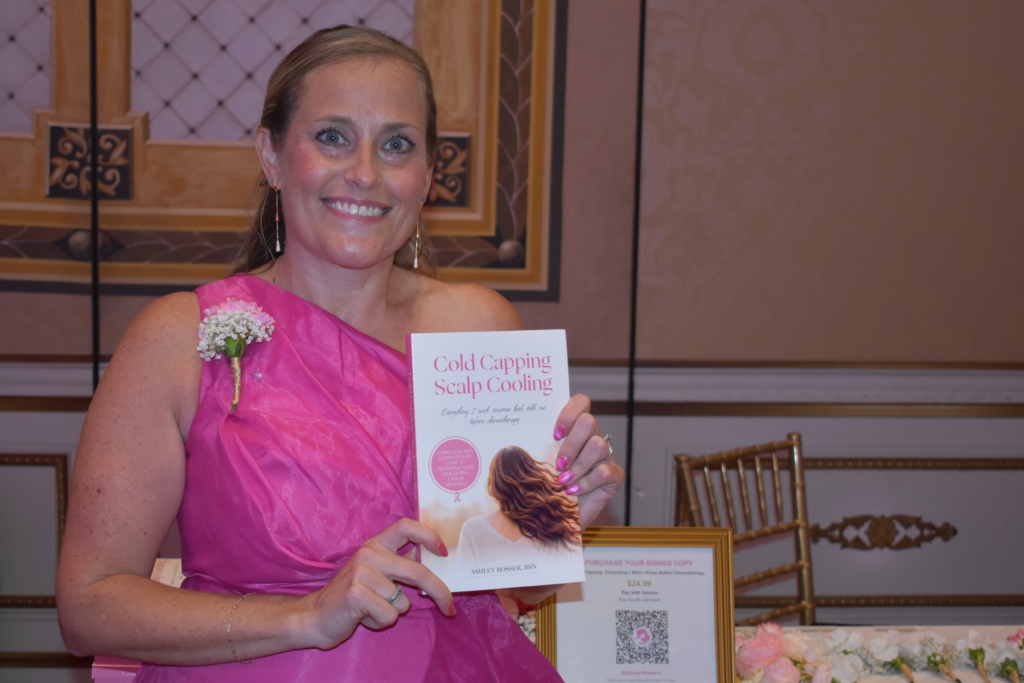
Breast cancer survivor and author Ashley Rosser during her book launch event at Adelphia’s in Deptford on October 1.

