On the “Nature: Accessible for All” website, Parvin State Park in Pittsgrove suggests that their Forest Loop’s paved campsite road also serves as anaccessible path. Each park has varying degrees of accommodations in striving toward access for individuals of all abilities. Photo: Nature Accessible for All
Several groups in New Jersey are looking to achieve greater accessibility to outdoor spaces.
Possibly you, a member of your family, or a friend has mobility challenges. A friend who has since passed used to lament to me that he had challenges finding places that were wheelchair-friendly. I had some ideas for him regarding where he might access the out-of-doors but at the time I found that few resources were available. I recently learned that the environmental community has been working on a resource for several years called “Nature Accessible for All.”
I was busy with a sign for a local natural area when the topic of handicapped access arose, and since then I’ve been considering opportunities in our region to increase access to trails. Since our landscape is a very flat one, many of our trails are less challenging than in other areas and ripe for a planning effort that provides greater accessibility.
The foundational beginning of Nature Accessible for All was in 2021 when the non-profit Pinelands Alliance, an environmental organization, launched a project called Pinelands Is for Everyone, using a grant from the Department of Human Services through an Inclusive Healthy Communities program.
Since then efforts have amplified, and a number of organizations in New Jersey have a statewide initiative called “Nature Accessible for All.” The Pinelands Alliance has partnered with the New Jersey Division of Disability Services, Department of Human Services, the Edward J. Bloustein School, and Duke Farms to lead a statewide effort to make natural spaces and nature-based programming inclusive and accessible for individuals of all abilities.
They have developed a user-friendly map that enables people to zoom in on their region of New Jersey to identify accessible parks. Once you select a destination, amenities and attributes that are available are described for the prospective visitor. The information is quite useful no matter your physical abilities.
Here are the questions that are teased out for each site. First a brief overview is provided—size of park, length of trail, and a very brief characterization of its nature, along with a link to the park’s website.
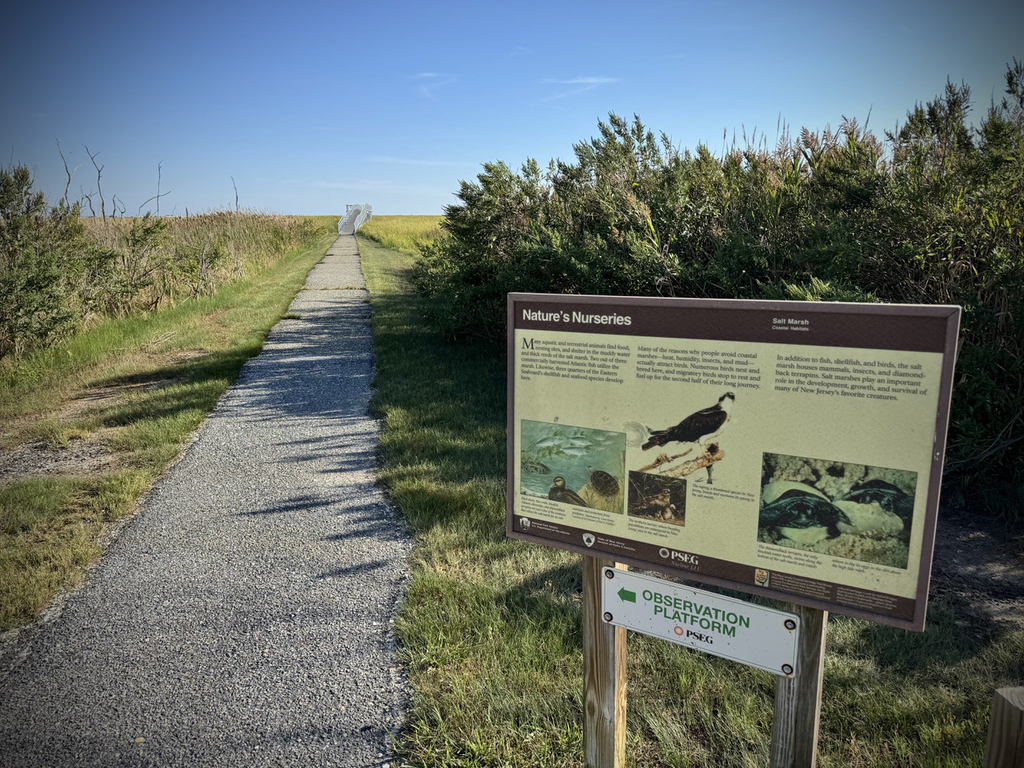
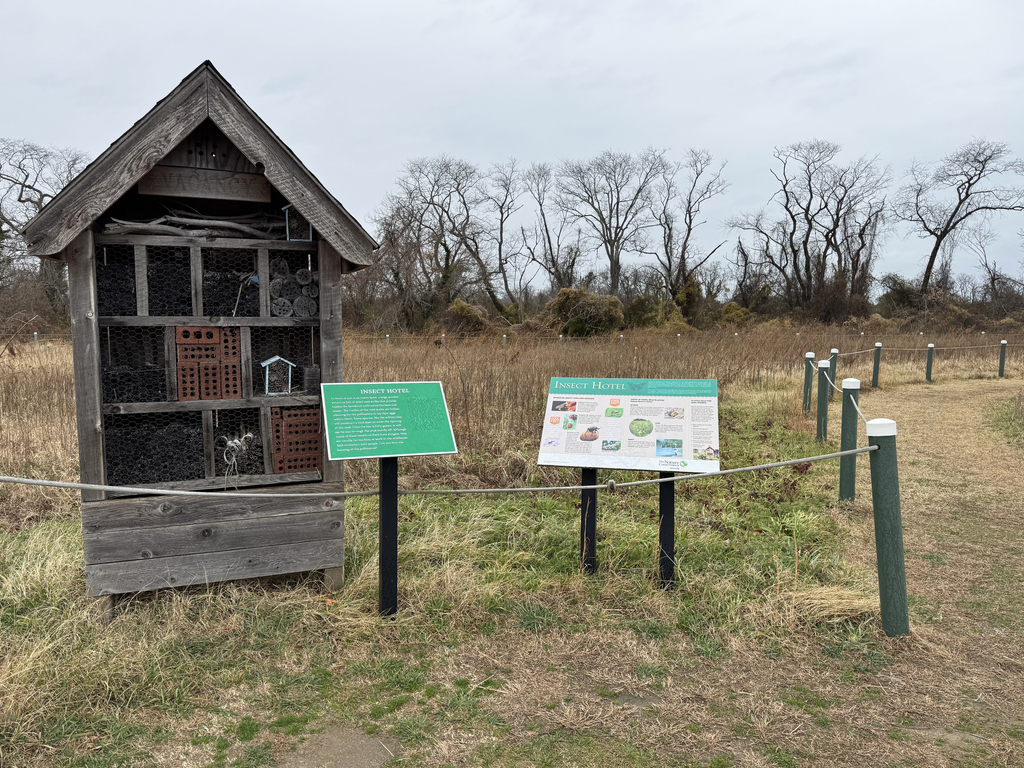
The Strawberry Ave. offers a boardwalk over the marsh plain on the PSEG corporate restoration site in Port Norris. There are paved and unpaved surfaces. A kiosk is readable from a wheelchair. RIGHT: The Nature Conservancy’s Garrett Family Preserve at Cape Island Creek in Cape May has a half-mile Braille trail and accompanying audio tour along a flat-mowed path that encircles a pollinator garden. A posted rope allows for a self-guided adventure. Photos: J. Morton Galetto
Many questions are addressed, falling into one of eight major categories: Trails Info, Scenic Spot/ Area, Gazebo Picnic Area, Parking, Restroom, Kiosk, Other Facilities, and Additional Barriers. Sometimes questions within each of these groups have a notation of “no data available” or are simply blank, but on the whole the information offered is most useful. After reviewing some of the material it might be wise for a person with personal knowledge of a prospective visitor’s abilities to make an advance trip to do a bit of reconnaissance.
The questions explored by Scenic Spot/Area were telling. Does the facility have a scenic spot/area? How is the scenic stop accessed? If on a road what is it like? If off-road, how long is the trek to the area in question?
Furthermore, the responses to questions are often simply yes or no—e.g. Does the facility have a trail? But when you get into What is the surface type? responses are variable, for example: Combination of compacted soil and boardwalk, Gravel and boardwalk, Gravel, Paved, and simply “Other.” Typical width of trails is provided. Condition of the trail is followed by a characterization. Additional questions are: Do the signs have information in Braille? Potential challenges or issues on the trail?
It occurred to me that responses to these questions might in themselves offer opportunities for future steps to accommodate a wider range of users. For instance most signage lacked Braille. And some signs could not be read from a wheelchair. On walks in southern New Jersey, we most often find the absence of restrooms to be a hurdle for all users.
Most locations provide some photos that help to further acquaint the prospective visitor with the park’s attributes.
Many parks included various hurdles, but I was most impressed that an effort is being made to quantify them so that users can consider exploration possibilities. In fact, a section of the website is devoted to just that—a technical support resource directory where organizations and individuals can connect to professionals, volunteers, and public and private organizations. The goal is to “assist with accessibility and inclusion resources, planning, and implementation to make natural spaces more accessible for individuals with disabilities. We are committed to providing you with information that empowers individuals and organizations in the advocacy, development, and implementation of best practices for accessible natural spaces.”
And there are also opportunities for people to make a difference in this effort with hands-on participation or financial support. The initiative focuses on collaboration and the exchange of information between professionals and park users with a goal of Nature Accessible for All. The coordinators are continually identifying barriers that prevent visits to natural areas, seeking solutions to such hurdles so that resolutions can be implemented.
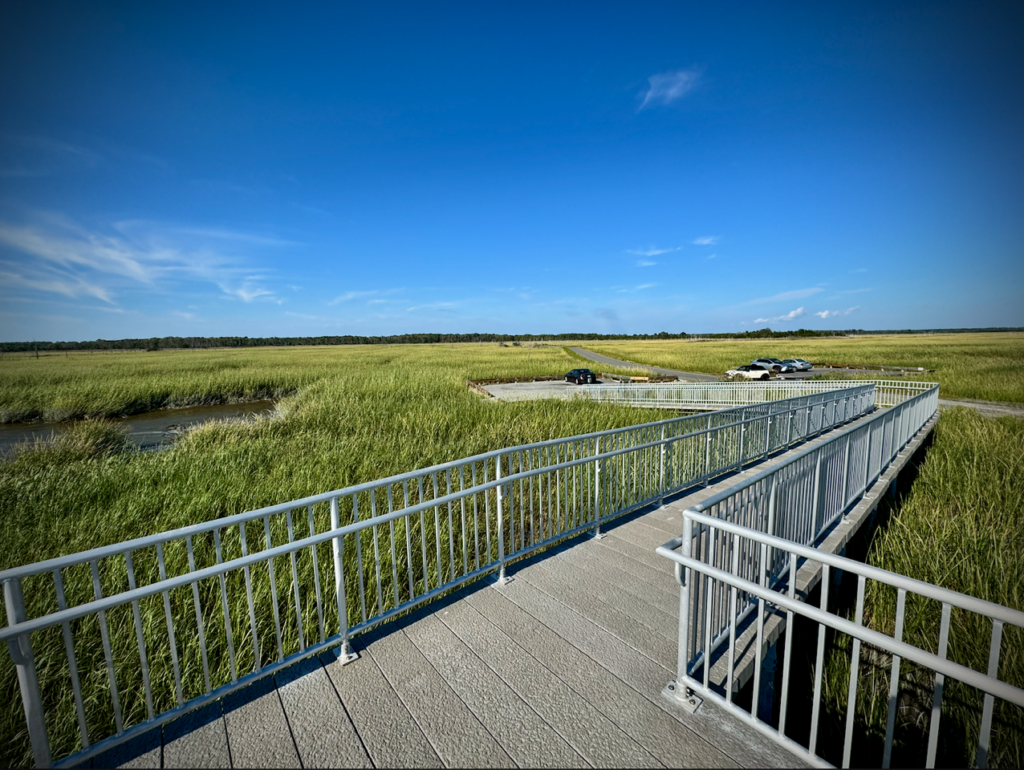
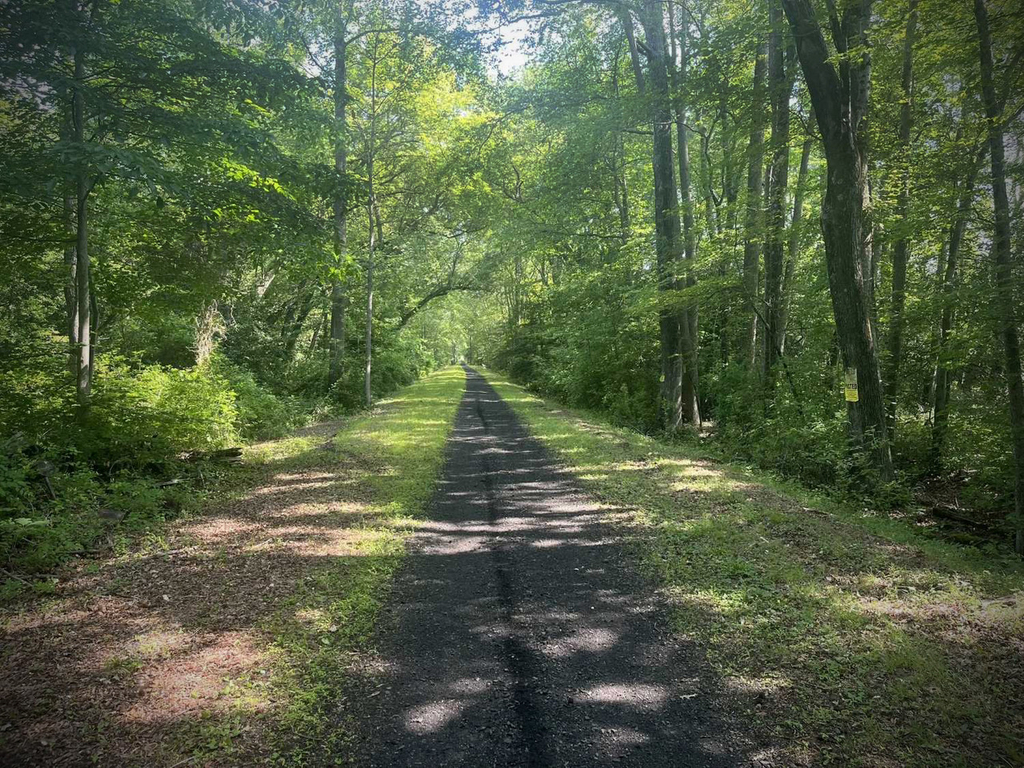
The Thompson’s Beach viewing platform in Heislerville offers great views of the marsh. The ramped platform allows wheelchair access. A display board is readable from a wheelchair as well. Photo: J. Morton Galetto • RIGHT: The Elephant Swamp Nature Trail, in Upper Pittsgrove is a rails-to-trail conversion. It offers a hard-packed gravel path about 11 miles long. It passes through many habitats and is easily walked. Photo: Nature Accessible for All
Those collaborating in the initiative Nature Accessible for All include a diverse group of partners. These include but are not limited to “state and private universities, non-profit and for-profit groups, national parks, disability advocacy groups, state agencies, regional planning groups, local municipalities, county parks systems, and business interests.” Twenty-four organizations participate in the steering committee.
Whether you are looking to explore the outdoors by yourself, with others, or wish to remove barriers to access, Nature Accessible for All provides you with the tools to see that all who wish to appreciate the beauty of nature have some access to it.
Source:
Nature Accessible for All – accessnaturenj.org – much of this article is written directly from the website’s content.

