Joel Mott, the principal public programs specialist with the New Jersey Pinelands Commission, gave an introductory presentation on the history, ecology and functionality of the Pinelands to members of the Haddonfield Garden Club on September 8.
The presentation, titled “Pinelands Discovery,” was part of the Garden Club’s first meeting of the 2026/2027 calendar year at Haddonfield’s Lutheran Church of Our Savior. Mott presented after the club mingled over refreshments and held its general business meeting.
Haddonfield Garden Club is the oldest garden club in New Jersey and third oldest in the country. It was originally founded in 1906, and it became part of the New Jersey State Federation of Garden Clubs when it was organized in 1925. Over the last hundred-plus years, the Haddonfield Garden Club has had a green hand in the community, participating in things like civic initiatives to beautifying the town.
As gardeners, much of the kind of environmental skills and knowledge differed from Mott and those who work in the Pinelands, as the Pinelands is not an ideal place for standard gardening. Wetlands make up 35% of the Pinelands, which in total is about 1.1 million acres, plus, there are required 300-foot buffers surrounding the wetlands; none of this land can be developed or disturbed.
Gardening and property development in the wetlands cannot happen, given the Pinelands Commission and the state’s regulations. Mott said that the commission acts as a land use agency to monitor the use of the land across the seven counties the Pinelands covers: Atlantic, Burlington, Camden, Cape May, Cumberland, Gloucester and Ocean. The only South Jersey county the Pinelands does not reach is Salem.
The rest of the Pinelands is mostly sandy soil, Mott said. The sandy soil is a large part of how the Pinelands functions.
“The reason we protect the Pinelands, the reason the Pinelands is so important to the ecology is all about that sand and all about that water,” Mott said. “When that rain comes, the water goes into the sand below the Pinelands. We have an aquifer, which is really literally layers of sand.”
The Kirkwood-Cohansey aquifer system lies below most of South Jersey, he said. According to research from the Pinelands Alliance, the aquifer is made up of more than 17 trillion gallons of fresh water.
The sandy soil dries out quickly, and some areas can absorb more than six inches of rain per hour. And on average, the Pinelands receives about 40 inches of rain per year; however, due to climate change in recent years, it has received about 60 inches per year.
“When it rains, it trickles through all those layers of sand, and that actually works as a filter,” Mott said. Due to this, most of the municipalities in the Pinelands use well water rather than public sewer water.
The sandy soil and water also impacts the kind of native plants in the area. Whereas many members of the Garden Club are used to planting all kinds of fruits and vegetables, the Pinelands is incredibly notable for its blueberries and cranberries (Hammonton, located in the Pinelands in Atlantic County, is known as the Blueberry Capital of the World), plus other berries like huckleberries and dangleberries. Mott said there is a mix of highbush and lowbush berries, and they are particularly in bloom during June and July.
Throughout the entire presentation, Mott talked about more of the Pinelands native plants and species, the timelines of how the Pinelands came to be and how the Pinelands Commission continues to work, preserve and educate others about the National Reserve.
Garden Club members had the opportunity to ask questions and participate during and after the presentation. In addition to Mott’s presentation, informational brochures from the Pinelands Commission were left for the members, including one that outlines living and landscaping in the Pinelands.
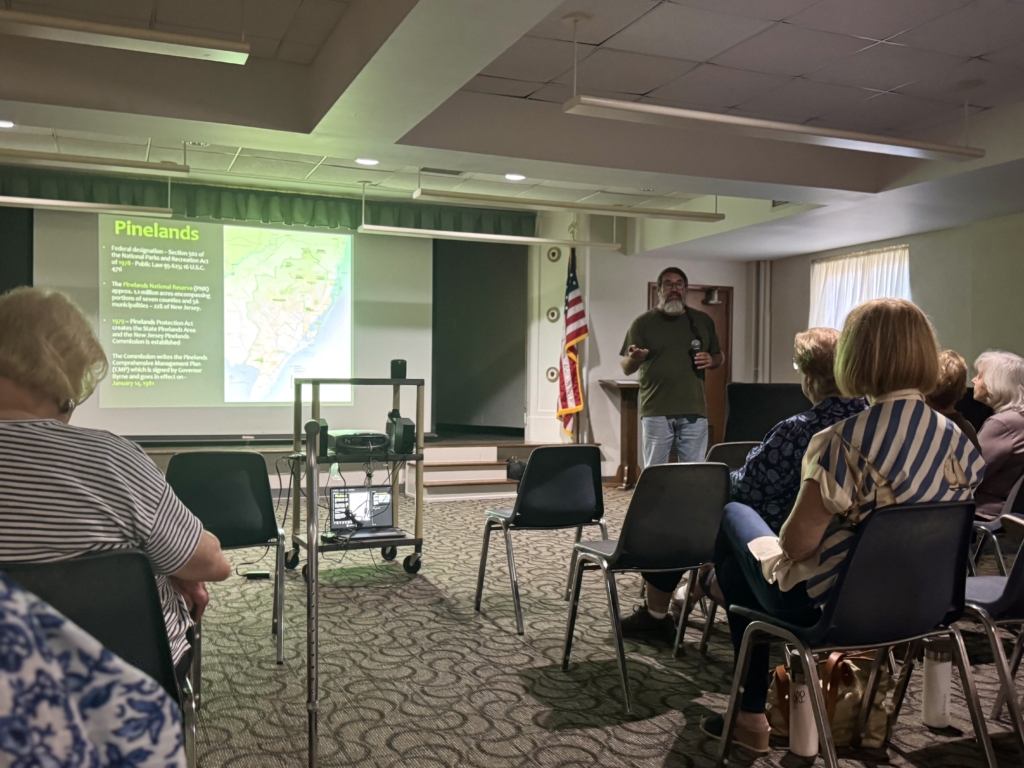
Joel Mott, principal public programs specialist with the New Jersey Pinelands Commission, gave a presentation on the Pinelands to the Haddonfield Garden Club at its first meeting of the 2026/2027 calendar year.

