You are never too old for dolls. That is what I learned from attending the Mullica Hill Doll Study Club’s September meeting at the library.
Like most other young girls, I was obsessed with dolls. I loved playing with my Barbies, Bratz, Polly Pockets, American Girls, old dolls that belonged to my mom or grandmother. I loved the houses, the accessories, the homemade pieces of furniture and dresses.
I loved how it was an activity, a passion, an extension of myself that I could enjoy all on my own or with my older sister and friends. That was one of the most beautiful parts of playing with or taking care of dolls: It was personal as much as it was communal.
However, by middle school I stopped playing with my dolls. Over time, some were donated or sold or given away. Others are kept in storage as childhood memories or for when I someday have children of my own.
This is a common experience for a lot of children across generations. For most of your developmental years, you love these dolls like they are a part of you, and then, one day, they are gone, and you will only play with them again maybe if you have children in your family down the line.
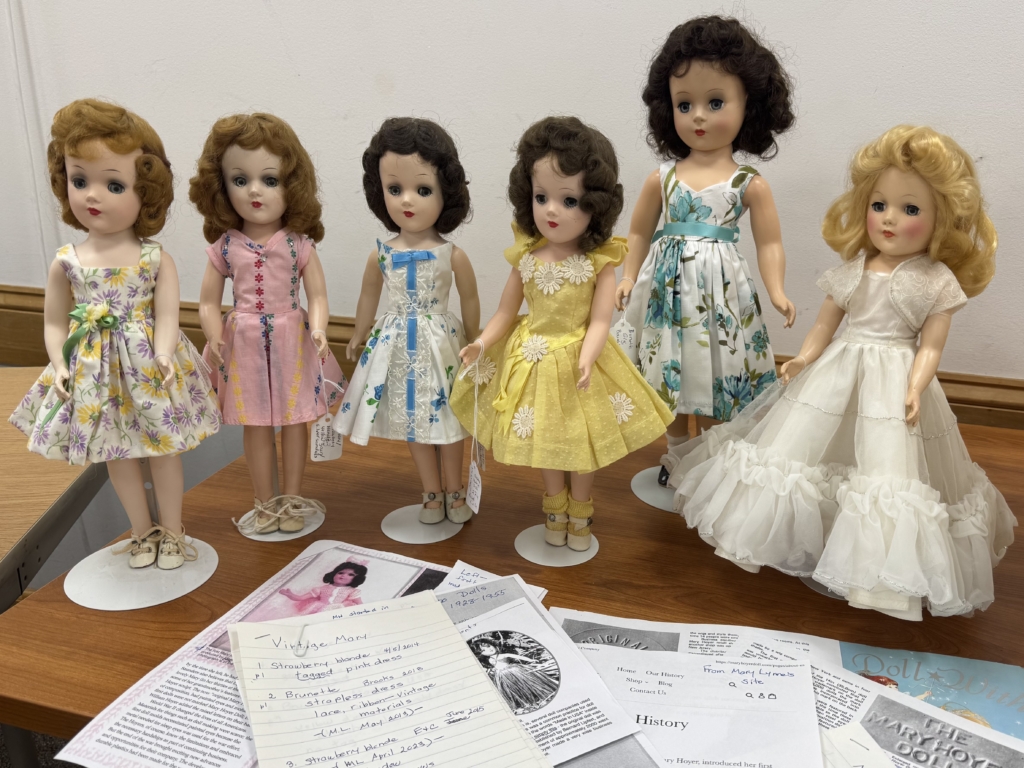
A collection of Mary Hoyer dolls that belong to club members, plus archival writing pieces.
But there are some people who do not listen to this societal narrative, and they appreciate the craftsmanship and history that went into creating the dolls they loved as a child or have discovered fondly as adults.
At the Mullica Hill Doll Study Club’s meeting, there were about a dozen women seated in an arch facing a table of more than 20 dolls lined up on top. The joy, interest and knowledge they all had for the dolls was admirable.
It was heartwarming and rejuvenating to see a group of women generations older than me express their love of dolls and show off their own with one another. While I only observed, I felt like the little girl I once was who cared so deeply and tenderly for my own collection of dolls. And I imagine this is a similar feeling many of the women part of the Doll Study Club feel, too.
The club is a charter of the United Federation of Doll Clubs, Inc. It is a non-profit organization with “the goal of being the foremost in research, education, conservation and appreciation of dolls,” according to its mission statement. And its vision is to “Educate-Preserve-Conserve”.
The Mullica Hill Doll Study club was chartered in December 1996, and it has been active ever since. Currently, it has about 16 active members, and it is led by president Mary Ellen Rucci, who lives in Cumberland County and has been part of the club for years.
The club is free and welcome to anyone who is passionate, interested or curious about dolls. And for the members here, “playing” with dolls is not the real point, which tends to be a common misconception for people beyond youth interested in dolls.
The club is primarily focused on learning about the history and culture of dolls and specific kinds, preserving dolls old and new, and sharing information about dolls with a community of people.
At each monthly meeting, which is on the first Wednesday of the month at 1:30 p.m. at the Mullica Hill branch library, a short business meeting is held, followed by an educational program.
In September, longtime member Sue Zimmerman gave an interactive presentation on Mary Hoyer Fashion Dolls. She outlined the rich history of the doll maker – Mary Hoyer, who lived in Reading, Pennsylvania, and eventually had a shop in Reading and on the Ocean City, New Jersey boardwalk where she sold her handcrafted dolls, clothing items, accessories and yarn supplies.
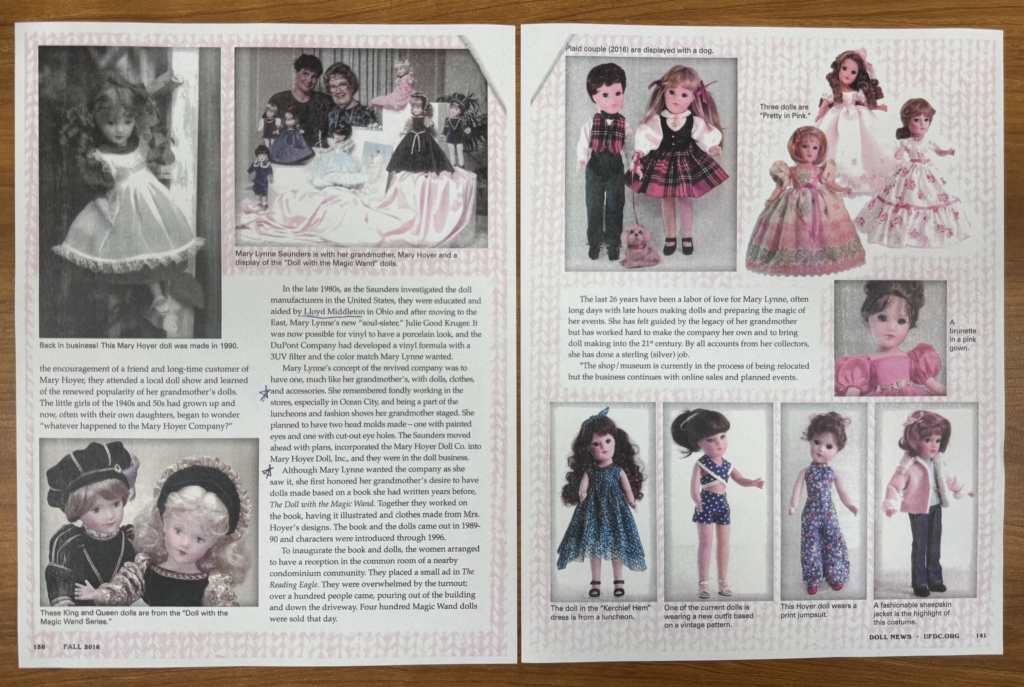
Scans of pages from a historical Mary Hoyer book.
Hoyer debuted her first doll back in the 1930s, and they were in production until the late 1960s. About 20 years later, Hoyer’s granddaughter launched a new doll that remained in production throughout the 2000s. While new dolls are not in production anymore, the company still sells new clothing and accessories. And, of course, there is an avid community of doll enthusiasts and historians who search for Mary Hoyer dolls anywhere they can – estate sales, auctions, Ebay, antique stores.
Zimmerman brought in a handful of her own dolls to share with the group, and any club members who had a Mary Hoyer doll brought it in, as well, and they all took turns discussing and showing off their dolls and their specific details. Even from the same brand, the dolls had different stylistic and production elements across generations: Some had bendable limbs while others did not, some had painted eyelashes while others had real eyelashes, some were much larger than others.
Additionally, Zimmerman had printouts of historical pages from Mary Hoyer books and magazines laid out on the tables for the women to look over. She thoroughly prepared her presentation, and she walked through the entire history of the dolls and her personal connection to them and the company.
Zimmerman, like most of the other women in the club, grew up playing with dolls and loving them. Getting back into them and becoming a collector was a “gradual thing over the years,” she said. She has been part of the club since it began in 1996.
“I never lost my love for them. But I went to college, I got married. Things changed,” Zimmerman said. “Then all of a sudden, it was like, ‘oh, my dolls are back.'”
While there are many members who have been with the club for 20 or 30 years, there are fresh faces, too. Rucci, the club’s president, said they are always looking for new members and happy to welcome any one of any age or doll interest to stop by a meeting.
The next meeting will be on Wednesday, October 7 at 1:30 p.m. at the Mullica Hill branch library. The educational theme will be dolls in costumes, such as Halloween, nursery rhyme and fairy tale costumes. It will be a club participation program, meaning attendees can bring their own dolls in costume to show off.
Or, if you are new like I was, you can just show up and experience the joy from these women first-hand. You might reconnect with a version of yourself you did not realize you were missing.
For more information on the club, check out its Facebook group called Mullica Hill Doll Study Club- UFDC Region 13.
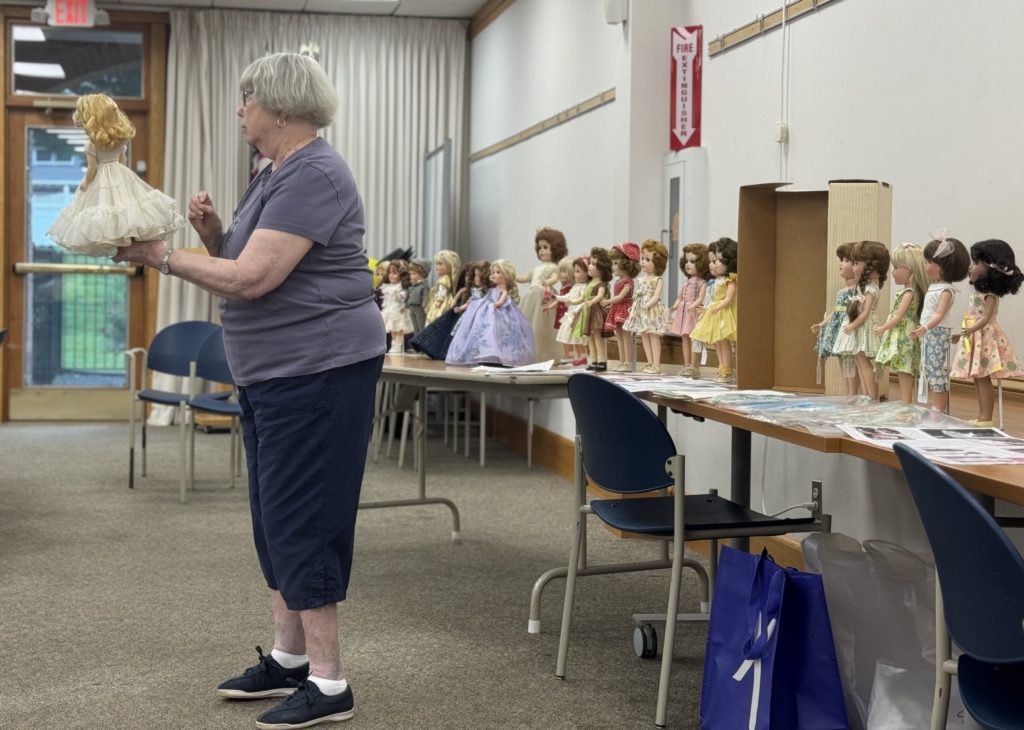
Sue Zimmerman giving a presentation on doll maker Mary Hoyer at Mullica Hill Doll Study Club’s September meeting.

