The ailanthus webworm moth spreads one wing, allowing the hindwing to be seen. In flight, the moth often looks similar to a wasp. Photo: J. Morton Galetto
Our columnist discusses ailanthus webworm moth and a not-so-heavenly tree.
In late summer and early fall, a really lovely moth can be found feeding on the nectar of goldenrod (solidago). Its common name is the ailanthus webworm moth, while its scientific name is Atteva aurea. In the larva stage it is called ailanthus webworm and as an adult it is grouped among the ermine moths, of which there are about 30 different species in North America.
You may recognize “ailanthus” in the moth’s common name as referring to the Tree of Heaven, an exotic invasive plant originating in Asia and a primary host for the ailanthus webworm moth. But the moth is native to North America, so you may be asking yourself, “What is its original host species?” Trees in the Simaroubaceae group are native to parts of Central America, the Paradise tree is a relative and native to Texas and Florida, and ailanthus is also a member of this family. The larvae of Atteva aurea made the leap to our region because of the availability of ailanthus. Prior to its spread the insect was restricted to southern Florida and southward to Costa Rica.
In 1784 the Tree of Heaven was introduced to a garden in Philadelphia and today it is found in most of the United States and southern Canada. A few hundred years later the tree is unpopular due to its displacement of native trees, in even the most difficult environs.
The insect’s presence was first recorded by a well-known assistant at the Academy of Natural Sciences in Philadelphia, Carl Ilg. In 1911 he noted the discovery of an Atteva aurea larva in an ailanthus bush that appeared in the Academy of Natural Sciences of Philadelphia. Carl described the larva he collected to be about one and a quarter-inch-long and entangled in a webbing, “with a distinct brown stripe all along its back, while the sides are dotted with fine white spots.” He found no prior records of the food plant or life history, discovering it to be a moth only by allowing the larva to mature.
Today the Tree of Heaven is only absent in seven of the lower 48 states (USDA plant data base mapping), and the occurrences of Atteva aurea track closely with its presence in nearly all of those states as well.
In Betty Smith’s book A Tree Grows in Brooklyn, the ailanthus serves as a metaphor for its main character, Francie Nolan—a young girl challenged by poverty and a chaotic family life, but showing resilience of spirit through inner strength, education, and hope. Her life story parallels the growth of the ailanthus that persists through a crack in the neighborhood concrete.
Both Francie and the tree rise up despite hardship. However, from a naturalists’ perspective the tree’s persistence has been at the expense of native flora that supports native species, and it is regarded with disfavor.
Although the ailanthus webworm feeds on the leaves of the Tree of Heaven, it sadly cannot kill or weaken it. In addition to the ermine moth’s larva, the invasive spotted lanternfly also robs vital nutrients from the Tree of Heaven. The adult ermine moth, Atteva aurea, expands its range northward to our area in the fall where it can nectar on goldenrod and lay its eggs on the ailanthus/Tree of Heaven, while the vagabond favors warmer climes.
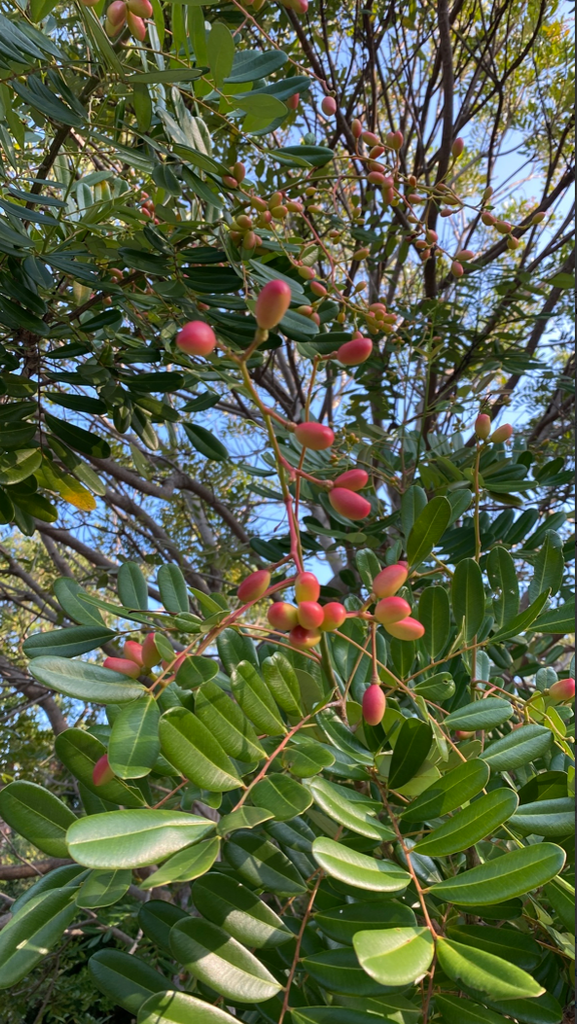
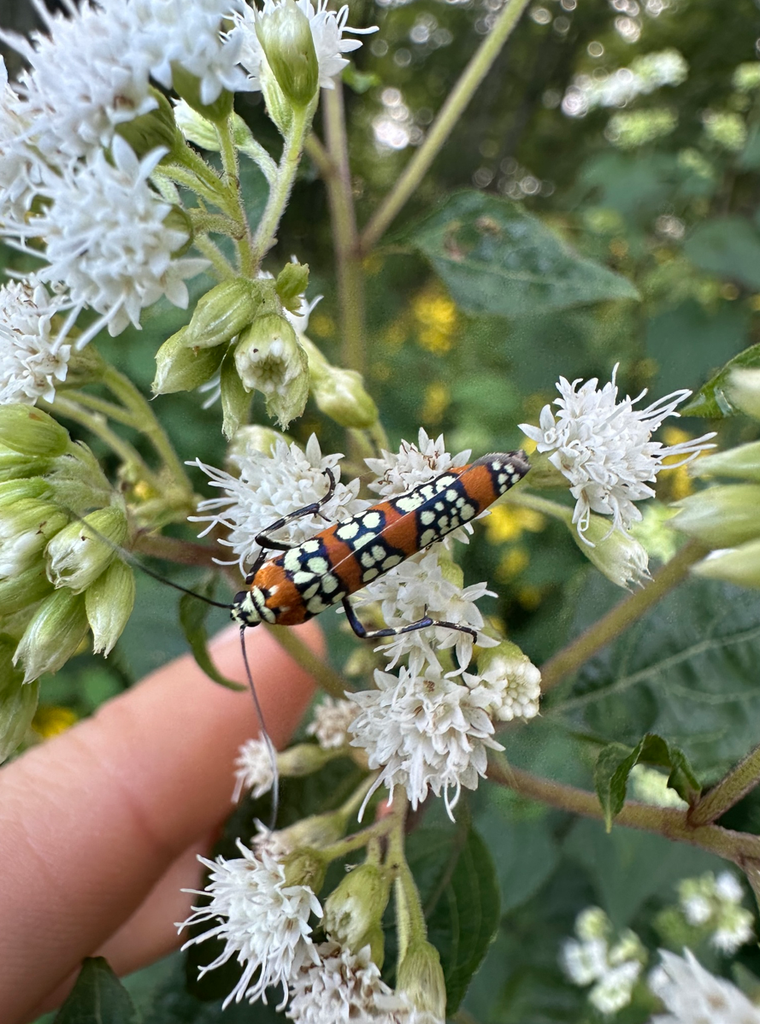
The paradise tree (Simarouba glauca), the original food plant of the ailanthus webworm, is an evergreen native to Florida. It grows to 40 to 50 feet tall and spreads to 30 feet. It has small yellow flowers in the spring and dark purple fruit enjoyed by wildlife in early summer. Photo by iNaturalist Angel Kelley • RIGHT: With both wings closed Atteva aurea resembles a beetle more than a moth. Photo by iNaturalist Tohmi Barrett
The adult’s cylindrical half-inch form is the first thing that catches one’s eye as it feeds on goldenrod. It has an orange tubular body with a patchy mosaic pattern of creamy white circles encircled by bold black outlines. Charcoal-black antennae curve outward like a downward-turned Dali mustache and its body is perched upon delicate, segmented legs. The real thrill is when it spreads its one-inch wings. The forewing almost appears like an elytron (wing cover) on a beetle, and the hindwing is translucent with a framework of black veins. It is a very fashionable insect.
Unlike most moths these are daytime flyers. In flight they can be confused with wasps, and when perched they are often mistaken for slender beetles. In their larval stage they live in communal silken webs. In their adult stage they have scales; they are indeed true moths.
It is thought—much like the monarch butterfly—that their bright orange forewings denote, “I taste foul.” Aposematism is the term used when an insect’s coloring signals unpalatable qualities. However they do not sting or carry venom, making them entirely harmless to humans.
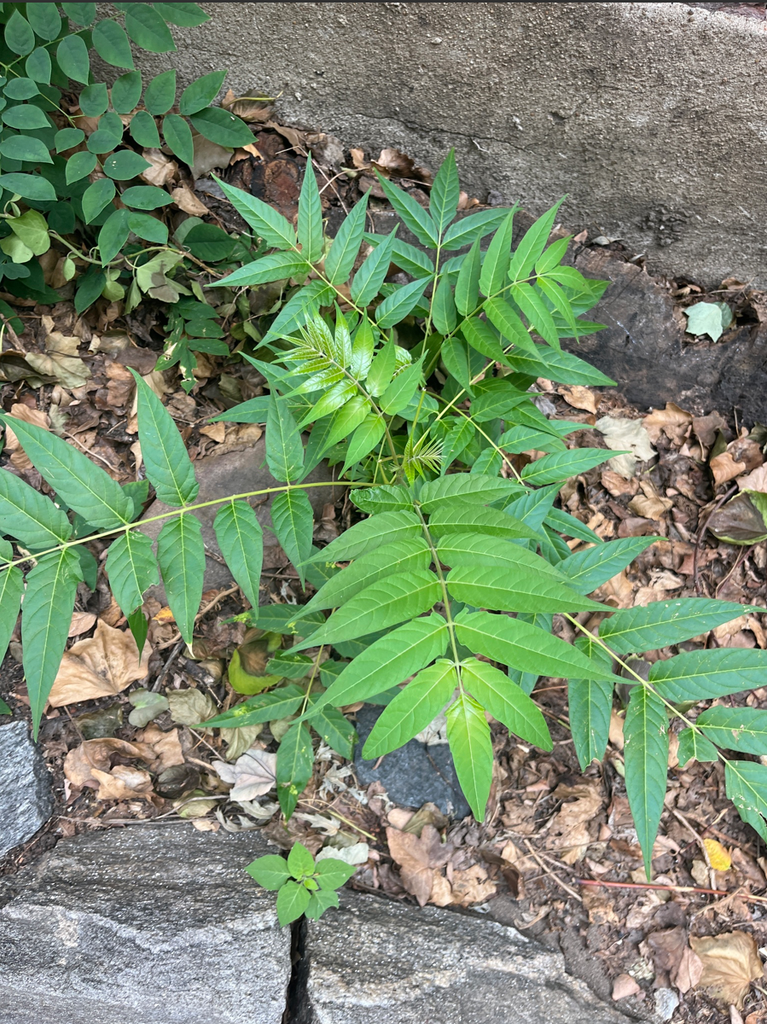
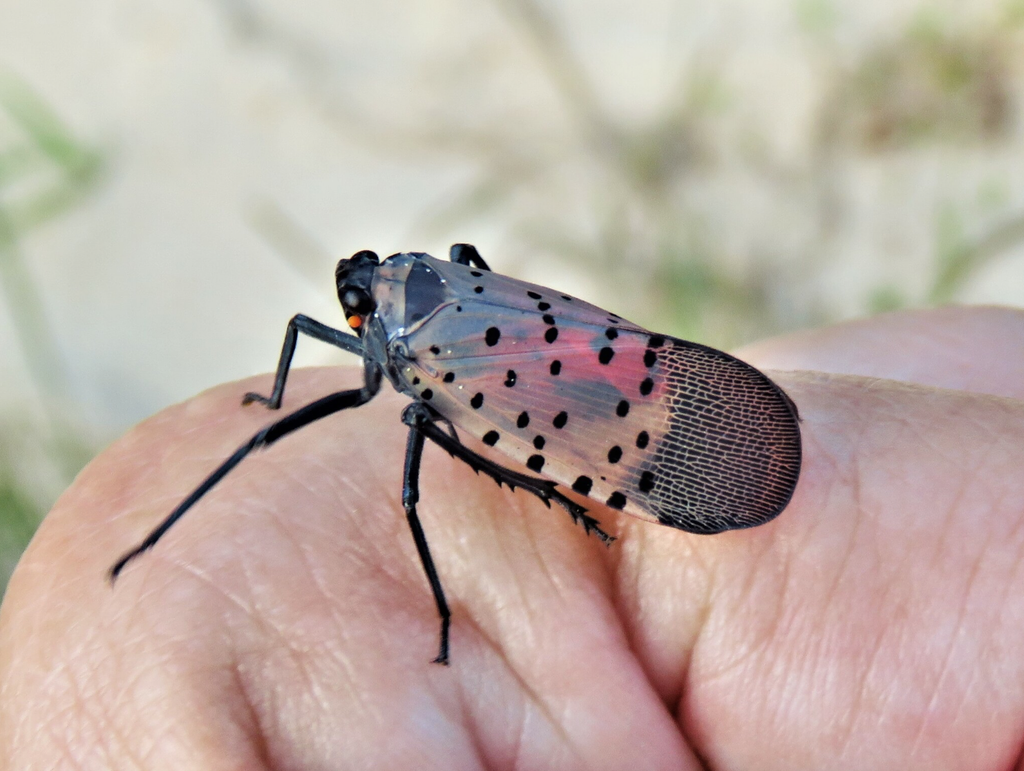
iNaturalist Elliot Greiner took this picture of the Tree of Heaven not far from the Betsy Ross House in Philadelphia. The Tree of Heaven was introduced in a Philadelphia garden, and now plagues our American landscape. When the ailanthus tree’s leaves are crushed they smell like putrid peanut butter. The conservation community sees invasive exotic species are one of the primary threats to global biodiversity, ecosystem health, and native species survival. • RIGHT: The spotted lantern fly is attracted to ailanthus as well. Both the tree and the lanternfly are introduced invasive species. Photo by iNaturalist Annika Lindqvist
While the invasive Tree of Heaven is disliked by ecologists for crowding out native North American flora, the native Ailanthus webworm moth uses it as a primary food source. While neither the moth nor the invasive spotted lanternfly manages to kill off the resilient tree, in the end the story is one of beauty and the beast—the fashionably-colored insect and the persistence of an introduced species both interfacing to survive.
Sources
Ailanthus Webworm Moth, University of Milwaukee, uwm.edu.
Bugs in Orange and Black, Part I: An Ermine Moth, Ailanthus Webworm, Atteva aurea, Bug of the Week, Michael Raupp.
Ailanthus Webworm Moth (Atteva aurea). Frank, Kenneth (2015)

