Riding mini bikes and dune buggies was a favorite pastime of Palmyra teenagers in the 1960s and ’70s, and a popular spot was the large expanse of undeveloped land south of Route 73, behind the highway’s truck stops and gas stations.
Other youngsters preferred fishing on the sandy beach under the shadow of the Tacony-Palmyra Bridge, hoping to catch carp, eels, perch and minnows – the only fish that could survive in the then-polluted Delaware River.
“The Clean Water Act of 1972 was a major success story,” said biologist and naturalist Mason Kramer, a 2020 graduate of Rowan University and a staffer at the Palmyra Cove Nature Park, which opened to the public in 1999.
“Now the beach is a popular fishing spot for striped bass, shad and herring, which have returned to the river. We have one of the few beaches along the Delaware that isn’t bulkheaded.”
Before that, the 250-acre site was used by the U.S. Army Corps of Engineers to dump dredge sediment as it made the Delaware River channel deeper for larger ships. Now it is a protected wildlife preserve.
“This is such a wonderful place to work,” noted Kramer, who grew up in Cherry Hill and majored in biology at Rowan. “There is so much beauty. We look at the Earth from the top down and the bottom up.”
The park is home to many species of wildlife living in habitats that include woodlands, meadows, wetlands and the shore line. The learning trail for students and visitors includes 30 signs with QR codes highlighting the butterfly meadows and information about wild turkeys, white-tailed deer, bald eagles, osprey, herons, peregrine falcons, beavers, bullfrogs, wildflowers and freshwater mussels.
The 2,000-square-foot Environmental STEM Center at the entrance to the park includes exhibits about the native fish and wildlife and an interactive virtual innovation lab that lets visitors dive into the sea or fly into outer space while learning about science and technology.
Kramer pointed out the Collection at the Cove display that includes skulls and specimens of native animals like red fox; deer; and otters, as well as mussel and turtle shells and snake skins. There also is a fish tank full of native species from the river, including white perch and eels.
Kramer enjoys teaching students on field trips during the spring and has set up a scavenger hunt list of the early spring wildlife, including cardinals, sparrows, hawks, woodpeckers, robins, groundhogs, deer, rabbits and different species of butterflies.
“They also like going into the space area of the STEM center,” noted Kramer, who looks forward to the summer camp for youngsters, from Monday through Friday, Aug. 10 to 14. Parents can register kids by going to palmyracove.org.
Another highlight of the trails is the wide variety of trees, including silver maples, red maples, pin oaks, holly, sassafras and dogwoods.
“As a biologist,” Kramer said, “this is a great place to work and to teach people about the natural world around them.”
The STEM center is open Monday through Friday from 9 a.m. to 4 p.m. The park itself and the trails are open from dawn to dusk. For information, call (856) 829-1900.
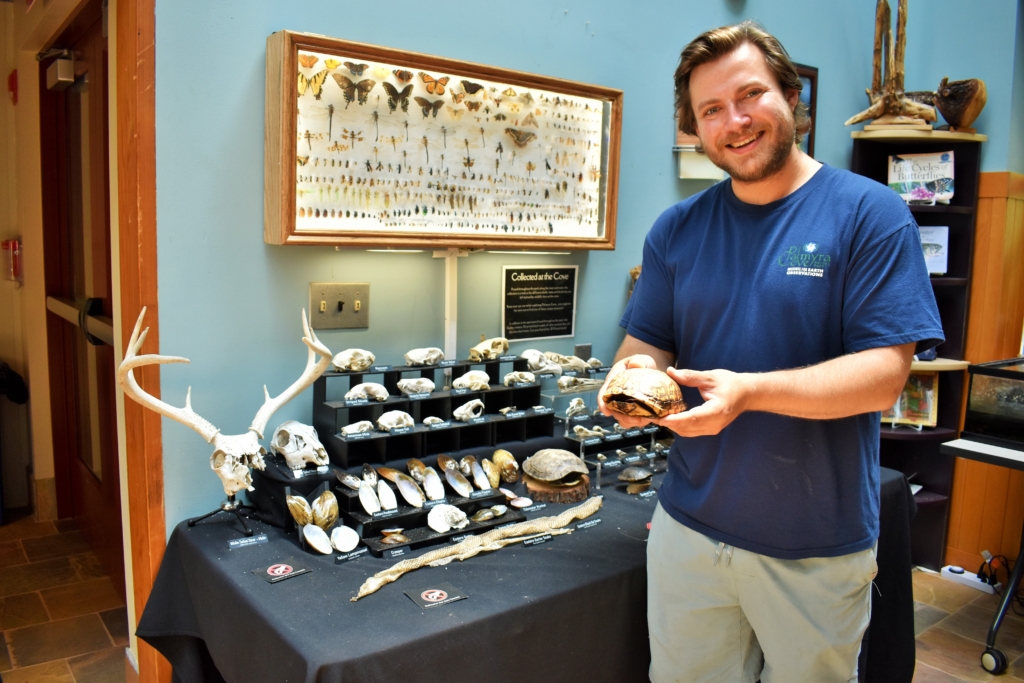
Biologist and naturalist Mason Kramer holds an Eastern Box Turtle shell from the Collection at the Cove display of skulls and shells found on the grounds and beach at the 250-acre Palmyra Cove Nature Park.

