Borough commissioners discussed the impact of recent flooding at a July 13 work session, prompted by a resident’s question that has no clear answers.
Joseph Pugh, who’s lived at the intersection of Barberry Lane and Mount Vernon Avenue for 26 years, discussed flooding outside his home and what the borough can do to address it.
“It’s clear to anyone who observed the flooding at the intersection during just about any heavy storm that the stormwater infrastructure project of several years ago is clearly inadequate,” Pugh complained. “I realize that’s my opinion and I’m not an engineer, but it is inadequate from our experience living in that intersection.”
Pugh was referring to the 2022 drainage improvement project along Homestead Avenue that encompassed the street’s sump pump, storage and manhole realignment and resulted in a larger underground storage area so more water could be collected before being drained to Newton Creek.
Camden County experienced heavy flooding on July 6 and 9, with the largest amount in Camden, positioned as it is next to the Delaware River. Areas further inland, like Haddonfield, saw roads completely flooded for a period of time.
Borough Administrator Sharon McCullough responded to Pugh by noting that 400 borough acres drain into the Barberry Lane and Mount Vernon Avenue intersection and end at a tributary that leads into the Newton Creek. It is also a tidal area.
McCullough said that the borough was denied a resiliency grant to fund a regional stormwater study of the area. She also explained that nothing could have stemmed the July 6 flooding.
“There is no system that we can build that will be able to handle that kind of water,” she added. “So there will be some degree of flooding regardless of how much infrastructure we have in the roadways.”
Commissioner Frank Troy said both the borough and state lack solutions.
“You’re seeing these flash floods that are at the rate of 4 inches an hour and stuff like that,” he noted. “Everyone’s going to ask the same question, and I would say, quite honestly, the state doesn’t have a good answer for it …
“It is a complex issue. I wish I did have an answer for it, but I don’t.”
A 2020 recommendation from the engineering firm Remington & Vernick to install another underground system around Barberry Lane estimated the cost to the borough would be about $2.2 million. McCullough called that unaffordable and noted that Haddonfield is not in line for federal help.
“The Army Corp of Engineers right now is not really doing much of anything with the federal government,” she added. “FEMA (Federal Emergency Management Agency) doesn’t really have money. So we’re not able to go to them and request money to help solve the problem because they don’t have it to give out.”
On the state level, because there is a new governor, McCullough said the borough is attempting to discuss the issue with the New Jersey Department of Environmental Protection. Despite that, she doesn’t envision a solution to the flooding anytime soon.
“The problem we’re having is the intensity of some of the storms … is far more than any of our systems can handle,” she acknowledged. “So it’s not a story of yes we can do it like this,” she added, snapping her fingers.
” … It’s going to take a while, because it’s a problem beyond just Haddonfield, and I’m not sure anytime in the near future that we’ll be able to get that solved.”
McCullough said the borough is trying to adjust to more extreme storms and that new infrastructure to withstand them can’t be done in every instance of flooding, in part because of Haddonfield’s advanced age.
“These things are popping up, unfortunately, with a higher level of frequency than they ever had because the climate just is changing,” she observed. “Maybe it’s what happened two million years ago, but it’s not what has happened over the past century, and now we’re trying to readjust it to a certain standard and now we’re getting something else.”
Pugh said he understood the complexity of the flooding issue and thanked the board of commissioners for the discussion.
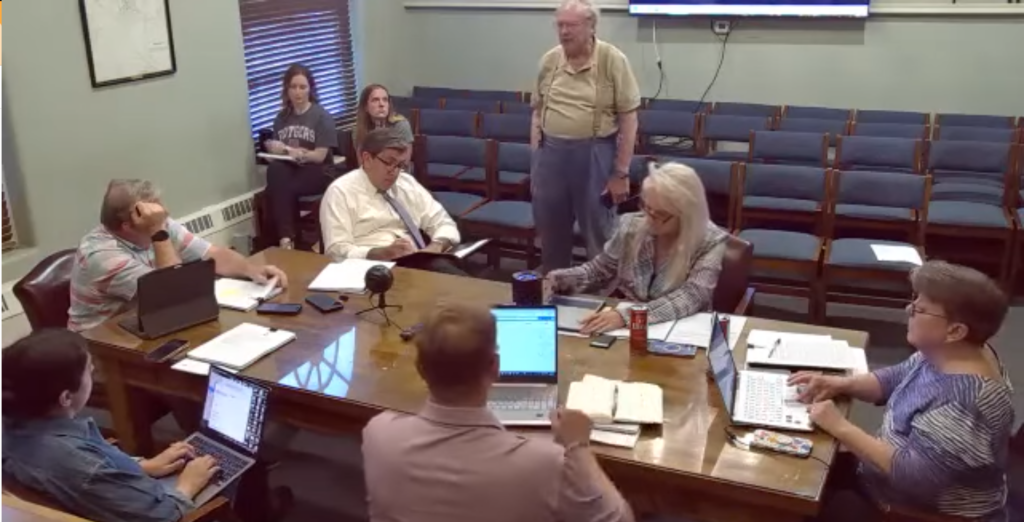
Borough resident Joseph Pugh addressed the board of commissioners about heavy flooding .

