Philadelphia has seen its share of monumental sporting events, but only once has it or anywhere else experienced what took place on the afternoon of Sunday, Jan. 11, 1976 at the Spectrum, the beloved former arena/concert venue and home of the Philadelphia Flyers in South Philly.
It was on that date that a sold-out crowd and global TV audience witnessed a hockey game that was framed as a battle for the ages between democracy – loosely represented by the Flyers – and the “tyranny” manifested in the Central Sports Club of the Army Moscow, commonly knows as the Red Army of Soviet Union military veterans.
“We didn’t like the Russians; (then-Flyers owner) Ed Snider really, really didn’t like the Russians,” recalled Joe Amodei, a Langhorne, Pennsylvania, resident whose documentary, “Cold War in Philly: Flyers vs. Russia 1976,” has its world premiere on Wednesday at the Suzanne Roberts Theatre in downtown Philly.
A second event is set for the following night at the Philadelphia Film Center, also downtown.
“Therefore, the team didn’t like the Russians,” Amodei added of the Flyers. “The city didn’t like the Russians. So, when the (Red Army players) walked off, it was just fantastic.”
The Flyers ultimately prevailed, 4-1, but that’s not what made the contest resonate so emphatically over the ensuing 50 years. Instead, it was what happened during the game that made history.
The Flyers were the defending Stanley Cup champions, having reached hockey’s pinnacle the year before with a physically aggressive style that earned them the immortal nickname, Broad Street Bullies. The Soviet team – generally acknowledged as the world’s best – played an elegant, finesse-driven style of ice hockey.
So they were vastly unprepared for the street-brawl tactics of the home team. It proved too much for the Russians, especially after Flyers’ defenseman Ed Van Impe delivered a particularly bone-rattling hit on one of their players. When the referees declined to penalize Van Impe, the Red Army coach pulled his players from the ice and refused to have them return, until capitalism triumphed over communism: Snider resolved the issue by threatening not to pay the team.
Sixteen minutes after they had headed to their locker room, the Soviets returned, only to suffer a convincing loss in which they were outshot 49-13.
Along with untold numbers of Philadelphia-area fans, a young Amodei (pronounced AM-a-day) was emotionally charged by the Spectrum drama. So when he realized several years ago that the 50th anniversary of the game was on the horizon, he decided a documentary was in order.
Amodei was uniquely positioned to get involved in such a project. Besides being a lifelong Philly sports fan, he was already a film industry veteran who – in 2003 – founded the Newtown, Pennsylvania-based Virgil Films & Entertainment The company’s specialties include sports documentaries; it also distributed the Oscar-nominated 2004 documentary “Supersize Me”.
The genesis of the Flyers project was a conversation Amodei had with Orest Kindrachuk, who played on the 1975-’76 team. “I asked Orest what it was like playing against the Russians,” Amodei recalled, “and he told me, and a light bulb went off in my head about how maybe a documentary should be about the day the Russians came to town.”
But it was not an easy lift.
“I had to first start talking to Flyers management and (current team owner) Comcast and come up with a contract,” Amodei acknowledged. “And that took a long time. I also had to talk to the NHL, had to get their approval. I got everybody’s approval and started to make this movie. It took about nine months to get all the rights to be able to make it.”
Now focused on lining up the movie’s theatrical release and potential TV and streaming deals, Amodei has one goal.
“From day one,” he said, “I wanted to make a film that paid tribute to that team known as the Broad Street Bullies. (The remaining players) are all getting up there in age. We actually lost a few of them while the film was being made.
“I wanted to make a film that will still be around for their grandkids and their grandkids’ grandkids that shows what this
team was like.”
Once the legalities and paperwork were attended to, Amodei’s next order of business was interviewing as many former Flyers as possible so “they could tell the story.”
“When you see the film,” he noted, “it’s the players that tell the story. There’s no narrator. I let the players narrate the film, and I was very fortunate that I got (almost) everybody that was alive. The only one I could not get in touch with was Mel Bridgman. And the reason was that he wasn’t doing well health wise.”
Bridgman passed away a few months ago. “Everybody else,” Amodei added, “was no problem.”
One key get was Bobby Clarke, the gap-toothed sparkplug who was the Flyers’ offensive star. But according to Amodei –
who has worked with media moguls Barry Diller and the late Ted Turner – he had to promise Brad Marsh, leader of the team’s alumni association, that the film wouldn’t emphasize Clarke over his teammates.
“And even Clarke said, ‘You know, I can’t be treated any differently than all the guys on the team,’” Amodei added.
Ultimately, what the filmmaker described as his “labor of love” is meant to be more than just a retelling of a historical event. It is also a tribute, he explained, to how much that historic game and that team meant and continue to mean five decades later.
“We were picked on, we were a butt of jokes all around,” he remembered of the city and its pro sports franchises. “So, when they won in ’74, it gave us a sense of pride that we hadn’t had before, and then they won a second time (in ’75). “And this team, these Broad Street Bullies, they weren’t on a pedestal. You could see them in the shopping center or at
Rexy’s (the Haddon Township bar that functioned as the team’s clubhouse).
“You could relate to them. They were scrappy, blue collar, and they were underdogs. They were us.”
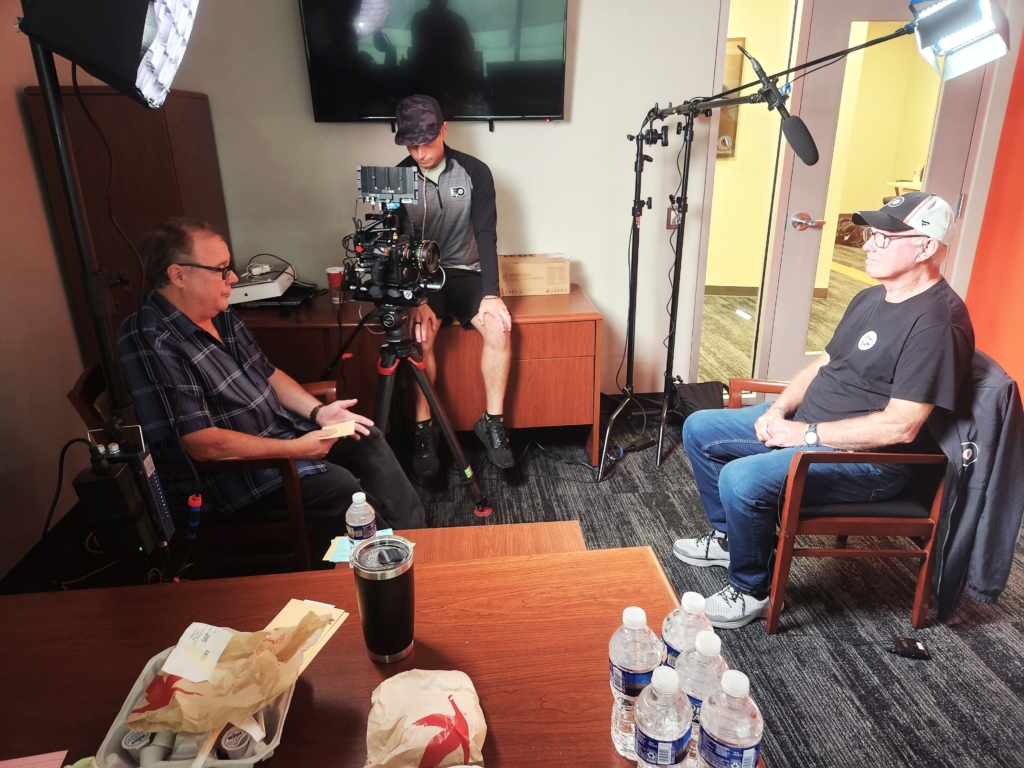
Filmmaker Joe Amodei (left) interviews Flyers legend Bobby Clarke (right) for his documentary, “Cold War in Philly: Flyers vs. Russia 1976,” about the Broad Street Bullies’ historic victory over the Soviet Union 50 years ago.

