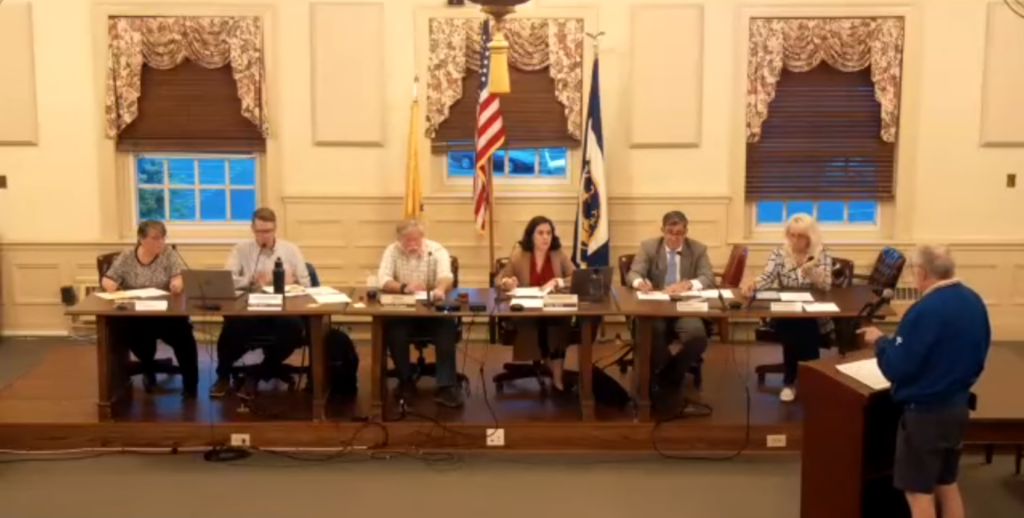
The Haddonfield Board of Commissioners discussed a recent ordinance at its April 28 meeting about Partnership for Haddonfield members after a resident complaint led to it being removed from the session’s consent agenda.
Items on the agenda aren’t usually discussed by the entire board, but removing the ordinance opened it for public comment and a back and forth between board members.
The partnership is a board made up of borough business owners who discuss ways to maximize investment in the borough.
Resident David Hunter sent emails to the board complaining about the ordinance, which would add two more members to the board of the District Management Corporation – to 13 from 11 – and change the makeup of members. The board is currently made up of three people who are licensed professionals, three retail business owners, three people who own property and are subject to a special assessment tax, a commissioner and a resident who doesn’t fall into the first three categories.
The proposed ordinance would change the requirements to include two people who are licensed professionals; two who own retail businesses; two who own property subject to the assessment tax; two who operate restaurants with Class A manufacturing licenses; two people who operate a professional service or type one, two or three business; a commissioner; and two residents.
The ordinance would require that when selecting the latter, “a good-faith effort will be made to appoint individuals who do not qualify under the other categories of appointments, but if such residents cannot be found, residents of Haddonfield who qualify under any other category as well may be appointed,” the ordinance states.
Hunter maintained that the ordinance does not clarify what a type one, two or three business is or what a Class A manufacturing license entails.
“I need not remind you of promises you all made during the 2025 election campaign to make Haddonfield’s municipal government more open and user friendly,” Hunter said. “This is an easy step along the way.”
He also took issue with the board being able to appoint someone who isn’t a resident if one can’t be found, but that a similar exception can’t be made for any of the other people on the board, and that the exception shouldn’t be given for the residents at all because of how many people who live in town meet the homeowner qualification.
“Surely if it’s appropriate to have that exit ramp for the resident class, it’s also appropriate to have it for the professional service use,” he argued. “That said, I think it’s absolutely inappropriate to have that language for the resident class anyway. Why?
“Because as I said, you’re looking for two representatives from a pool of 6,000 once every three years.”
Because of the meeting’s five-minute time limit on public comments, Hunter did further address his complaints.
Commissioner Itir Cole mentioned that in emails sent to the borough, Hunter also asked that the ordinance clarify that only one commissioner can serve on the board and that the two people who are licensed professionals be added.
Administrator Sharon McCullough said the reason the professional services were separated from the licensed ones is because people in professional services complained that the partnership only represented retailers.
“(T)hey were not the folks appointed to the board, and they did not have input on the board and felt some of the events and stuff could be (changed) to better incorporate and support the whole downtown, rather than just the retailers,” she said.
“So the idea that we’ve been talking about and bandying about for a number of years is the ability to expand the categories that we have to make sure truly all of the downtown is represented.”
Mayor Dave Siedell opined that more people need to be represented in the partnership.
“I’m not on the Partnership for Haddonfield, but I’m a downtown buyer of goods and services, and I do hear those complaints that they’re under-represented in some of the activities that we have,” he noted.
McCullough explained the intent behind allowing a resident from the other categories was to make sure that the two spots are filled. She also clarified that it’s never been the case where a second commissioner gets appointed to the board instead of a resident.
Siedell said if there were another commissioner on the partnership, it would “fundamentally change the (group), and I don’t think anybody wants to do that.”
He agreed that there should be more clarity, but thought the issue should be in something like an appendix rather than added to the ordinance.
McCullough said the explanation of the types of business covered could be added to the partnership’s website instead of the ordinance, because if the definition of any of those businesses is changed at the state level, it would alter the ordinance.
Cole asked if there could add a clarification to the ordinance saying the definitions are based on land use rules – something McCullough said could be done – and that the intent of the ordinance is to find residents, with the language acting as a fail safe.
“I understand they have needs we’re basing this off of,” Cole remarked. “And I really appreciate Mr. Hunter’s comments and diligence to read through this and find some of these gaps. So I do want to find some way to find an in-between ground. So if we can make minor modifications here to refer to the land use document, we know where to go for that.”
The ordinance will have a first reading at the commissioners’ meeting this month, with a second reading and possible passage in June.