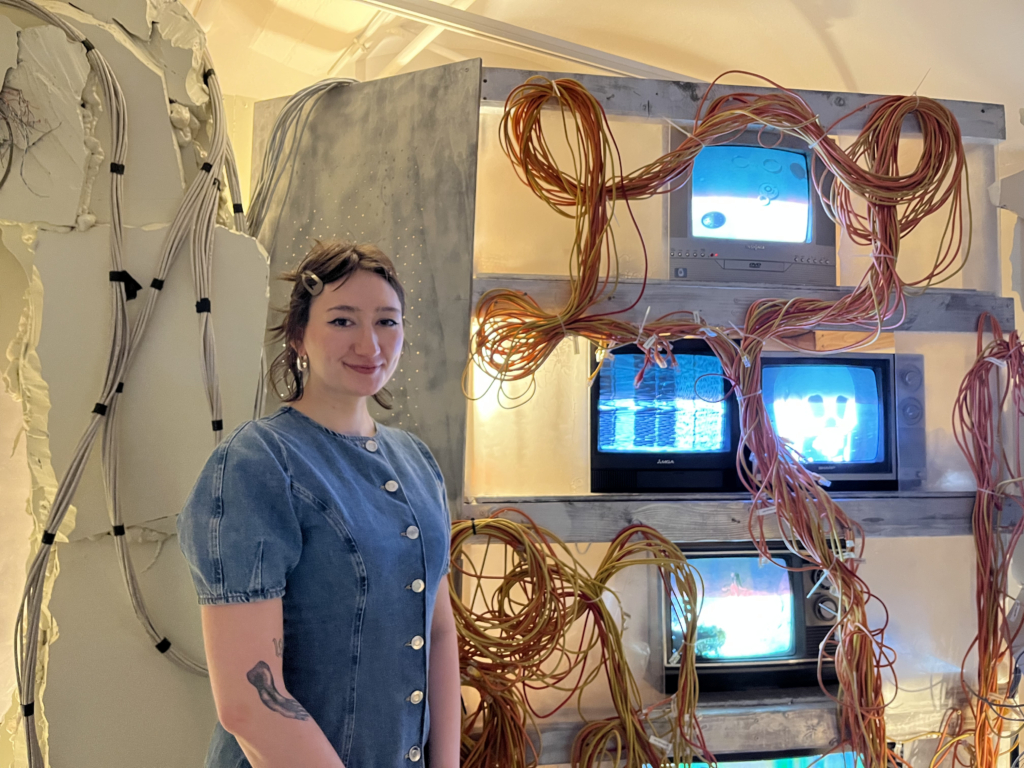
Moorestown native Katarina Poljak’s immersive installation “CRASH SITE” fuses performance, video, sculpture and retro-futuristic design to illustrate society’s accelerating dependence on technology.
Moorestown High School alumna Katarina Poljak’s immersive installation “CRASH SITE” is currently on display in Philadelphia.
The piece is housed at the Ministry of Awe, a former bank and now an art space in the city that is Poljak’s base.
The 30-year-old Poljak works across film, performance and installation to explore the entanglement of technology, consumer culture and environmental collapse through immersive, narrative-driven works that blur the boundaries between cinema and live experience. Drawing from science fiction, ritual and embodied performance, Poljak constructs layered environments that invite audiences into alternate systems and futures.
Collaboration is central to Poljak’s work, which engages queer, femme, transgender and BIPOC (Black, Indigenous and People of Color) artists in the creation of expansive, inter-disciplinary worlds. The artist graduated from Moorestown High in 2014 and currently lives in South Philadelphia.
Having been an artist for as long as they can remember, Poljak attended Philadelphia’s University of the Arts for dance and film.
“I am a filmmaker, sculptor and performer, and I think all of the things that I make usually involve each other,” they explained. “Art is your diary to the world, so each entry has been meaningful to me …
“I think that all I’m trying to do is continue to make entries.”
Rooted in both visual art and performance traditions, Poljak emphasizes scenography, movement and symbolic imagery to build experiential narratives. Through sculptural set design, costuming, and spatial storytelling, they create environments that function as both film sets and stand-alone installations, positioning audiences as active participants within imaginative, sensorial landscapes.
Poljak is currently co-directing “Untitled Pennhurst Film,” a documentary supported by the Ford Foundation, Perspective Fund, Catapult Film Fund and the Sundance Institute, while also directing a short experimental dance film supported by the Philadelphia Illuminate the Arts Grant, the Ministry of Awe and the Scribe Video Center.
Besides “CRASH SITE,” Poljak’s recent projects include “INCREDIBLE MACHINE GLASS BODY,” a film that investigates the body as both interface and artifact within mechanized and extractive systems. The immersive “CRASH SITE” combines performance, video and retro-futuristic design to examine the psychological and material debris of technological excess. It fuses performance, video, sculpture and retro-futuristic design to confront our society’s accelerating dependence on technology, Poljak explained.
At its core, the project is a speculative and deeply poetic exploration of life in a digital dystopia, a near future where human connection and identity itself have been eroded by systems that demand constant visibility, optimization and control.
“It was sort of surreal,” Poljak said of seeing “CRASH SITE” after completion. “I think often, as an artist, the moments you enjoy things feel very brief, and immediately, I felt a sense of, ‘On to the next,’ (but) I’m really excited to continue working in this space and maybe even evolve it as the installation stays open … and bring in a bunch of other wonderful collaborators in the city to make it happen.”
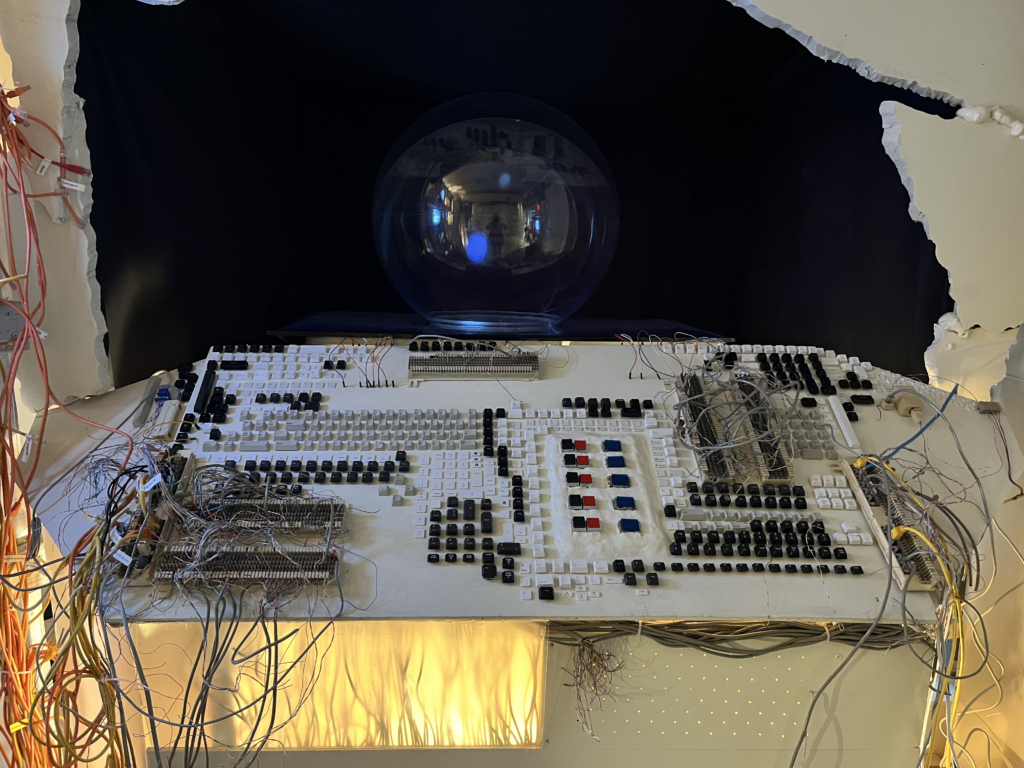
“CRASH SITE” includes interactive buttons and a virtual AR performer.
“CRASH SITE” is also going to be the set of Poljak’s experimental short film, which has the working title of “SOURCE ARCHITECTURE.” That project merges performance and video to critique society’s increasing dependence on technology. The film follows the virtual ghost of a cyborg navigating a post-human existence, haunted by fragmented memories of a time when humanity valued emotional connection and authenticity.
“I’m super excited to activate that process in June,” Poljak enthused. “After a long time working toward finding a space to build the set in – and I think the fact that it doubles as a live exhibit – speaks to a lot of my work, which involves performance, mixed media and film elements.
“I’ve always been enamored with movement and, coming from a place of performance, this is an evolution of my work into a dance film and an interactive, immersive live experience.”
Artist Meg Saligman launched the nonprofit Ministry of Awe in 2022, in a bank that had been vacant since 1985. More than 100 artists of all disciplines from Philadelphia have their work featured in the space, described as a bank with no money, where the only currency is the human spirit, the only dividend, awe. According to its website, the Ministry of Awe believes in collaboration over isolation and choosing inclusivity over division.
“I think that people enjoy digesting things in different ways and coming in here,” Poljak commented of the nonprofit. “It feels like a different sensory space and there’s something magical about it, maybe because I know there’s more to come.”

