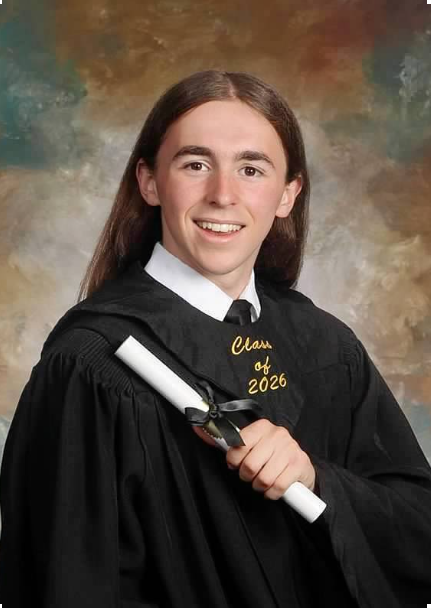
Christopher Sempier is a three-sport varsity athlete at Moorestown High who plays French horn and cello in the school orchestra and band.
Moorestown High senior Christopher Sempier has been named one of more than 5,000 candidates in the 2026 U.S. Presidential Scholars Program who were chosen from among nearly 3.6 million students graduating this year.
Sempier is a three-sport varsity athlete in cross country, swimming and distance track, and was a captain on the cross-country team. He is a principal French horn in the school band and principal cello in its orchestra. He performed in the All-South Jersey High School Honors Band and orchestra in each of the last two years, and was in the brass quintet this year.
A member of the school’s math club, Sempier has since September participated in the Moorestown Community Band, the First Presbyterian Church Chapel Choir and Scouting America. He’s working toward his Eagle rank, and recently had his project approved by township council.
“My student career has been a journey of self-discovery and decisions,” he said.
In elementary school, Sempier wasn’t motivated to work quickly because there was no incentive, he recalled. He would always be one of the last to finish his tests, but not for lack of knowledge. During COVID, Sempier could play outside or do a jigsaw puzzle as soon as he finished his work, and that gave him motivation.
During the 2021-’22 year, Sempier found a group of friends who encouraged him to care about school and aim for the stars, advice he carried into high school.
“Over these last few years, the challenge shifted from building momentum to finding direction,” he explained. “A finite number of hours in the school day limited my classes, and I had to decide which of my interests not to pursue as deeply. A 24-hour day limits my extracurriculars. I have had to choose between sports and music on numerous occasions, between completing the pre-requisites for a future class and taking a more enjoyable class, and between getting eight hours of sleep or three more hours of homework and study.
“This has all been building towards picking a college and a major,” Sempier added, “deciding where to apply and which are worth that precious time … Now, school is a game of waiting. The end of senior year holds much excitement, but for now, my school journey is full of anticipation and reflection.”
After graduation, Sempier plans to attend college close to home. He loved his Physics C: Mechanics class last year, so he believes he could be satisfied with that career. He’s applied to a few colleges for engineering and others as undecided.
“I have no vision of my future impact at this point, but I have a few hopes and ideas,” he acknowledged. “I love to visit neighbors to clear snow from their cars and sidewalks and talk to them. I find it fulfilling and rewarding. But I hope to have an impact beyond the individual, beyond my community as well …
“My goal in life is either to figure out something that improves a multitude of lives or to discover something that enables others to improve lives more easily and efficiently,” Sempier added. “I don’t know where that direction will be, but I hope with all my heart that I someday make that goal a reality.”
The U.S. Presidential Scholars Program was established in 1964 to recognize some of the nation’s most distinguished graduating seniors for accomplishments in academics, leadership and service to school and community. It was expanded in 1979 to recognize students demonstrating exceptional scholarship and talent in the visual, creative and performing arts. In 2015, the program was expanded again to recognize students who demonstrate ability and accomplishment in career and technical fields.
Up to 161 U.S. Presidential Scholars are chosen each year, and a distinguished panel of educators will select approximately 600 semifinalists in the spring. The Commission on Presidential Scholars – a group of citizens appointed by the president – will select the finalists, and the U.S. Department of Education will announce the scholars in the summer.
“If I am selected as a finalist, I will be shocked, thrilled, nervous …” Sempier revealed. “I would be beyond glad to have the chance to make hundreds of connections with so many wonderful people, but I would not be able to comprehend it immediately. Less than 3% of candidates are selected as finalists, and so it is a very long shot even with an ordinary pool of applicants.
“I can only imagine that it would be surreal.”
Some of Sempier’s role models are his mom, for her mental fortitude at the beginning of COVID; his dad, for his willingness to grow; his sister, for her unconditional love; his grandfather, for his determination; Jeff Smith and John Stroud of the Philadelphia Boys Choir and Chorale, for their high standards and balance of understanding and discipline; and his former physics teacher, George Engle, for making the most of his time.
Sempier’s community has helped shape him into who he is today by giving him a group of peers who challenge and stimulate him, encourage that he try different activities and teach him about his limits, he said.
“ … I have found success in challenging environments,” he observed, “but I have also found disappointment. People in Moorestown have supported me in both.”

