For six millennia humans have enslaved other humans, treating and mistreating them as chattel property that could easily be disposable.
The empires of the ancient world – including Mesopotamia, Egypt, Greece, China and Rome – all used enslaved people for forced labor. They could be sold and even killed by their masters. Sadly, the International Labour Organization estimates there are 50 million enslaved people worldwide in forced labor, debt bondage, forced marriage and sex trafficking.
In the U.S., the scourge of slavery existed for nearly 250 years until a bloody Civil War and the 13th amendment abolished it.
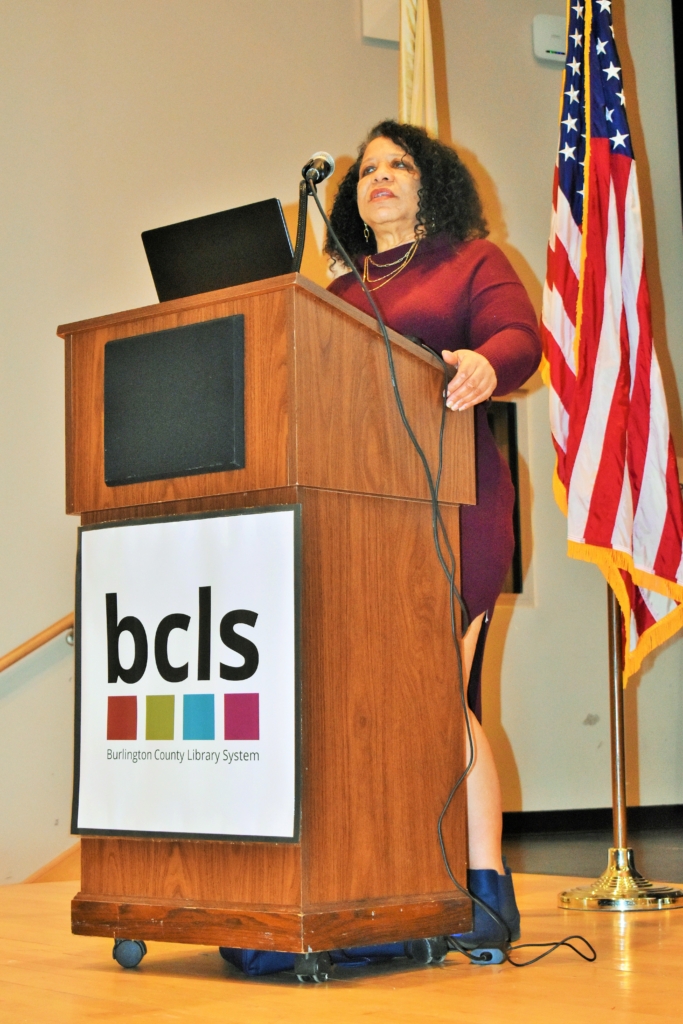
“The Dutch West India Company began transporting enslaved Africans for labor to the New World in 1624,” said Carolyn C. Williams, during her presentation on the history of slavery at the Burlington County Library on Feb. 21.
“In 1646, the first documented Africans appeared in New Jersey for Dutch farmers who purchased land from various Lenape indigenous tribes,” explained Williams, president of the African American Genealogy Group of Philadelphia. “The earliest presence of African slavery in South Jersey was in New Sweden from 1638 to 1655.”
British slavery and expansion – in what was then known as West Jersey – began after 1664, according to Williams, the first of five speakers at the presentation, sponsored by the South Jersey Black History Roundtable.
“British courts recognized enslaved people as property,” said Williams, adding that the highest concentration of them was in Burlington and Salem counties. British codes were harsh, restricting movement of slaves, prohibiting weapons and allowing severe physical punishment or even execution for disobedience.
Queen Anne created the Royal Colony of New Jersey in 1702, and the number of enslaved people continued to grow.
“By 1745, New Jersey had the largest enslaved population in the North,” Williams pointed out. “Burlington City, the capital of West Jersey, had the largest number of enslaved people.”
Throughout South Jersey, slaves worked on farms and orchards and in saw and grist mills, including properties along the Rancocas Creek. They also worked on ships involved with riverfront transportation on the Delaware Bay, as well as the Delaware River and its tributaries. Some even worked on whaling boats.
Slavery continued after the Revolutionary War in the U.S. despite the Declaration of Independence, “that “all men are created equal,” Williams noted. “What it meant was that all white men who owned property were equal, disenfranchising enslaved people, poor people and all women.”
New Jersey approved the Act for the Gradual Abolition of Slavery in 1804, the last state above the Mason Dixon Line to do so. The law did not make enslaved people free until a male reached the age of 21 and a female turned 25, Williams emphasized.
Following her presentation, Paul W. Schoop talked about black enclaves and marginality in Antebellum South Jersey, and Michael J. Gall discussed the herbalism, methodism and archaeology of the legendary Still family. Giving a presentation together were Shamele Jordon of the Lawnside Historical Society and her cousin, Floyd M. Riley, who addressed the Family DNA Project for Antebellum Connections.
“It’s very important to share information about people who are rarely talked about in the North,” advised Jordon, who also emphasized the importance of documentation for people seeking information about their ancestors.
She recommended going through county records from the past, including manumissions, wills, inventories, deeds and bills of sale, adding that the purpose of the roundtable event was to get a group of knowledgeable people together to help “document the history of Black South Jersey.”
There are also places people can visit to learn about African American life in the state, including the Dr. James Still Historic Office Site and Visitor’s Center in Medford, the Peter Mott House in Lawnside, the town of Timbuctoo in Burlington County, the Historic Underground Railroad Museum of Burlington County at Smithville and walking tours of historic African-American sites sponsored by the Preserving Black Haddonfield History Project.

